Midhun Mohan, lead author of a major review of drone seeding, has a pointed criticism of the industry. Aerial seeding companies, he told a UBC student newspaper in 2025, place too much emphasis on how many seeds are dropped and not enough on how many sprout into trees. The distinction is the heart of the question. Drones can cover rough ground quickly. Whether the seeds they drop become forests is a separate matter.
How drone seeding works
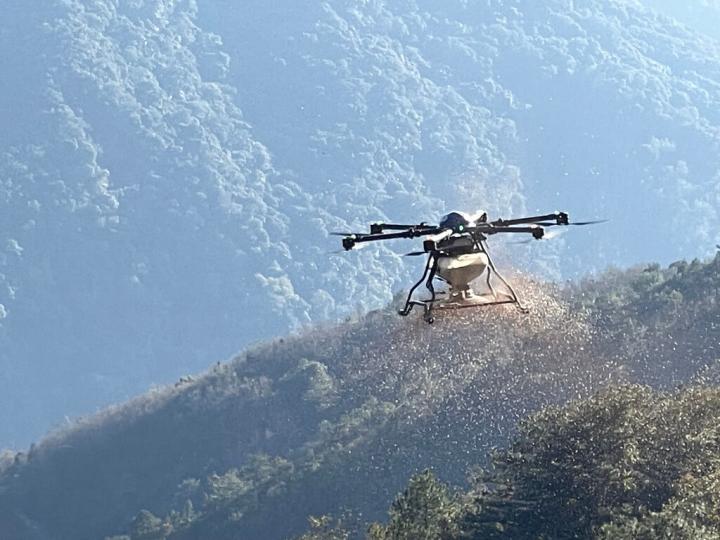
A seeding drone carries a hopper or a set of pods and releases them over a planned area. Often the seeds are packed into seed balls, which an Indian explainer describes as seeds covered with a mixture of clay, compost, char and other components. Once dropped they are left alone, which is why the method is nicknamed "fire and forget". Flash Forest says it pre-germinates the seeds inside its pods, though it has not disclosed how.
The technical chain
Three parts decide whether a seeding flight works: the payload, the release and the flight plan. The payload is limited by what the airframe can lift, so every extra gram of clay, compost or pod casing reduces the number of seeds carried per flight or the time in the air. The release can be a hopper that scatters seed balls along a path or a mechanism that drops individual pods, and this changes how precisely a seed lands. The flight plan is usually a set of waypoints flown with satellite positioning over mapped terrain, which sets spacing and coverage. Most designs fly at a steady height and speed, which is why spacing is easy to control and microsite choice is not: the drone places seeds where the route passes, not where soil and moisture are best. Some newer ideas try to improve this with AI-selected planting sites, but that remains experimental. This is not an AI-model or compute story, and no source reviewed here gives compute requirements or model parameters for it. The limits are mechanical and biological.
Why speed and access matter
The attraction is access and speed. The Mohan review, which surveyed the literature, found the main uses to be post-wildfire reforestation, mangrove restoration, restoring degraded forests, weed eradication and desert greening. Drones can reach steep or unsafe terrain, and the review says the method can supplement manual planting if done correctly.
What the evidence shows
The review also lists the obstacles: low seed survival, uncertainty about future forest diversity, weather limits, cost and the accuracy of seed placement. A news report on the review cites a 2020 study by the company DroneSeed that found survival for some conifer seeds ranged from zero to 20 per cent, similar to results from aerial seeding by plane and helicopter in the 1950s and 1960s. The review's authors urged companies to be more open about results.
A Penn State research blog repeats the range: zero to 20 per cent seed survival in recent pilot projects. It argues that drones often put seeds on unsuitable surfaces, and says the team is exploring a mucilage-based seed coating, a natural gel-like layer, to improve survival. That work is at a research stage.
A conventional benchmark exists. The UBC article cites a British Columbia Ministry of Forests study showing average survival two years after planting greater than 85 per cent for planted seedlings since 1987. It adds that no data on drone seed survival exist for the province. The same article says Flash Forest planted more than 300,000 seed pods at 13 Canadian sites, which is a company figure for pods delivered, not trees established.
An Australian native-plant society's review of drone seeding makes a similar point: there is little information yet on the survival rate of dropped seeds, and no independent evidence on the success rate of one company's technology.
India's attempt
Telangana's government partnered with the Hyderabad firm Marut Drones in August 2021 to launch Hara Bahara, which aimed to plant 50 lakh trees across about 12,000 hectares of forest land in all 33 districts. Local women's groups prepared the seed balls. The company's founder said the growth would be monitored for ten years using satellite imagery. The sources reviewed contain no published results on how many seeds survived, so the programme's outcome cannot be judged from public information.
What is in use, and what is not
What is in practice
Drones dispersing seed balls or pods over burned, degraded or hard-to-reach land, run by companies and some forest departments.
What is experimental
Better seed coatings, AI-selected planting sites and pods that place seedlings more precisely.
The constraint that matters most
Survival, not flight. A seed must land in a suitable microsite, get moisture, survive animals and compete with weeds. Seed supply is also limited, and cost per surviving tree is the figure that counts, which most programmes do not publish.
So drones are best viewed as a way to reach places people cannot, supplementing planted seedlings. They have not shown that they can replace them. Any claim of millions of trees planted should be read as seeds delivered until survival data says otherwise.