What Is Happening?
At a top school in Beijing, students use AI to build working apps in modern computer labs. But a few hundred miles away in rural Anhui, a school with 4,000 students depends on AI-made lessons for daily classes because there aren’t enough human teachers.
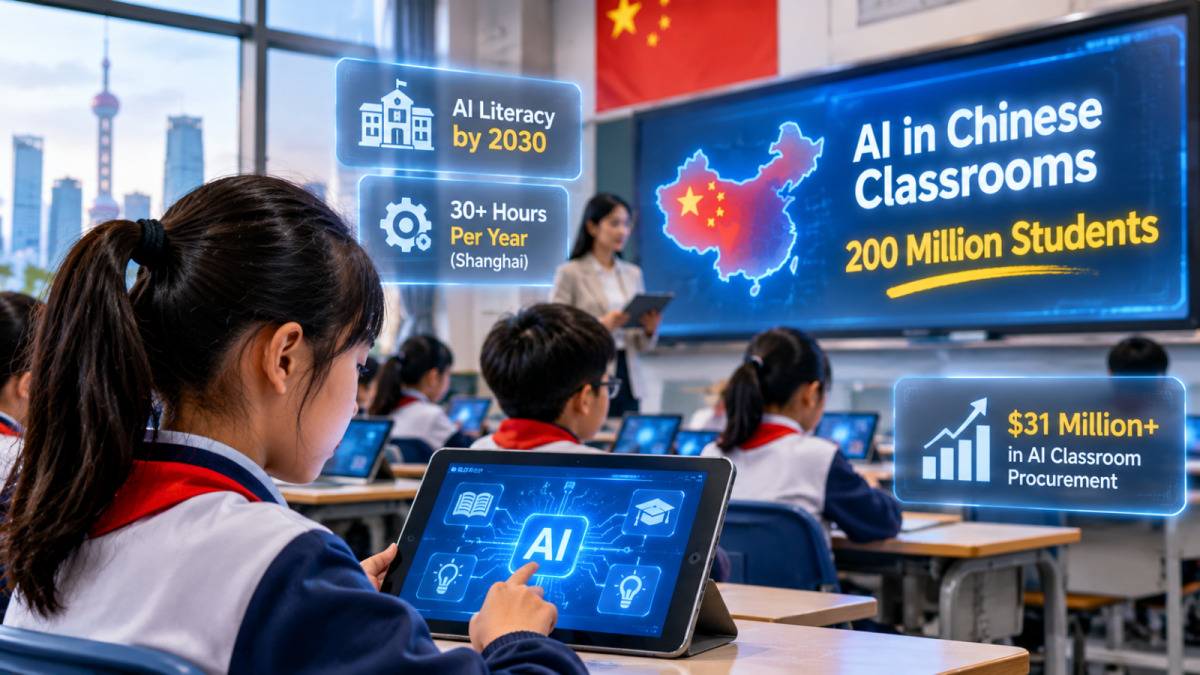
These two very different classrooms show a huge change across the country. A Reuters report from November 16, 2026, says China is running the world’s biggest AI learning experiment, with nearly 200 million students. Beijing wants every student to understand AI by 2030, and almost half of China’s provinces already have strict rules to make that happen. Shanghai requires at least 30 hours of AI lessons per grade each year, and other provinces plan to add AI questions to high school entrance exams by 2027.
Reuters found that schools spent at least $31 million on AI tools last year, and the real number is probably much higher. The big problem is that China still has no clear way to test whether students actually learn better this way.
How Does It Work?
Schools are rushing to buy AI tools, but studies on how well students learn are raising red flags. The research in the Reuters report shows a gap between easy homework and real exam results:
- A study of almost 27,000 teenagers found that heavy AI use raised homework scores by 18%, but monthly exam scores dropped 20% within six months.
- A bigger survey of over 320,000 students found that kids who used AI at least three times a week had weaker memory, focus, and creativity.
These studies don’t prove AI caused the drop, but they point to a real risk called cognitive outsourcing. That’s when students let software do all the hard thinking for them.
Schools also use AI in very different ways. A headmaster in Anhui said AI lessons raised his students’ college admission rate from under 60% to 90%, but Reuters couldn’t confirm that number. In other regions, schools use facial recognition cameras and track student behavior, which raises serious privacy worries.
Why Is It Important?
China’s top-down plan is very different from Western countries. Stanford University’s 2026 AI Index says the United States mostly uses local, optional advice instead of strict national rules.
For readers in India, this is a useful comparison. The Central Board of Secondary Education (CBSE) added AI and computational thinking classes for Classes 3 to 8 in the 2026-27 school year. Both countries want students ready for a tech-driven future, but buying software is the easy part. Proving it actually helps kids learn is much harder.
What Are the Challenges?
The biggest problem is that tech moves much faster than education research. Without a clear way to measure real understanding, schools might trade deep problem-solving skills for quick digital shortcuts.
What Happens Next?
As Beijing heads toward its 2030 goal, officials have to figure out how to test what students really know. For teachers and leaders everywhere, China’s experiment is both a preview and a warning about rushing AI into classrooms.