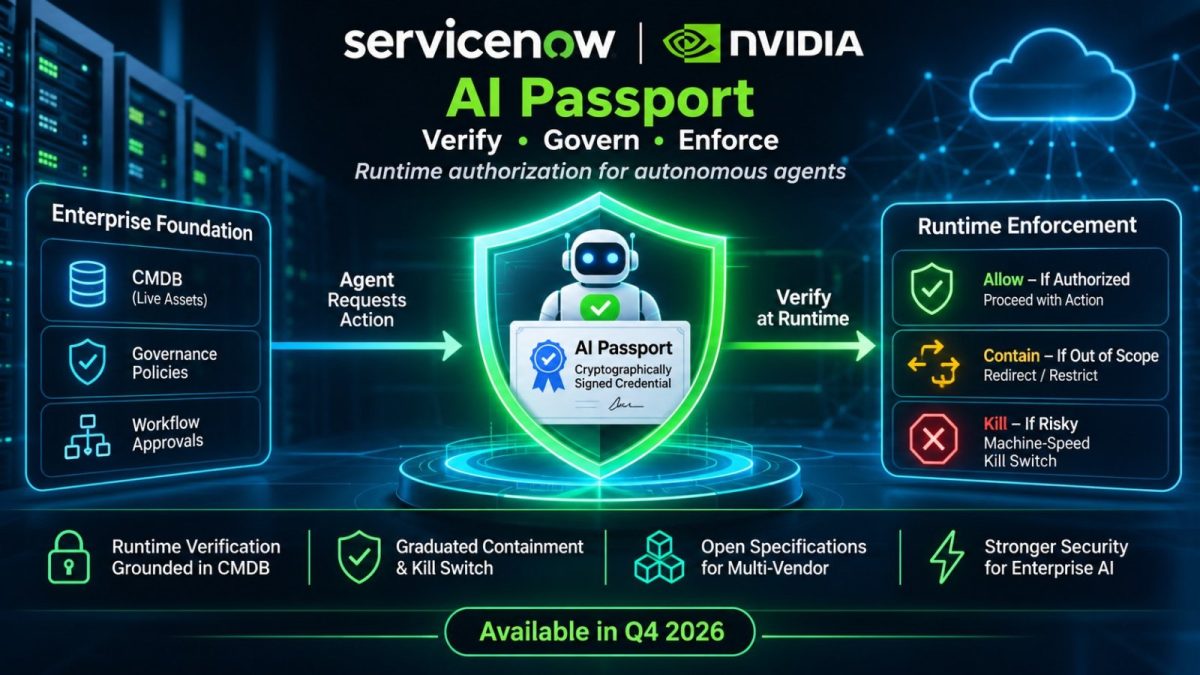
Companies are using more AI agents to run workflows across different platforms, but nobody’s really checking what those agents are allowed to do while they’re running. On October 15, 2026, ServiceNow announced AI Passport, working with NVIDIA as its design and launch partner. It also added more governance features to its enterprise AI harness. Instead of just trusting an agent when it says who it is, or checking for mistakes after they happen, AI Passport gives each agent a cryptographically signed credential. The agent checks that passport while it’s running to confirm what it’s allowed to do.
So what an agent does is now tied directly to its signed permissions. ServiceNow is moving from just keeping logs to actually enforcing the limits in real time.
How AI Passport works
According to ServiceNow’s October 15 press release, AI Passport is a credential that can be verified while an agent runs, and it’s connected to the company’s existing records. There are three main parts.
Checking at runtime using the CMDB. Each passport comes from ServiceNow’s Super Intelligence Control Tower and is based on the company’s Configuration Management Database (CMDB), its governance policies, and workflow approvals. When an agent tries to do something, whether it’s built by ServiceNow or someone else, the system receiving the request checks the cryptographic credential. It doesn’t just take the agent’s word for it anymore.
Step-by-step containment and a super fast kill switch. If an agent goes outside what it’s allowed to do, the harness responds in stages, like redirecting the workflow or limiting its permissions. If it needs to be stopped right away, a machine-speed kill switch shuts down the rogue agent. Other workloads next to it keep running without problems.
Open specifications for different vendors. ServiceNow built AI Passport on open specs, so outside identity providers, governance tools, and enforcement points can issue and check compatible credentials too. That includes NVIDIA’s Open Agent Safety Platform, so it works in setups with lots of vendors.
Trade-offs to think about
Honestly, I think checking credentials while agents run fixes a big problem with the first wave of company AI agents. Logs only tell security teams what went wrong after someone already accessed data or changed a setting they shouldn’t have. Basing credentials on the CMDB means permissions match how the infrastructure actually looks right now, instead of old static API keys.
But there are two downsides for architects.
The CMDB has to be accurate. AI Passport gets permissions straight from the CMDB and workflow approvals. So if asset records are out of date or service connections are set up wrong, agents could end up with way too much access or not enough.
Speed and credential timing. Checking signed credentials and drift rules during multi-step agent loops adds extra authorization checks along the way. Security teams have to carefully set when credentials expire and how revocation works. If they do it right, the kill switch works cleanly without slowing down busy workflows.
What happens next
AI Passport is expected to be available in the fourth quarter of 2026, and it makes ServiceNow’s Super Intelligence Control Tower into a control center for running many agents at once. For regulated companies using more third-party agents, having permissions that are checked in real time seems like a much better safeguard than only looking back at audit trails after something goes wrong.