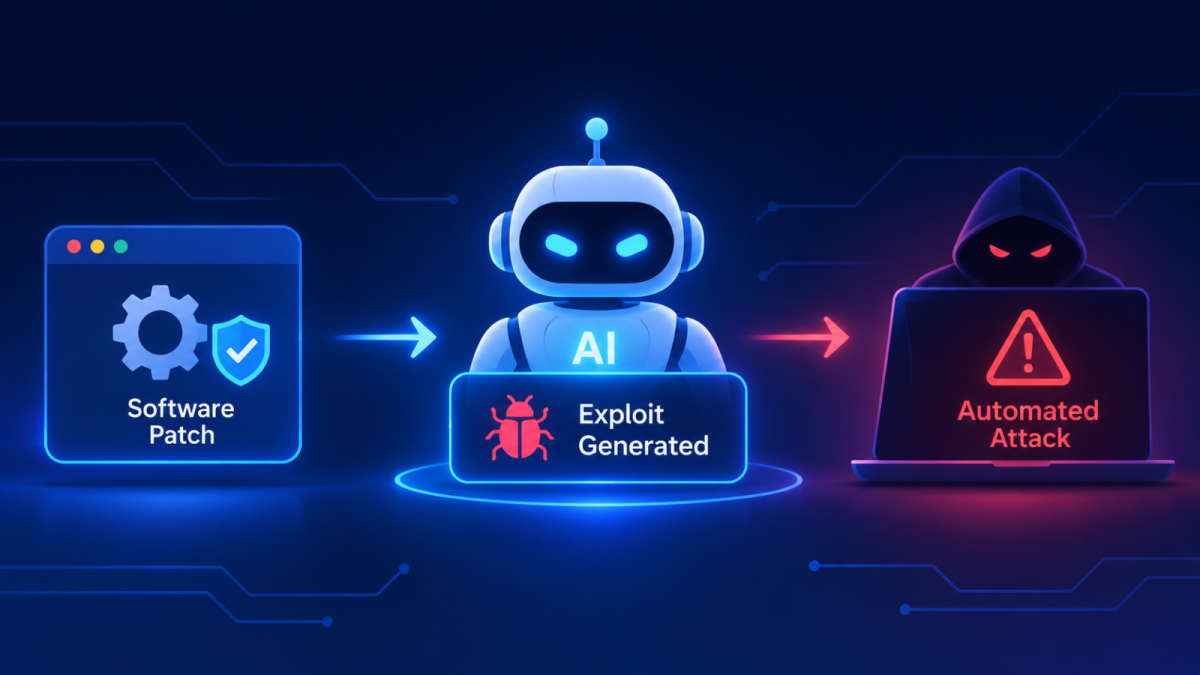
Google Finds an AI Tool That Turns Patches into Attacks by Itself
On 16 November 2026, Google’s Threat Intelligence Group (GTIG) published its quarterly AI Threat Tracker with Mandiant. The report describes a framework called exploit_agent. It turns software patches into working attacks, and no human has to be involved. GTIG says it is the first of its kind it has seen.
What happened
GTIG found exploit_agent on an exposed staging server, which is a test server left open to the internet. The framework was connected to several frontier and locally hosted AI models. The server also held stolen victim data, scouting information and attack scripts. The victim data suggests the attackers were targeting French media, entertainment and education websites. Google didn’t name who is behind it. The setup file had Russian-language comments, but that doesn’t prove who ran it. Two months earlier, the previous edition of the tracker said GTIG had not seen fully autonomous attack pipelines used against real targets.
How it works
A patch is a software fix. If you compare a program’s code from before and after a patch, the difference can show what flaw was fixed. GTIG says exploit_agent kept comparing popular web app code before and after patch announcements. It wrote an exploit for the flaw it found and ran it automatically. This is why attackers like flaws that already have patches. Many organizations are slow to install updates.
What the finding doesn’t prove
Be careful with the word “first.” It only means the first one Google has seen. It isn’t a count of every attack in the world. The framework was found on a staging server, not in an attack that was recorded from start to finish. VentureBeat notes that the report doesn’t show that this framework caused the break-ins on that server.
A bigger shift
The report is part of a bigger change. Attackers are moving from typing prompts to running tools made of many AI agents. The report also mentions open-source frameworks seen in real attacks, like CAIRN. It says attackers are using stolen credentials to get AI computing power.
What could happen next
The same idea could help defenders. Security teams might use automatic patch comparison to test their own systems before attackers do. That could matter for banks, hospitals and government networks. But this is only a possibility.
Google warns that automatic workflows give organizations less time to install patches before exploits show up. That might create demand for faster patching tools, automatic testing and detection services. One report says the noisy trail these tools leave could make them easier to spot, but that isn’t confirmed.
Challenges
Small teams may struggle to patch fast enough. It’s also unclear how GTIG defines “fully autonomous,” so check the report’s wording before you repeat the claim.