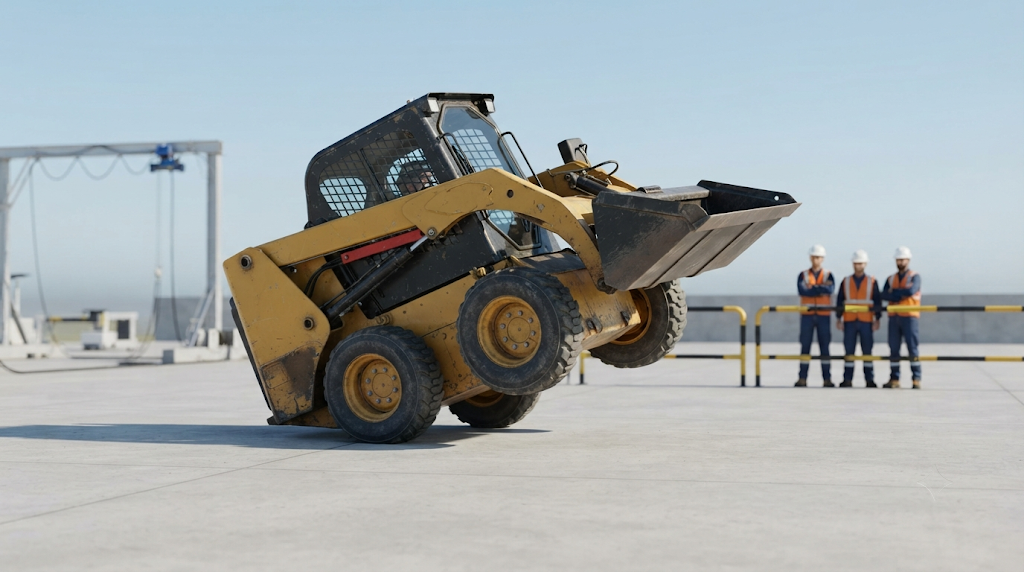
Imagine a huge construction machine balancing on just two wheels, like someone doing a wheelie on a bicycle. It may sound impossible, but researchers have trained AI to do exactly that.
A team of researchers taught a five-tonne John Deere 332G skid-steer loader to balance, drive, turn and land safely on two wheels.
The research was published in Science Robotics on November 11, 2026.
What Did the Researchers Do?
Researchers from ETH Zurich, Blue River Technology, Gravis Robotics and Intel worked on this project.
They used a John Deere 332G, a heavy construction machine with a large bucket in the front.
The machine started on four wheels. It moved back and forth to gain momentum before lifting itself onto its two front wheels.
Once balanced, it could drive over bumps as high as 75 centimetres, turn, move its arm and return safely to four wheels.
According to the researchers, only a few highly skilled human operators had performed similar movements before.
How Did the AI Learn This Skill?
The researchers used a method called reinforcement learning.
In this method, AI learns by trying different actions and receiving scores based on its performance.
However, testing every movement on a real five-tonne machine would be dangerous.
So the researchers first trained the AI in a computer simulation.
They studied how the machine's hydraulic system responds to commands and used that information to create a realistic virtual model.
The AI learned four main skills: lifting onto two wheels, balancing, driving while balanced and landing safely.
After training, the researchers tested the AI on the real machine.
Why Is This Research Important?
Heavy construction machines are difficult to control because they are powerful and respond slowly to some movements.
Even a small mistake can cause serious damage.
During testing, the researchers compared their AI system with a traditional control method.
The traditional system could balance but could not cross the first bump.
The AI successfully crossed it, even though it had only practised on flat ground.
Researchers believe this technology could eventually help machines climb onto trucks without ramps or move across sensitive ground with less tyre damage.
What Are the Limitations?
This was only a research demonstration, not a fully working construction robot.
The machine did not perform normal construction jobs like digging or loading trucks.
It also had extra safety equipment, including a rear support bar and small wheels near the bucket.
In one test, the bucket touched the ground in 3 out of 14 attempts when the arm was raised higher than during training.
More testing is needed to understand its safety, reliability and performance in real construction areas.
What Happens Next?
Researchers want to add cameras and LiDAR sensors so the machine can detect obstacles and understand the ground ahead.
They also hope to combine its different movements into one AI system.
This research does not mean construction machines can now work completely on their own.
However, it shows that AI trained in simulations can learn to control heavy machines in new ways.