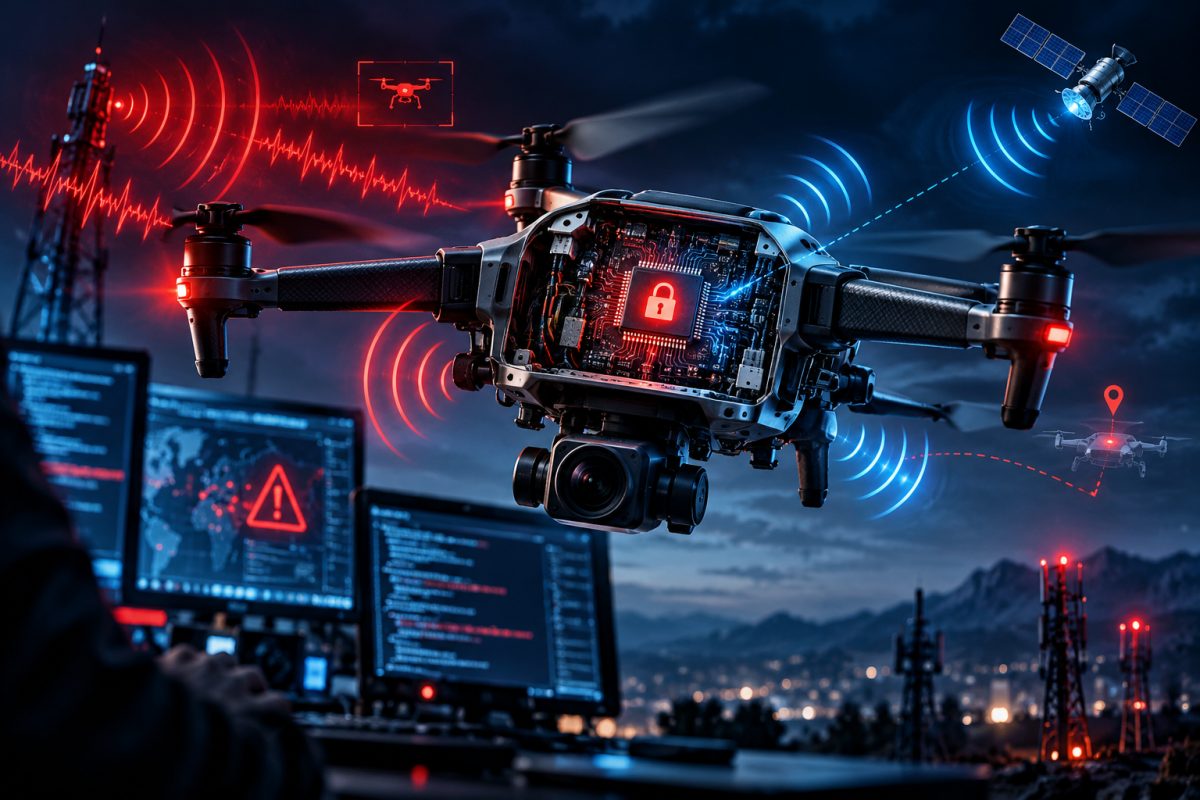
A widely cited 2023 study by German researchers found 16 vulnerabilities in DJI drones, ranging from denial of service to arbitrary code execution. Fourteen could be triggered remotely through the operator's smartphone and could crash the drone mid-flight. DJI fixed the flaws after the researchers disclosed them privately. It illustrates a basic point: a drone is a flying computer, and it can be attacked like one.
Four places a drone can be attacked
The same paper, presented at the NDSS security symposium by researchers from CISPA, Ruhr University Bochum and other institutes, describes the attack surface. The first place is the firmware, the drone's built-in software. The team reverse-engineered it and used fuzzing, which means sending huge numbers of malformed messages to see what makes the software fail, to find flaws. The second is the controller and phone app, the path through which 14 of the 16 bugs could be reached. The third is the radio link. The researchers decoded DJI's tracking broadcast, called DroneID, using cheap off-the-shelf hardware, and found it was not encrypted, so anyone nearby could read position information. The fourth is satellite navigation, which can be jammed or spoofed, as the earlier article in this series explains.
These flaws matter for more than crashes. Gaining elevated privileges on the drone, the paper notes, could let an attacker disable or bypass safety features such as geofencing, which keeps drones out of restricted zones.
The supply-chain argument
A different category of risk concerns who made the parts and software. On 22 December 2025 the US Federal Communications Commission added foreign-made drones and critical components to its Covered List, which stops new models from receiving the authorisation needed to be marketed or sold. The action followed a national security determination by a White House-organised interagency body. It also covers equipment from the Chinese makers DJI and Autel, as the 2025 defence authorisation law directed. It is not a ban on existing drones: models already in service can keep flying, according to industry guidance. In January 2026 the Department of War said drones on the Blue UAS list do not present unacceptable risks, and the FCC exempted certain categories until 1 January 2027.
DJI said it was disappointed and questioned the transparency of the review. China called the move discriminatory. DJI petitioned the Ninth Circuit on 20 February 2026, and its opening brief is due on 2 November 2026, according to an Iowa State University legal-centre summary. The dispute is therefore ongoing.
An important distinction applies. The sources reviewed describe risk assessments, policy findings and vulnerabilities that were found and patched. They do not describe a publicly demonstrated hidden backdoor. Policy based on supply-chain trust is about what could be done by whoever controls updates, cloud services and components, not only what has been done.
India's version
India took a different route. The Directorate General of Foreign Trade prohibited imports of completely built, semi-built and knocked-down drones from 9 February 2022, with exceptions for research, defence and security, while keeping component imports free. A May 2026 Outlook Business report says most Indian start-ups still rely on foreign components, especially Chinese, and cites import of motors, sensors, batteries and cameras worth $50 to 70 million between March 2022 and February 2023. In 2023 Reuters reported that India had barred makers of military drones from using Chinese parts in communications, cameras, radio transmission and operating software, over worries about security loopholes; one tender document asked vendors to disclose where components came from.
What is in place, and what is not
In practice: responsible disclosure and firmware patching, import and procurement rules, and approved-supplier lists such as Blue UAS.
Unproven or limited: assurance that any drone's software and cloud services are free of weaknesses. Independent audits of commercial drones are rare, and a patched flaw tells you about the past, not the next one.
The constraint that matters most: trust is hard to verify. Even domestic firms use foreign chips, radios and cameras, and almost nobody outside the manufacturer can inspect the full software stack. For buyers, a practical question is simple: who controls updates, where does data go, and can the drone fly offline?