Drone photographs are not always clear. Camera movement, poor lighting, distance and focus problems can make images look blurry. AI sharpening tools help improve the appearance of these photographs by making edges and objects look clearer. However, a sharper image does not always mean the details are correct. This is especially important when drone images are used for building inspections, damage reports and measurements.
1. How Does AI Sharpening Work?
Normal sharpening increases contrast around the edges of objects, while noise reduction removes unwanted grain from photographs. Deblurring tools try to reduce blur caused by camera movement or poor focus.
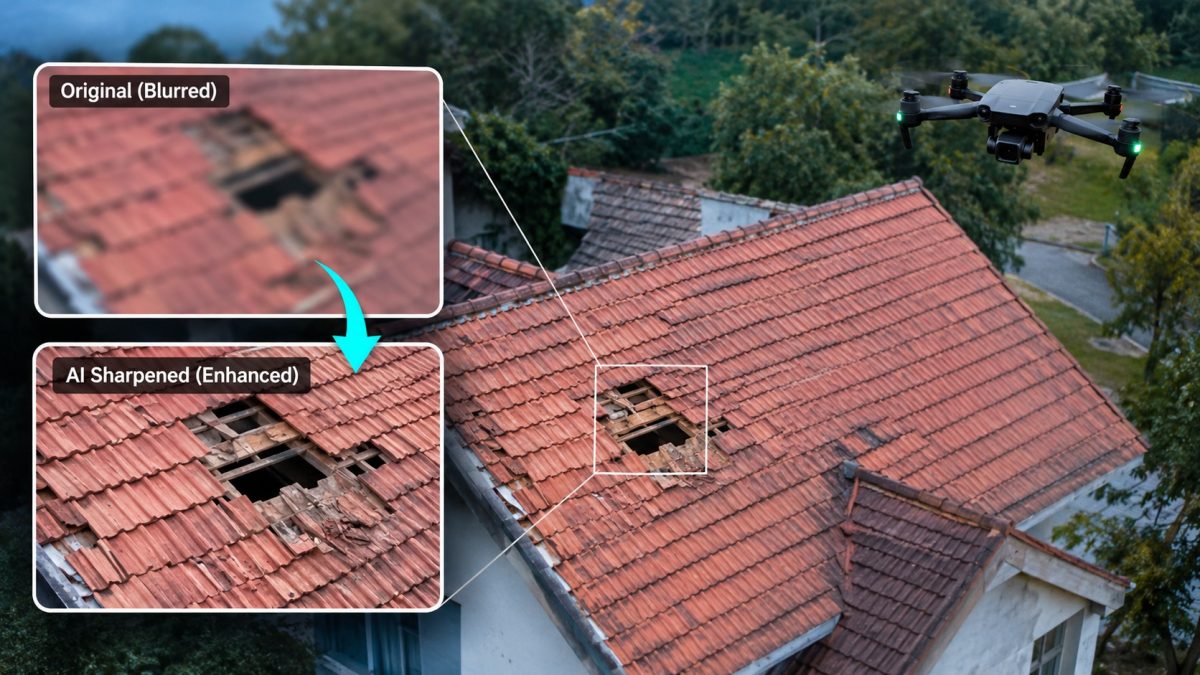
AI upscaling works differently. It uses a trained neural network to analyse an image and predict how additional details might look. During training, the model learns patterns from many images, including roof textures, windows, edges and fine lines.
When a drone photograph is processed, the software uses these learned patterns to create extra pixels and produce a higher-resolution image. The result may look clearer, but some of the added details are predictions rather than information captured by the camera.
2. What Happens Inside an AI Model?
Many AI image-enhancement systems use a generator network to create an enlarged image. Some models also use a discriminator network, which checks whether the generated image looks realistic.
Real-ESRGAN is one example of an image-enhancement model designed to handle problems such as blur, noise and image compression.
The final result also depends on the settings used during processing. Common settings include:
- 2x or 4x upscaling: Increases the image size.
- Denoising: Reduces unwanted grain and noise.
- Sharpening: Improves the appearance of edges.
- Processing quality: Affects the final image appearance and processing time.
Using very high settings can sometimes remove small details, hide thin cables or create false edges. Large drone photographs also require more computer memory. A graphics processor can make the work faster, while tiled processing can help handle large images.
3. Can AI Create or Remove Details?
One major limitation of AI sharpening is that it can produce details that were not clearly visible in the original photograph.
For example, a blurry roof tile may be changed into a sharp-looking pattern based on what the AI model has learned. Similarly, an unclear mark may appear as a definite line after enhancement.
Although these changes can make the image look realistic, they do not guarantee that the details are correct.
A 2024 study presented at the IEEE/CVF Conference on Computer Vision and Pattern Recognition Workshops also highlighted this issue in forensic facial image enhancement. It showed that AI processing could create facial details that were not reliably present in the original image.
This is a useful reminder that better-looking images are not always more accurate.
4. Why Is AI Sharpening Important for Drone Inspections?
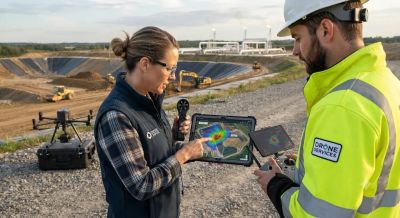
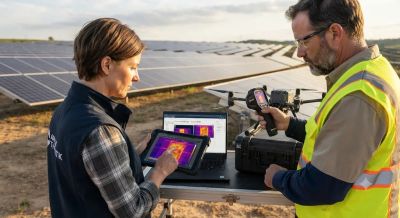
Drone photographs are often used to inspect rooftops, buildings, electrical equipment and construction sites.
Imagine an inspector checking a roof using an AI-enhanced drone image. A faint mark may become a sharp line and look like a crack. If it is reported as confirmed damage, the property owner may spend money on unnecessary repairs.
The opposite can also happen. Excessive noise reduction may remove a real hairline crack or thin cable from the photograph.
For this reason, inspectors should never depend only on enhanced images when making important decisions. If a possible defect is unclear, take another photograph from a different angle or arrange a closer inspection.
5. Does AI Sharpening Improve Measurement Accuracy?
AI sharpening can improve image appearance, but it does not automatically increase surveying accuracy.
Drone measurements depend on several factors, including image resolution, camera geometry, image overlap, ground control points and correct photogrammetry processing.
Enlarging a photograph does not add actual ground information. Newly generated pixels should not be treated as real measurements.
For land surveys, construction work and engineering inspections, use original images and validated surveying methods. AI-generated details should not be used for measurements unless the method has been independently tested for that purpose.
6. Best Practices for Drone Teams
Drone operators and inspection teams should follow a few basic steps when using AI enhancement:
- Keep the original drone photograph unchanged.
- Create a separate copy before editing.
- Avoid excessive sharpening and noise reduction.
- Compare the original and enhanced images.
- Mention AI processing in inspection reports.
- Record the software name, settings and processing date.
- Keep the full-resolution original for future reference.
- Mark unclear details as unconfirmed until they are checked.
The Scientific Working Group on Digital Evidence (SWGDE) also recommends preserving original images and documenting the changes made during image processing.
Conclusion
AI sharpening is useful for improving the appearance of drone photographs, especially when images contain blur or noise. However, it cannot guarantee that every enhanced detail is correct. Sometimes it may create false details or remove important information.
For normal photography, AI enhancement can be helpful. But for inspections, measurements and safety-related work, always compare the enhanced image with the original. The main aim should be to make photographs easier to examine without treating AI-generated details as confirmed evidence.