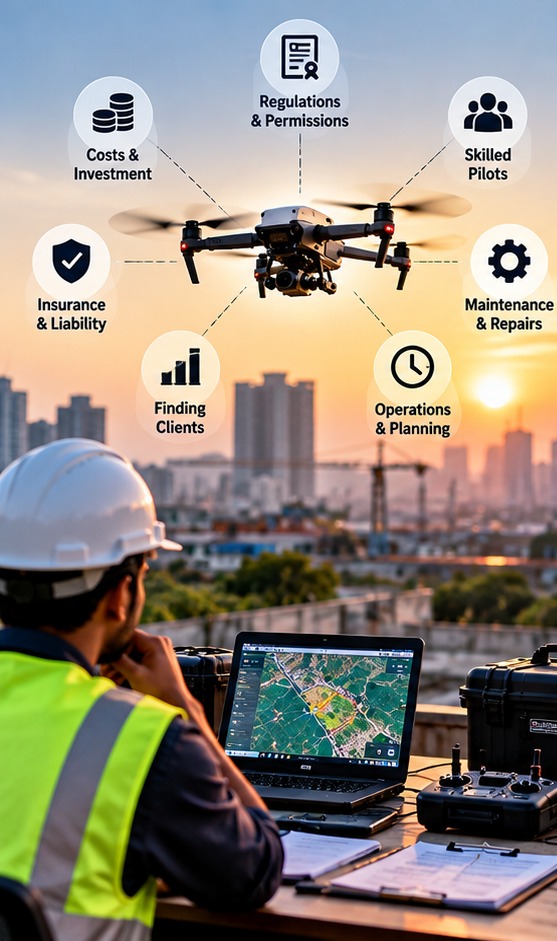
A person can learn the basic controls of a modern camera drone in a short time. Running a reliable drone service is a different problem. A client does not pay simply for a drone to fly; the client pays for a safe operation, usable data, predictable delivery and a result that can support a decision.
The flight is only one part of the job
India’s regulatory framework covers drone ownership and operation, while DGCA guidance tells remote pilots to check Digital Sky airspace information, hold the applicable Remote Pilot Certificate, maintain visual line of sight, keep a safe distance from people and property, conduct pre-flight checks and ensure maintenance is carried out according to the manufacturer’s manual.
For a business, those requirements become operating procedures rather than occasional checks. Someone has to confirm the aircraft is eligible for the job, review the airspace, prepare the mission, inspect batteries and propellers, check weather and define what happens if the aircraft loses a link or develops a fault.
Permissions and client requirements can change the job
A mapping mission near an airport, a power-line inspection, a construction survey and an agricultural spraying operation can have very different operational requirements. Airspace is divided into green, yellow and red zones, and the applicable approvals depend on the location and operation. The rules also distinguish drone categories and include requirements around certification and remote-pilot credentials.
Clients add another layer. A construction company may want a particular coordinate reference system and accuracy. An engineering firm may require raw images, processed outputs and a defect report. A farmer may want field-level recommendations rather than photographs. A service provider that does not define deliverables in advance can finish a technically successful flight and still deliver something the client cannot use.
Insurance and risk management are business costs
A commercial operator has to think about what happens if equipment is damaged, a third party is injured, property is affected or a mission has to be repeated. India’s drone rules include provisions dealing with third-party insurance, with specific treatment for nano drones. Even where a particular insurance product is not legally mandatory for a given operation, clients and risk managers may still require coverage as part of a contract.
Maintenance quietly decides whether the business works
Drones are machines operating with small margins for error. Batteries age, propellers are damaged, motors collect dust and sensors can drift or become miscalibrated. A professional operator needs inspection logs, battery records, spare parts, firmware-management procedures and a clear decision on when an aircraft is not fit to fly.
Downtime also has a commercial cost. If a client expects a survey on a particular day, a single damaged drone can become a missed deadline unless the company has backup equipment or a contingency plan.
The data pipeline can be harder than the flight
For many commercial jobs, the pilot is only the first specialist. Mapping may require photogrammetry and survey expertise; inspection may require an engineer; agricultural analytics may require agronomy knowledge. Data must be copied, backed up, processed and quality-checked before a final report is sent to the client.
Survey of India maintains an empanelment pathway for firms providing Drone-as-a-Service and other geospatial services, illustrating how the market is developing around services and deliverables rather than aircraft alone.
Owning a drone is not the same as delivering a service
The difference is operational discipline. A hobbyist can ask whether the drone flies. A service provider has to ask whether the mission is legal, safe, repeatable, accurately documented, properly processed and useful to the customer. That is why professional drone businesses tend to look less like gadget shops and more like small aviation, surveying, inspection or data companies.