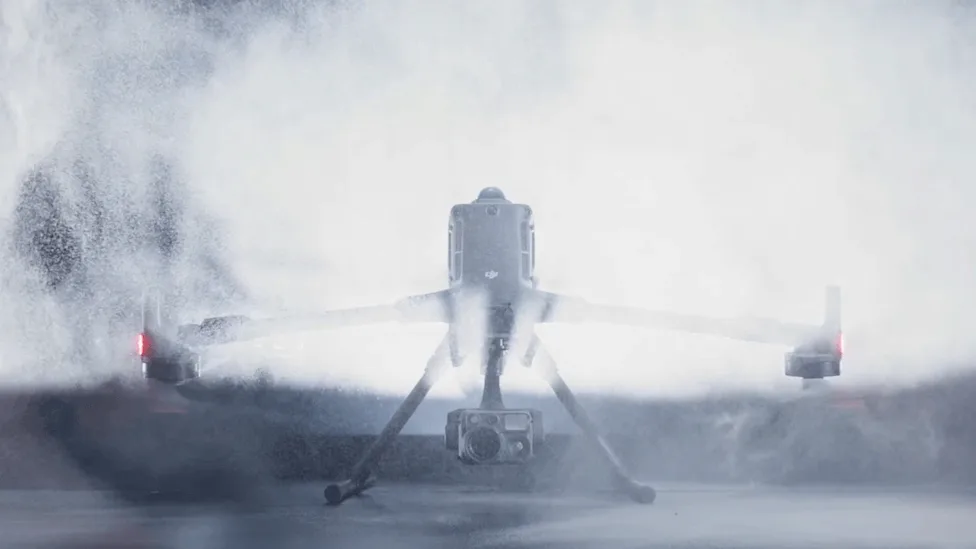
DJI lists its flagship enterprise drone, the Matrice 400, as IP55-rated and usable from –20°C to 50°C. The specification sheet carries a qualifier that rarely reaches the headlines: the 12 m/s wind limit applies to take-off and landing, and the 59-minute flight time assumes no wind at all. That gap between the brochure and the working day is the real story of all-weather drones.
What "IP55" does and does not cover
An IP (ingress protection) rating is a two-digit code from an international standard. The first digit describes protection against dust, the second against water. A 5 in the second position means the aircraft withstands jets of water from any direction, which is why makers describe it as suitable for rain. It does not mean the drone can be submerged, flown through salt spray all season, or left unchecked as seals age.
Rain-sealed drones of this kind are deployed products, not prototypes. DJI sells both the Matrice 400 and the smaller Matrice 4 series with the rating, and the larger model is aimed at power-line inspection, firefighting and offshore work.
Wind: the battery pays first
A multirotor holds position by constantly changing the speed of its motors. In a steady wind it must tilt into the airflow, and gusts demand sudden bursts of power. The Matrice 4TD, for example, is specified for a maximum tilt angle of 30 degrees. Twelve metres per second is about 43 km/h, which sounds generous until you remember that wind usually strengthens with height, and inspection drones often fly well above the level where ground crews feel the breeze. The practical effect is shorter flights: every extra bit of motor effort comes out of a battery sized for calm air.
Ice: where the engineering is unfinished
Rain is a sealing problem. Ice is an aerodynamic one. Supercooled droplets freeze on the leading edge of a spinning propeller, change its shape, add weight and cut thrust.
A 2025 study in the journal Drones tested a hovering quadcopter in a cold chamber and compared rime ice, which is white and forms from small droplets, with glaze ice, which is clear and dense. Motors on the affected propellers drew roughly 16 to 26 per cent more electrical power in glaze than in rime conditions.
Protection methods are still being compared. In a 2025 AIAA Journal paper, US researchers tested three approaches on a rotating propeller: a water-repellent coating, heating the whole blade, and a hybrid that combines the coating with heating along the leading edge only. The coating alone was marginally effective in glaze icing and ineffective, or even harmful, in mixed and rime ice. The hybrid kept the blade ice-free in every tested condition and used less power than full heating. That is laboratory evidence, not a product. In Austria, the IceDrone project, scheduled to run from January 2024 to June 2026, is developing a chemical ice-protection system and a propeller with a built-in ice detector for emergency-service drones, with certification requirements in mind.
Heat, dust and the limits of a spec sheet
Heat is a quieter hazard. The Matrice 400's 50°C ceiling is quoted without solar radiation, so direct sun on a hot launch pad adds load that the number does not count. Cold cuts lithium battery capacity, which is one reason low-temperature flights end sooner than the manual suggests.
What you can buy, and what you cannot
Deployed: IP55 enterprise drones that operate in rain and dust, with wind limits around 12 m/s for take-off and landing.
Tested: hybrid anti-icing for propellers, shown in icing tunnels and cold chambers.
Company claims: temperature ranges and endurance figures are manufacturer numbers, measured under stated conditions. No independent test of them was found for this article.
Planned: drones certified to fly routinely in icing conditions, which is the stated aim of the Austrian project.
For a buyer, the useful habit is to read the footnotes. Ask what wind speed the figure refers to, whether the flight time was measured with a payload, and whether the temperature range includes sun. A drone that is sealed against rain can still be grounded by a cold, damp morning.