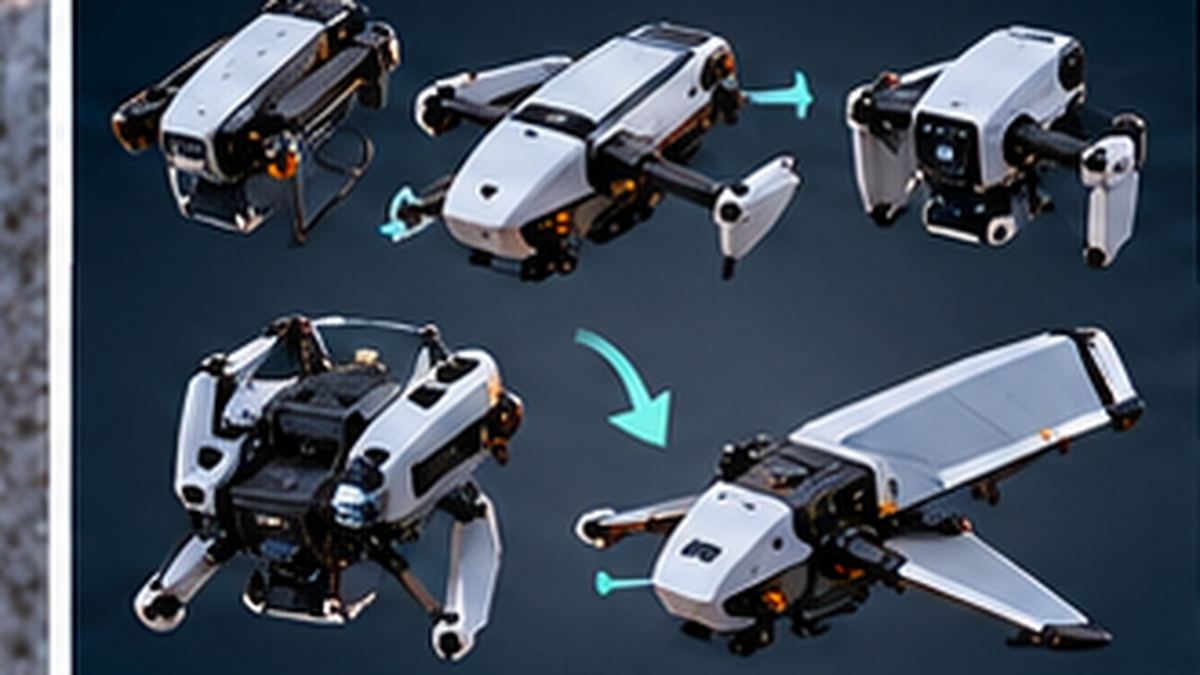
Morphing changes the control problem
Conventional drone design forces a compromise. Larger propellers and wider frames are generally useful for efficient flight, but a wide aircraft cannot pass through a narrow opening. A small drone fits through gaps but gives up some efficiency and payload capability. Morphing designs try to keep the advantages of both by changing shape only when the environment demands it.
MorphoCopter, reported in 2025, uses a single rotary joint to transform from a conventional X-shaped quadrotor into a narrow stacked-bicopter-like configuration. The researchers report reducing its width from 447 millimetres to 138 millimetres — nearly 70 percent — and completing the transformation within a few seconds. They also conducted flight experiments including trajectory tracking and narrow-gap traversal. [1]
Morphing for narrow gaps
Another 2025 direction is the FLIFO “flip + fold” drone developed at the University of Twente. The design was presented for small-gap traversal and uses passive morphing to reduce width by about half while maintaining controllability. The basic engineering argument is compelling: a drone can use large propellers during normal flight, then temporarily become smaller and less aerodynamically efficient only for the short period needed to pass through a gap [2]
Shape change affects almost every part of flight control. Folding the arms changes the centre of mass, moments of inertia, propeller spacing and airflow interactions. The controller therefore cannot assume that the aircraft is always the same rigid body. Morphing systems need models that understand the configuration, sensors that know when the transformation is complete, and transition control that prevents instability during the movement.
What recent prototypes demonstrate
There are also mechanical trade-offs. Hinges, actuators and flexible structures add weight and failure points. A morphing drone may be more complicated to maintain than a fixed-frame aircraft. A design that changes shape to fit through a gap also has to recover a stable flight configuration quickly after emerging. If the environment is dusty or wet, moving joints can become another reliability concern.
Commercial usefulness is emerging first in inspection, search-and-rescue and confined environments where access matters more than maximum endurance. The 2025 prototypes show that morphing can be achieved with surprisingly compact mechanisms. The long-term question is whether the extra hardware produces enough operational value to justify the complexity. If it does, the future drone may no longer have one fixed shape: its geometry could become another flight-control input.
The reliability problem
Morphing can also be useful without dramatic folding. Wing twist, rotor tilt or small changes in arm geometry can improve stability in wind, reduce transport volume or change the balance between speed and efficiency. The important engineering idea is that the airframe becomes an active mechanism rather than a fixed container for motors and electronics. That increases software complexity, because the controller has to know the current geometry, but it can make a single aircraft adaptable to several environments. For TrackFuture readers, the most significant trend is not one particular prototype; it is the merging of mechanical design and flight software into a single adaptive system.
A commercial morphing system will ultimately be judged by reliability. If the aircraft needs a shape change only once during a mission, the mechanism has to be extremely dependable because a failed transition can be more serious than a normal flight-control error. Engineers therefore favour passive transformations, fewer actuators and designs that fail into a stable configuration. The most successful morphing drones may be the ones whose shape-changing hardware is almost invisible to the operator.