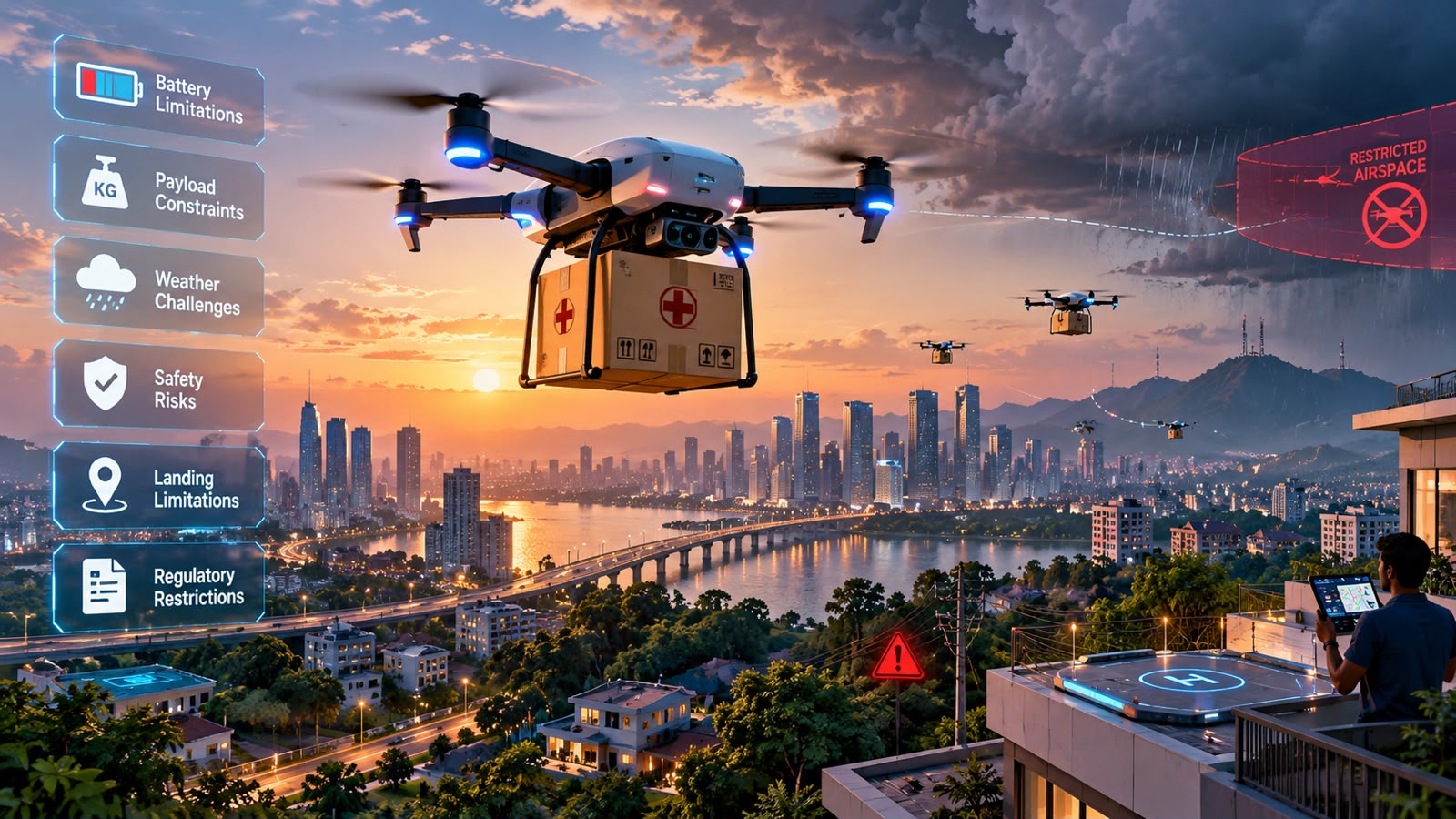
A drone can carry a package across a road in minutes, but that does not automatically make it a practical delivery business. The difficult part begins after the demonstration: the drone must fly safely in changing weather, carry a useful payload, navigate a repeatable route, reach an approved landing or handover point, return with enough energy and operate under the applicable aviation rules.
A demonstration can solve one route; a business needs thousands
Recent Indian trials show the potential. In April 2026, FedEx and IIT Madras reported intra-city drone delivery trials in Bengaluru in which an aerial route of roughly 39–42 km was completed in about 21 minutes, compared with a typical 53 km road journey that could take about an hour. The trial was a mid-mile logistics demonstration, not evidence that every parcel can be delivered this way. citeturn1search1
That distinction matters. A scheduled trial can use a controlled corridor, prepared launch and landing locations, trained staff and defined operating conditions. A consumer delivery network has to handle addresses, failed handovers, changing weather, airspace restrictions, batteries, maintenance and unexpected obstacles every day.
Battery energy limits the business model
A delivery drone has to spend energy carrying both the package and the aircraft itself. Larger payloads usually require more lift and therefore more power. The mission also needs an energy reserve for wind, route deviations, holding, landing and contingencies.
Indian BVLOS experimental-flight conditions have historically required energy reserves and weather limits, illustrating why endurance cannot be treated as a simple maximum-flight-time number. The Telangana BVLOS trial conditions, for example, required a 15% energy reserve and operation within manufacturer weather limitations. citeturn1search0turn1search3
Payload creates a trade-off
A delivery service needs the payload to be valuable enough to justify the aircraft and operating costs. Medicines, laboratory samples and urgent spare parts can make more sense than low-value everyday goods because the time saved may have greater value.
The 2026 ICMR i-DRONE study in Telangana is a useful example. Researchers evaluated drone transport of tuberculosis sputum samples from peripheral health facilities to diagnostic laboratories in Yadadri-Bhuvanagiri district. The use case is valuable precisely because the cargo is small, time-sensitive and linked to access in remote areas. citeturn1search13
Weather and the last few metres are harder than they look
Wind, rain, heat and poor visibility can change whether a route is safe. A drone may have enough energy to reach a destination but face difficulty during landing or return. The final delivery point can be even more complicated: a house may have trees, wires, people, animals or no safe open area.
That is why practical systems often need designated landing zones, trained recipients, controlled handover procedures or delivery boxes rather than simply dropping a parcel at a GPS coordinate.
Regulation limits where and how routine delivery can operate
DGCA guidance currently says pilots should check Digital Sky airspace information before every flight, fly type-certified and registered drones where applicable, maintain visual line of sight, respect safe distances and not conduct BVLOS flights without specific approval. These requirements matter because routine delivery is most attractive when a drone can fly beyond the pilot’s direct view, yet BVLOS operations require a different safety framework. citeturn2search10
India has conducted experimental BVLOS programmes, including selected consortia working on delivery-related concepts. Those programmes were designed to gather evidence and develop safe operating procedures; they should not be confused with unrestricted permission for nationwide autonomous delivery. citeturn1search8turn1search35
Public acceptance and economics still matter
Even if a drone can technically deliver a package, communities may object to noise, privacy concerns or repeated flights over homes. Operators also need to pay for pilots and supervisors, batteries, charging infrastructure, maintenance, software, insurance, airspace coordination and customer support.
Where drone delivery makes the most sense
The strongest early use cases are likely to be routes where the value of speed outweighs the cost of specialised aviation: medical samples, urgent medicines, critical spare parts, difficult terrain and predictable mid-mile logistics. The technology becomes less compelling when the payload is heavy, the destination has no safe landing area, the route is short enough for conventional delivery or weather and airspace conditions make operations unreliable.
The lesson from current trials is not that drone delivery has failed or that it is about to replace road logistics. It is that the aircraft is only one part of the system. Commercial scale depends on batteries, payload economics, safe corridors, landing infrastructure, regulation, weather tolerance and a repeatable operation that works on ordinary days—not only during a successful demonstration.