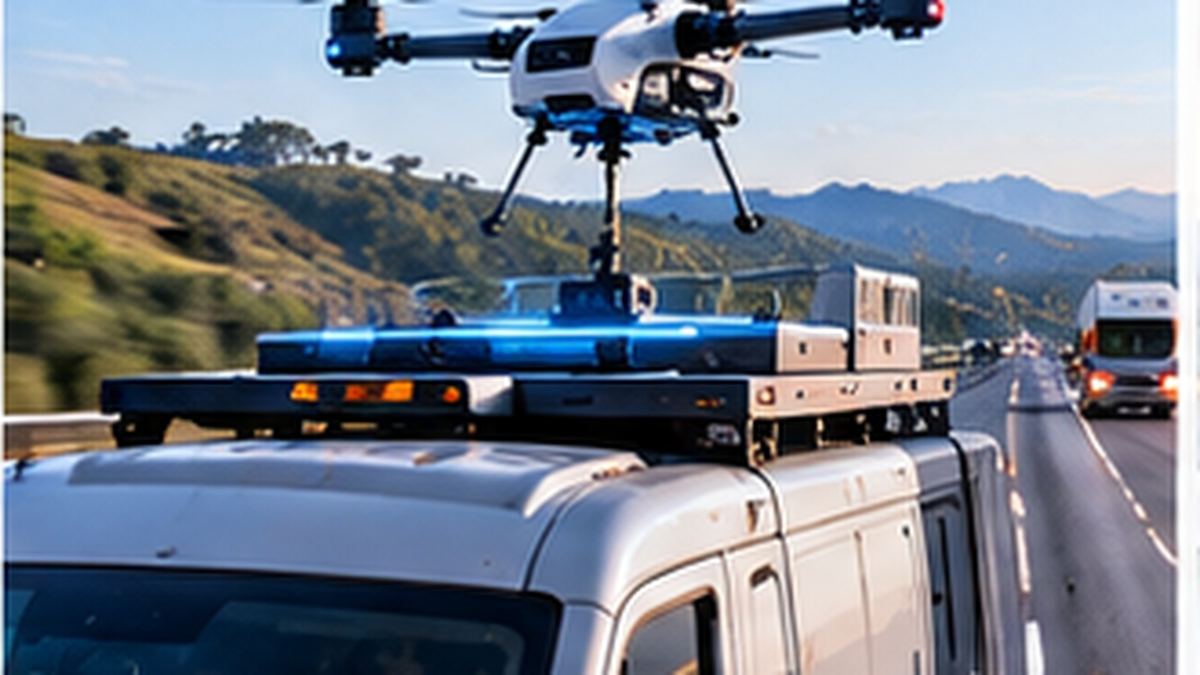
Landing on a moving target is a prediction problem
A drone landing on a stationary pad is mostly a precision-navigation problem. A drone landing on a moving vehicle is different: the target has its own velocity, acceleration, rotation and uncertainty. A ship adds wave-driven heave, pitch and roll. A road vehicle can accelerate, brake or turn. The drone must therefore estimate not only where the landing pad is, but where it will be when the aircraft reaches it.
Recent 2026 research combines visual, inertial and altitude information to estimate the relative pose between a UAV and a ship while also estimating deck motion. One open-access study in the Chinese Journal of Aeronautics describes a tightly coupled visual-inertial estimator based on an error-state Kalman filter. It uses sparse ship keypoints, the sea horizon, inertial measurements and an altimeter to initialize and update the relative state. That is important because open water often provides very few stable visual features.
The sensors behind the landing
Another 2026 study on UAV landing on dynamic unmanned surface vessels combines probabilistic perception, image-quality assessment and model-predictive control. The system can change its descent strategy when visual observations become unreliable. In other words, the drone should not blindly continue a landing just because its controller has a target coordinate; it needs to understand whether its measurements are good enough to make the final descent safely.
The control loop is typically layered. First, computer vision detects the landing surface or a fiducial marker. Second, sensor fusion estimates relative position, velocity and orientation. Third, a prediction model estimates target motion. Fourth, a flight controller generates a trajectory that compensates for that motion. Finally, the system needs a landing decision that can abort if the platform moves outside a safe envelope. On a ship, this can involve choosing a brief period of lower deck velocity rather than simply aiming at the geometric centre.
Ships, cars and mobile landing pads
The technology has already been demonstrated in real-world settings. A 2025 Journal of Field Robotics paper described an autonomous aerial transport system operating in a marine GNSS-denied environment, using ultra-wideband and visual markers to deal with moving decks and wind. Earlier work has also demonstrated autonomous landing on vessels in ocean conditions. These results show the problem is technically tractable, but they do not mean that arbitrary drones can land safely on arbitrary moving vehicles.
Commercially, the capability matters most where landing is necessary for battery exchange, cargo transfer or recovery. Offshore inspection drones, ship-based surveillance aircraft and logistics systems all benefit from reliable autonomous recovery. The remaining hurdles are harsh weather, poor visibility, uncooperative targets and certification. The key technology is not one magic sensor; it is the complete loop from seeing a moving platform to predicting it and controlling the aircraft through touchdown.
Why reliable recovery is still difficult
One practical engineering lesson is that the landing pad itself can become part of the solution. Fiducial markers, high-contrast patterns, infrared beacons or radio ranging equipment give the drone a reference that is easier to track than a natural surface. A moving vehicle can also transmit its own position and motion data to the drone, reducing the amount of prediction the aircraft has to infer visually. That cooperation is particularly attractive for logistics fleets, where the truck, ship or robot can be designed from the beginning to provide a known landing interface. The more cooperative the platform, the more repeatable the autonomous landing becomes.
For road vehicles, the same technology can support autonomous recovery from delivery vans or mobile robots. A vehicle can carry the landing pad, provide its own motion data and act as the drone’s charging station. The result is a mobile base rather than a drone that must always return to a fixed site. This is particularly useful when the aircraft is collecting information ahead of a moving inspection or logistics convoy.