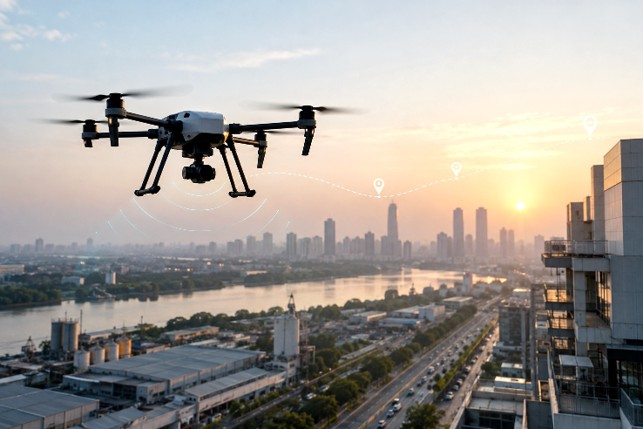
A drone can now be programmed to take off, follow a route, avoid obstacles and return to its starting point without a pilot continuously moving the controls.
But there is a big difference between following a carefully planned route and making safe decisions in a crowded, unpredictable environment. That difference will determine how far autonomous drones can actually go.
GPS gives the drone a starting point
Autonomous flight begins with navigation. Satellite positioning systems such as GPS provide information about the drone's location. A flight controller compares the aircraft's actual position with its planned route and adjusts its movement.
For a mapping mission, for example, an operator can define a series of waypoints. The drone then flies between those points, maintains its altitude and captures images at specified locations. This is already practical technology.
But satellite positioning alone does not tell the drone everything it needs to know.
Cameras and sensors give it eyes
More advanced autonomous systems combine satellite navigation with cameras, inertial sensors, altitude sensors and obstacle-detection systems.
Cameras can help a drone identify objects and understand its surroundings. Computer vision—the use of software to interpret images—can help determine whether an object is a building, tree, vehicle or other obstacle.
The drone can then change its path. The basic principle is called sense and avoid: detect what is around the aircraft, determine whether it presents a hazard and adjust the flight path.
Route planning is more than drawing a line
An autonomous drone also needs to decide how to get from one location to another. Its route may have to account for obstacles, battery level, altitude, restricted airspace, communications and the destination.
India is investing in research around exactly these problems. The SwaYaan programme brings together academic and industry partners around drone technologies, including navigation and autonomous systems.
The goal is not merely to make a drone fly without a pilot. It is to develop systems capable of making better decisions when conditions change.
Why cities are much harder than demonstrations
Consider a drone flying over an empty field. There may be very few obstacles and little traffic. The route can be planned in advance.
Now put that same aircraft over a busy city. Buildings can interfere with satellite signals. Cars and pedestrians move unpredictably. Birds can cross the flight path. Weather can change. Another aircraft may appear. The planned landing location may suddenly be occupied.
A system designed for a predictable environment may therefore struggle when confronted with something it did not anticipate. GPS-denied environments create another challenge because the drone needs another method of determining its position.
Humans are unlikely to disappear completely
The most realistic near-term model is therefore autonomy with human supervision. The drone can handle routine navigation while a human monitors the mission and intervenes when necessary.
That distinction is particularly important for commercial operations. A company may describe a system as autonomous because the aircraft can navigate a route automatically, but that does not necessarily mean it can independently handle every emergency.
Indian companies including TechEagle are developing autonomous BVLOS systems and logistics infrastructure, while research programmes continue to work on navigation and control.
The real test is reliability
The next stage of autonomy will not be proved by one successful demonstration. It will be proved when hundreds or thousands of flights can be performed safely under changing conditions, with predictable responses when something goes wrong.
That means better sensors, better navigation, better route planning and better emergency handling.
The question has therefore changed. It is no longer simply 'Can a drone fly by itself?' It is: 'Can a drone make the right decision when the world does something it was not expecting?' That is the problem researchers and companies now have to solve if autonomous drones are to move from controlled demonstrations into everyday operations.