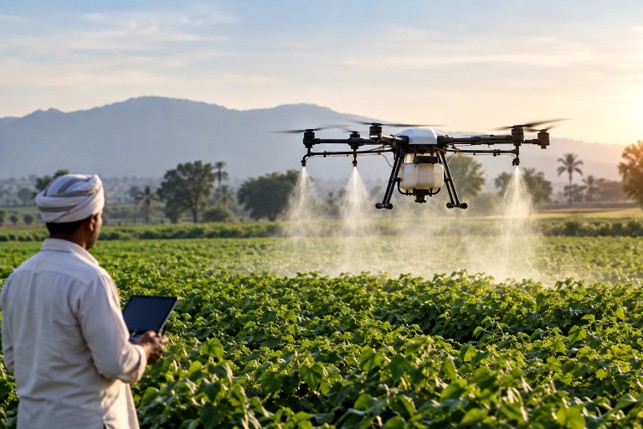
A drone flying over an Indian farm may look like a flying camera, but increasingly its job is much more practical: spraying crops, mapping land, measuring mines or inspecting infrastructure.
That shift is already visible across India. The government says drones are now being used for land surveys, precision agriculture, infrastructure inspection, disaster management, railway and highway monitoring and other public-service applications. As of February 2026, more than 38,500 drones had been registered and 39,890 remote pilots certified.
Agriculture is one of the clearest use cases
Agricultural spraying is among the most practical applications. The government's Namo Drone Didi programme is providing drones to women self-help groups so that they can offer agricultural services to farmers. The programme is intended to improve the efficiency of applying fertilisers and crop-protection chemicals while creating new income opportunities.
Companies such as Garuda Aerospace are also developing agricultural drone services. Its portfolio includes precision-spraying drones designed for crop protection and farm management.
The technology is relatively straightforward. A drone carries a tank and spraying system, flies over the crop and distributes the liquid according to the planned route. Sensors can help maintain height and detect obstacles.
But this does not mean that drones are replacing conventional farming equipment. Battery endurance, payload, weather, field size and operating cost all affect whether drone spraying makes economic sense.
Mapping may be an even bigger opportunity
One of India's most significant drone applications is surveying. Under the SVAMITVA scheme, drones are being used to survey rural inhabited areas and help create property records. By August 2026, the government said drone surveys had been completed in 3.30 lakh villages.
The process involves flying a planned route while collecting overlapping aerial images. Software then combines those images into maps and three-dimensional models.
Commercial drone companies are applying similar technology to construction, mining and infrastructure. Garuda Aerospace, for example, offers mapping platforms using RTK/PPK positioning, autonomous mission planning and obstacle sensing for applications including mining, construction and infrastructure inspection.
This is an important advantage: a drone can collect detailed information over a large area without putting survey personnel into every difficult or hazardous location.
Mining, inspection and disaster response
Mining operations can use aerial surveys to measure stockpiles, excavation areas and terrain. Infrastructure operators can use drones to inspect structures, monitor construction and collect visual information.
The same basic capability becomes particularly valuable during disasters. After a flood, landslide or other emergency, an aerial platform can quickly provide imagery of areas that may be difficult or dangerous for people to reach.
The government identifies disaster management, infrastructure monitoring and public safety among India's expanding drone applications.
Delivery is progressing—but remains more specialised
Drone delivery attracts more attention than many of these less glamorous applications. India has seen trials involving medical supplies, logistics and other time-sensitive cargo. But delivery remains a more difficult proposition because drones must deal with battery endurance, payload limitations, weather, airspace restrictions and safe package drop-off.
That makes controlled routes and specialised deliveries more practical today than unrestricted door-to-door delivery.
Where India stands
The Indian drone industry is therefore developing at different speeds. Already practical applications include agricultural spraying, mapping, surveying, selected inspections and several government programmes. Industrial monitoring, disaster response, security and specialised logistics are growing. Large-scale autonomous delivery, dense urban operations and highly autonomous fleets remain under development.
The important measure of progress is therefore not how spectacular a drone demonstration looks. It is whether the aircraft can perform a useful task safely, repeatedly and at a cost that makes sense.
That is where India's drone industry is gradually moving: from drones as flying cameras to drones as working tools.