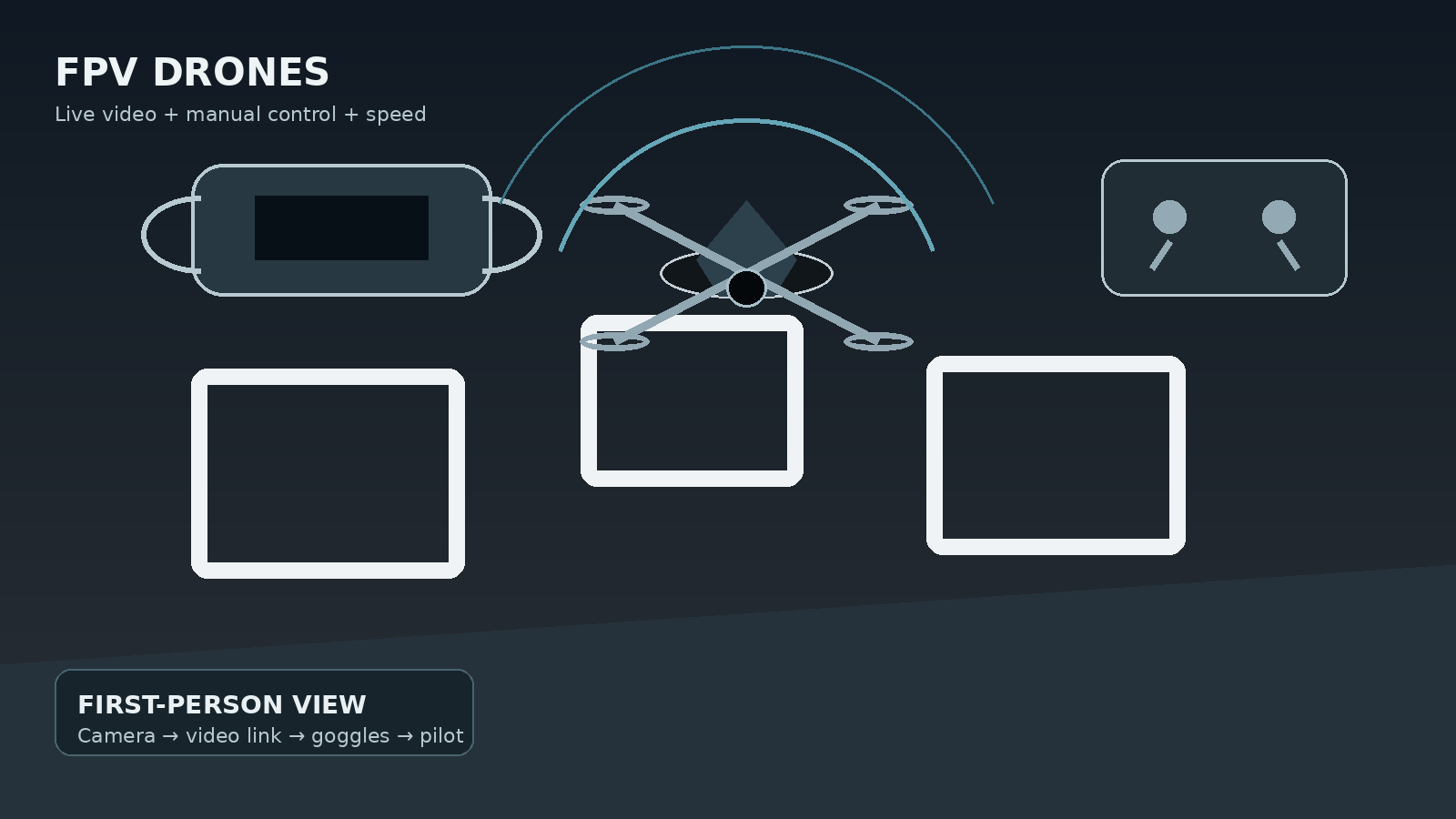
The camera becomes the pilot's eyes
Put on an FPV headset and the drone stops looking like a small aircraft flying somewhere in front of you. The camera becomes your view of the world. A turn can tilt the horizon, and a dive can make the ground rush towards you.
FPV means First Person View. It describes a system in which the pilot flies using a live video feed from a camera mounted on the aircraft. The technology is simple to describe, but demanding to operate.
How the FPV system works
An FPV system connects an onboard camera, a video transmitter, a receiver and the pilot's goggles. The camera captures what is in front of the drone and sends the video to the pilot in real time. The pilot uses a radio controller to fly the aircraft.
The Fédération Aéronautique Internationale (FAI) describes drone-racing pilots as using goggles to pilot from the onboard camera's real-time video feed. If there is too much delay between the drone moving and the pilot seeing that movement, precise control becomes difficult, particularly at speed.
Why racing drones are different
A conventional camera drone is often designed to make flying easier. GPS positioning, altitude control and automated flight modes can help it remain stable while the pilot concentrates on the camera or destination.
Racing FPV drones are built around a different priority: agility and direct pilot control. The pilot continuously manages the aircraft's movement rather than simply giving it a destination. Rapid changes in pitch, roll and yaw allow the drone to dive, bank around corners and pass through narrow gates.
FAI recognises F9U Drone Racing as a formal competition class with rules for organised racing.
Speed comes with a learning curve
FPV racing is not simply about pushing the throttle forward. A racecourse can contain gates and obstacles at different heights, forcing pilots to judge position and speed in three dimensions. FAI's beginner guidance describes racing as learning the best line through a course rather than simply flying as fast as possible.
Because the pilot wearing goggles cannot see the entire environment around the aircraft, organised racing can use a spotter or helper to watch the wider area. The result is a skill that combines hand-eye coordination, spatial awareness and fast decision-making.
Crashes are also part of the learning curve, which is why racing drones are commonly built around replaceable components.
FPV is moving beyond racing
The same agility that makes an FPV drone useful on a racing course has attracted filmmakers. FPV aircraft can produce fast, immersive shots that move through spaces and follow subjects dynamically. This does not mean every film-production drone is a racing drone; professional cinematography can use different aircraft and cameras depending on the shot.
India is developing its own FPV ecosystem. FPV India maintains pilot profiles, rankings and an events calendar for FPV racing. That community aspect matters because FPV is unusually dependent on operator skill.
Why the technology remains demanding
The biggest difference between FPV and highly automated drones is where the intelligence sits. With an automated camera drone, some of the work of maintaining position and stability is handled by the flight controller and sensors. With a racing FPV drone, more of that responsibility remains with the pilot.
That creates both the performance advantage and the difficulty. A pilot can make aggressive movements that are difficult to reproduce through a simple automated route, but the pilot must also react quickly when something goes wrong.
FPV's progress is therefore not just about faster motors or better cameras. Improvements in video links, flight-control electronics, batteries, simulators and pilot training all contribute to what the aircraft can realistically do. India's organised racing and technical communities show how this specialist category is becoming a more structured part of the wider drone ecosystem.