Beyond Parcels: The Cargo Drones Built to Carry Hundreds of Kilograms
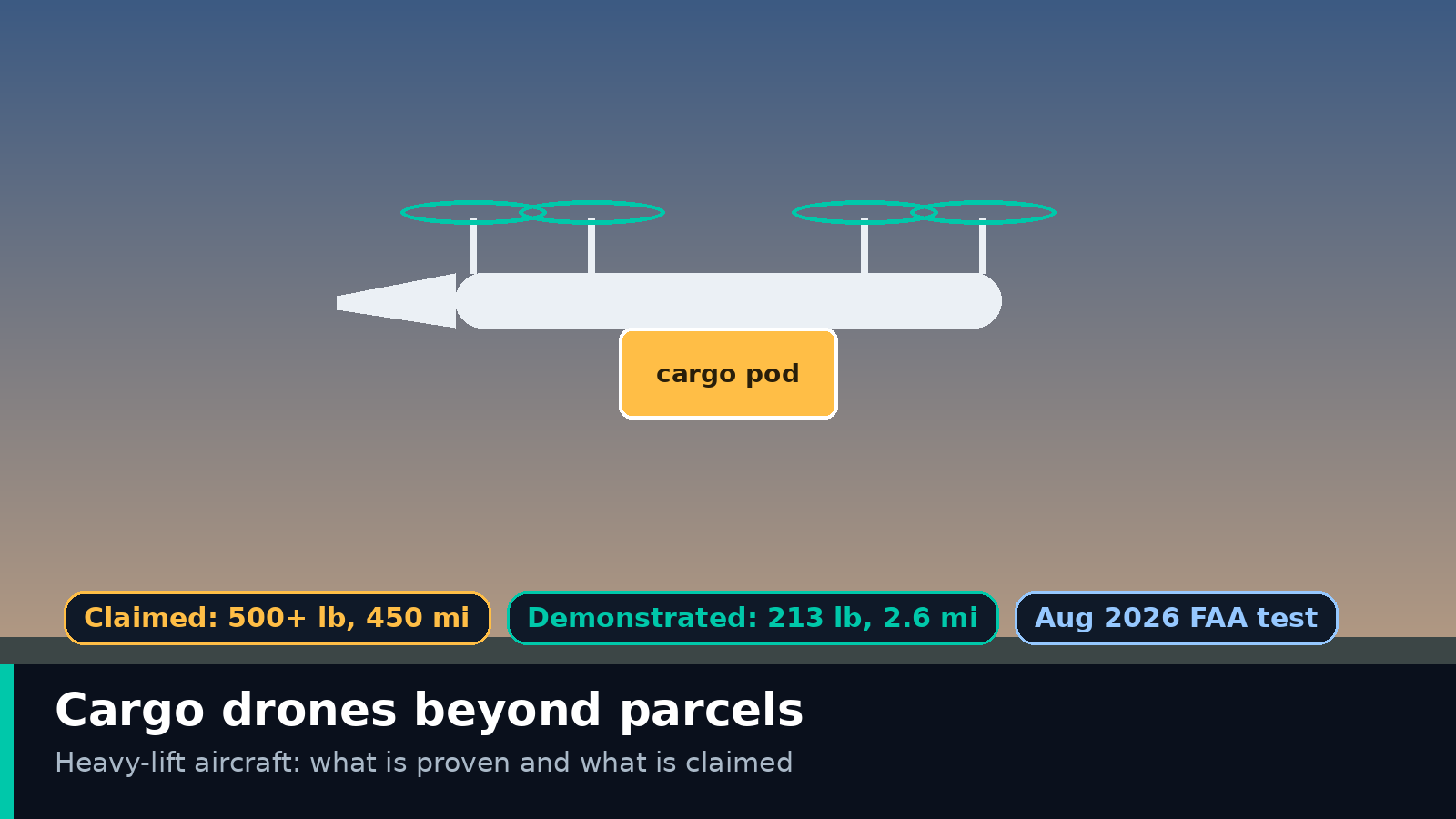
Elroy Air describes its Chaparral cargo drone as able to carry more than 500 pounds, about 227 kilograms, for up to 450 miles. In December 2025, the aircraft's first point-to-point flight carried 213 pounds over 2.6 miles. Both numbers are true. They describe different things: a design target and a demonstration. Heavy-lift cargo drones are full of that kind of gap, which is why the details matter.
What happened in Louisiana
In late August 2026, Elroy Air flew Chaparral at Houma-Terrebonne Airport in Louisiana as part of the FAA's eVTOL Integration Pilot Program, which was created under a June 2025 executive order. The FAA announced it as the first remotely piloted aircraft test flight under that programme. Elroy Air's 2 September press release then described a week of flights in which the aircraft flew autonomously with no pilot on board, under air traffic control oversight, in partnership with LIFTOFF Louisiana and the helicopter operator Bristow Group.
The wording difference is real. The FAA called it remotely piloted; the company calls it autonomous. A remotely piloted aircraft has a human flying it from the ground. An autonomous one follows a mission it plans and flies itself, with people supervising.
How the aircraft works
Chaparral takes off vertically, then cruises on a fixed wing, which is more efficient than hovering propellers over long distances. A hybrid-electric powertrain means, Elroy says, that no charging infrastructure is needed. Flying magazine reported that cargo travels in modular pods loaded separately from the aircraft.
Elroy Air targets what logistics firms call the middle mile: movement between distribution hubs, ports and remote facilities, not delivery to a doorstep. Bristow, the helicopter operator that joined the Louisiana flights, says Louisiana is its core US base and that it wants new ways to move freight offshore and across the region.
What is demonstrated and what is claimed
Demonstrated: a 213-pound point-to-point flight over 2.6 miles in December 2025, and a week of autonomous flights in Louisiana in August 2026.
Claimed: a payload of more than 500 pounds and a range of up to 450 miles. Earlier descriptions gave 300 pounds over 300 miles, so the specification has moved over time.
Demand claim: the company says its pipeline exceeds 1,400 aircraft. Its own release describes that pipeline as non-binding letters of intent and memorandums of understanding that may not become orders, and warns that the stated specifications may not be achieved without more development or certification.
Other companies are working in the same weight class. Pipistrel, a Textron company, announced the first hover flight of its remotely monitored Nuuva V300 in a press release dated 31 January 2025. That release states the aircraft is designed to carry a 600-pound payload, about 272 kilograms, over a range of up to 300 nautical miles. These are manufacturer design figures, not demonstrated performance.
Limits that lift alone cannot solve
AeroCorner reported that commercial cargo runs would still need separate FAA approvals, and that the Louisiana programme is a multi-year effort to gather data for future rules. There is still no complete framework for routine uncrewed aircraft sharing airspace with ordinary traffic. No published cost per tonne-kilometre turned up in the sources reviewed, so claims that these aircraft undercut helicopters or trucks cannot yet be checked.
Offshore and remote-region work is a plausible niche because the alternatives are expensive. But hundreds of kilograms is still modest compared with a crewed helicopter, so the economic case depends on routes where small, frequent loads matter more than volume.
Is it commercially useful yet?
Not yet at scale. The FAA flight shows regulators are testing the concept in real operations, and the company reports a pipeline of letters of intent, not firm orders. Elroy Air's press release says Kratos Defense & Security Solutions will manufacture the aircraft in California, with the first production unit planned for late 2026. That is a company plan, not a delivery. What does not yet exist is a certified, scheduled service with published costs. The honest status of heavy-lift cargo drones in 2026 is tested and being trialled, with commercial operation still planned.