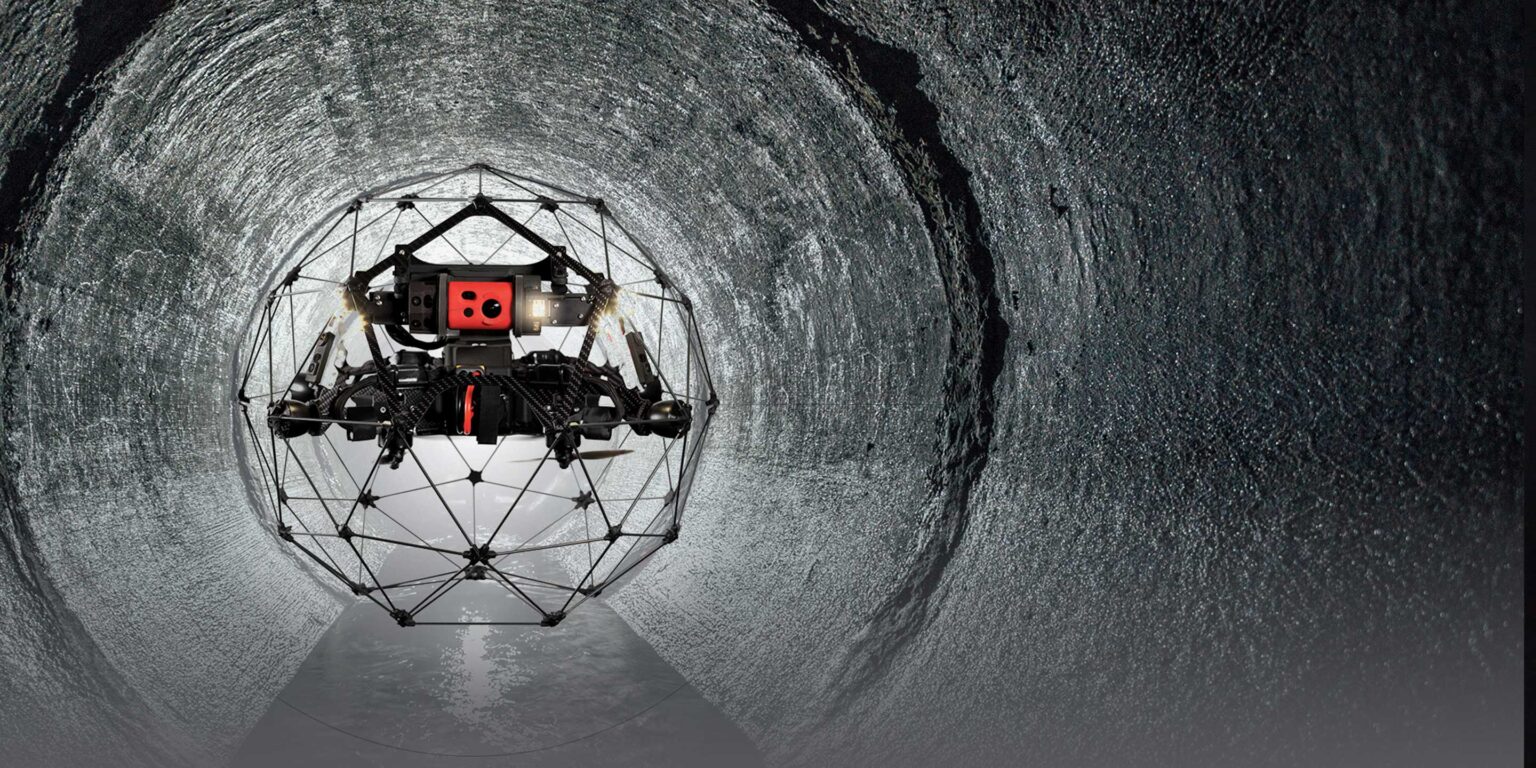
Most drone engineers spend their careers trying to stop their aircraft from touching anything. The Swiss company Flyability built a business on the opposite idea. Its Elios 3 flies inside a protective cage, can bump into walls without consequence and, according to a September 2026 profile published by Switzerland Global Enterprise, can enter a space through an opening as small as 50 by 50 centimetres.
Why ordinary drones fail inside a boiler
A boiler, tank or chimney defeats a standard drone in three ways. There is no GPS signal inside steel. Metal walls interfere with radio links. And the space is dark, dusty and full of obstacles, so a single contact with a propeller can end the flight.
How a caged drone finds its way
According to Flyability's technical specifications, the Elios 3 carries an Ouster OS0 LiDAR in an IP68-rated payload. LiDAR times laser pulses to measure distance and builds a 3D map of points around the aircraft. SLAM software, short for simultaneous localisation and mapping, joins the scans into one map while estimating where the drone sits inside it. Three optical cameras add a second estimate by tracking how nearby surfaces move past. Flyability's product literature, as reproduced by a distributor, says the processing runs on an NVIDIA graphics engine and gives centimetre accuracy, which is a company claim. The same specifications give the frame as 48 by 38 centimetres and 2,412 grams with the LiDAR fitted, with flight times of up to about 12 minutes without the LiDAR and about 9 with it.
In September 2025 Flyability announced a Tether Power Unit. A ground unit converts 100 to 240 volt mains power into high-voltage DC, which travels up a 50-metre reinforced cable rated to 50 kilograms of tension. A swivel is meant to stop a snagged cable from pulling the drone over, and a backup battery lets it land if ground power fails.
Smaller spaces, stranger machines
Sewer pipes need a different design. The Japanese company ACSL developed the Fi4 with the engineering firm NJS for pipes 400 millimetres wide or more. Its datasheet describes a carbon-fibre core inside a replaceable foam bumper that lets the drone float, IP55 dust and water protection, a weight of 2.4 kilograms with camera and battery, a top speed of 3 metres per second and a flight time of roughly four to five minutes. A launch pad means nobody has to climb into the manhole.
Research goes smaller still. A July 2025 paper in npj Robotics, from teams at Inria, CNRS, Université de Lorraine and Aix-Marseille Université, tackled air ducts. Rotor airflow recirculates inside a duct and pushes a drone towards the wall, so the team mapped the forces and found that the stable position is not the centre. A neural network using small time-of-flight sensors then kept a 180-millimetre quadrotor in position in ducts down to 350 millimetres, and it flew autonomously for over two metres.
A November 2025 paper in IEEE Transactions on Automation Science and Engineering, from the University of Strathclyde, describes a fly-crawl-fly drone for non-magnetic pipes. It flies to a pipe, holds itself on with propeller thrust, crawls around the full circumference carrying inspection sensors, then flies away. The aim is contact inspection of elevated pipework.
What has been shown, and what has not
The Elios 3 evidence comes mostly from operators and vendors. A case study published by a Flyability reseller describes a Texas refinery inspection of a 60-foot tank. An offshore-industry report from February 2025 said two Flyability drones inspected 63 offshore tanks in two weeks. A Flyability manager told Inspenet about a wet well in Seattle. None of these figures is an independent audit. The duct and fly-crawl-fly results are laboratory work.
Limits and commercial reality
Short battery flights, a fifty-metre cable and a cage that cannot pass a smaller opening all limit reach. Weak radio links inside metal vessels are a known problem, and Flyability added a Return to Signal function in a firmware update.
Commercially, the Elios 3 and Fi4 are products on sale. Air-duct flight and fly-crawl-fly inspection are research, and neither is ready for routine use.