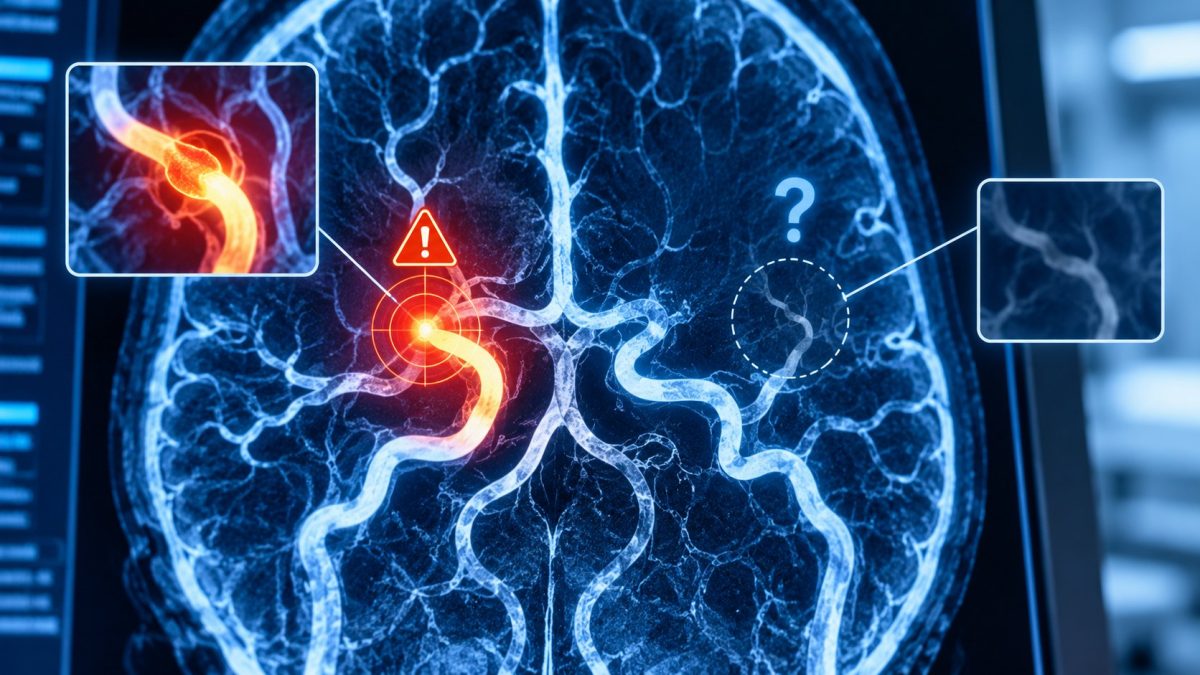
Stroke software can say “no blockage” and still be wrong. A new review in Radiology: Artificial Intelligence combined 31 reports on 15,708 patients. The software caught 91.6% of big blockages. For smaller ones deeper in the brain, it caught only 52.7%.
How the Software Works
When a stroke is suspected, the patient gets a CT angiogram. That is a CT scan with a dye that makes the brain’s arteries show up. The software checks the pictures for a large vessel occlusion, which is a blocked major artery. If it finds one, it alerts the stroke team so treatment can start sooner.
Most tools use deep learning, a kind of AI that learns from example scans. One research model turned vessel outlines into a compressed image and trained an image-recognition network called EfficientNetV2 on it. The designs of commercial products are not public in what we found. We also found no model sizes or computing needs.
One Number Hides the Gap
Sensitivity is how many real blockages the software catches. Specificity is how many people without a blockage it correctly clears. Overall, sensitivity was 80.1% and specificity was 91.9%.
That single number hides a big gap. For blockages in the carotid artery or the first part of the middle cerebral artery (ICA/M1), sensitivity was 91.6% and specificity was 92.7%. For smaller, more distant blockages (M2 and M3), sensitivity fell to 52.7%. Specificity stayed high at 94.8%.
Why the Smaller Ones Get Missed
The review’s abstract does not give a reason. One idea is how the tools are trained. One product, CINA LVO, was built to find blockages in the distal ICA, M1 and the start of M2, according to one evaluation. So missing the farther branches may be partly by design. That is a guess, not a finding of the review.
A hospital test shows the same pattern. In one year of 491 scans at a stroke center, the software missed 20 blockages. Fifteen were in M2.
Why “All Clear” Is Not Proof
High specificity means a “blockage” alert is usually right. It does not make an “all clear” safe. Using the review’s M2 and M3 numbers, a negative result only cuts the odds of a blockage in half.
Say a doctor thinks there is a 30% chance of a smaller blockage. After a negative AI result, it is still about 18%. If the doctor starts at 50%, it only falls to 33%.
What the Review Cannot Show
The authors combined published studies. Their abstract rates the evidence for the smaller blockages as very low certainty. The review also did not test whether the software helps patients.
A different review found that treatment started about 20 minutes sooner with AI, but it found no clear difference in how patients recovered.
What It Means for Hospitals
Treat the software like a smoke alarm, not a safety check. A radiologist should still look at the smaller vessels, whatever the AI says.