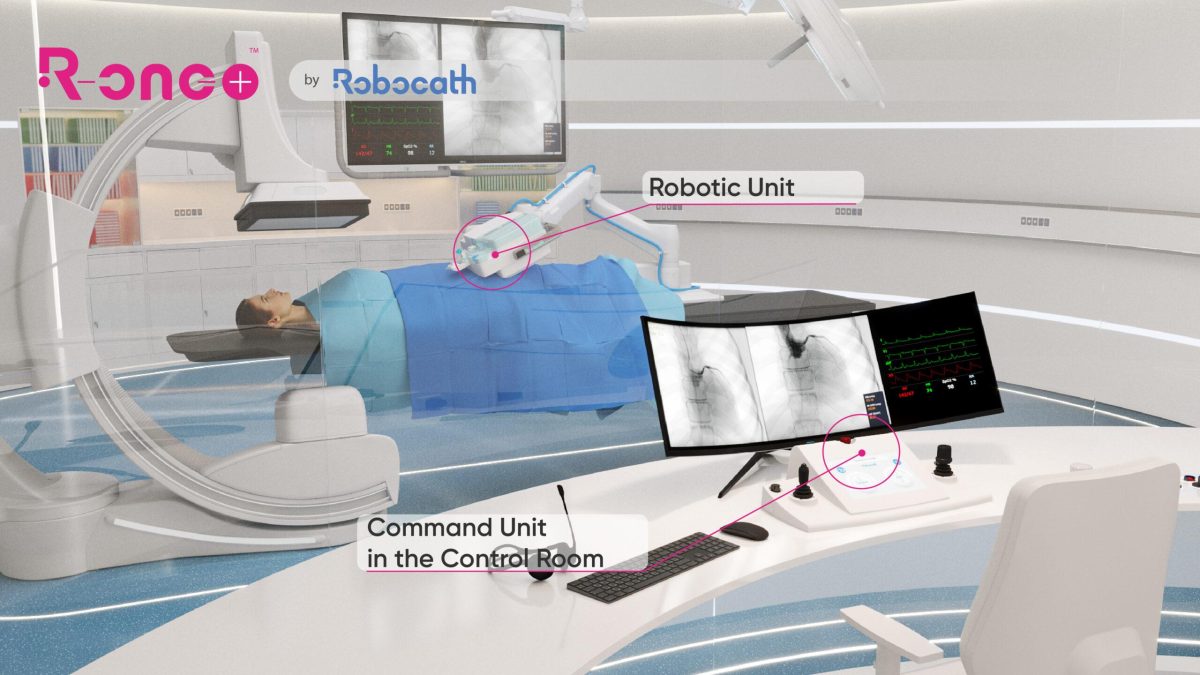
Twenty patients had heart procedures with a new Robocath robotic system, and the companies say none had a device-related problem. Robocath and its parent company, Stereotaxis, shared this on November 2, 2026. The results come from the makers themselves, and the robot is still being tested. Here is how this kind of robot works, and what is still unknown.
What Robotic Telemanipulation Means
The system uses robotic telemanipulation. The idea is simple. The doctor does not hold the tools by hand. Instead, they sit at a separate workstation and control a motorized robot. The robot turns the doctor's commands into small, exact movements.
How the Older R-One Works
To see how this works, look at Robocath's older system, the R-One. Robocath now sells an updated version, the R-One+, in Europe and China. The R-One has two main parts. The first is the control station, with screens, radiation protection for the doctor, and two joysticks. One joystick moves the guidewire, a very thin wire. The other moves the catheter, a thin, flexible tube that carries a balloon or a stent. A stent is a tiny mesh tube that keeps a narrow artery open.
The second part is the robotic unit, a motorized machine on a movable support arm. It moves the tools through a cassette, a small holder that is used once and then thrown away. The cassette gives the guidewire and the catheter separate paths. Motors push the guidewire forward, pull it back and spin it, which helps steer it through the twisting arteries of the heart. The catheter has its own mechanism for placing the balloon or stent.
So this is not just a robot arm copying a human hand. The system turns joystick movements into controlled steps. Robocath's published documents for the R-One also mention speed settings and a clamp that holds the guidewire in place. Robocath also says its robots work with tools from other makers.
The Newest System Handles Several Tools
Robocath's newest system builds on this design. The companies say it is built to handle up to five tools at once. That matters because complex heart procedures can need more than one instrument. The 20-patient study was a first-in-human study, which checks whether a new device is safe and workable. Stereotaxis bought Robocath in 2026 and plans to add some of its own hardware and software over time.
What We Still Don't Know
The study was small, with 20 patients, and the results come from the companies. The new system is not yet cleared by the U.S. FDA. Stereotaxis expects to file for approval in the U.S. and Europe within about two years.
Robocath has not shared how the new system works inside. We don't know about its motors, control software, sensors or how fine its movements are. We should not guess those details from the R-One. The next step is outside checking, through larger studies and regulators' decisions.