AI Measured Heart Function on 27,000 Scans, and Its Numbers Predicted Survival Slightly Better Than Doctors’
A large Lancet Digital Health study tested an AI tool by asking which measurement better predicted who died.
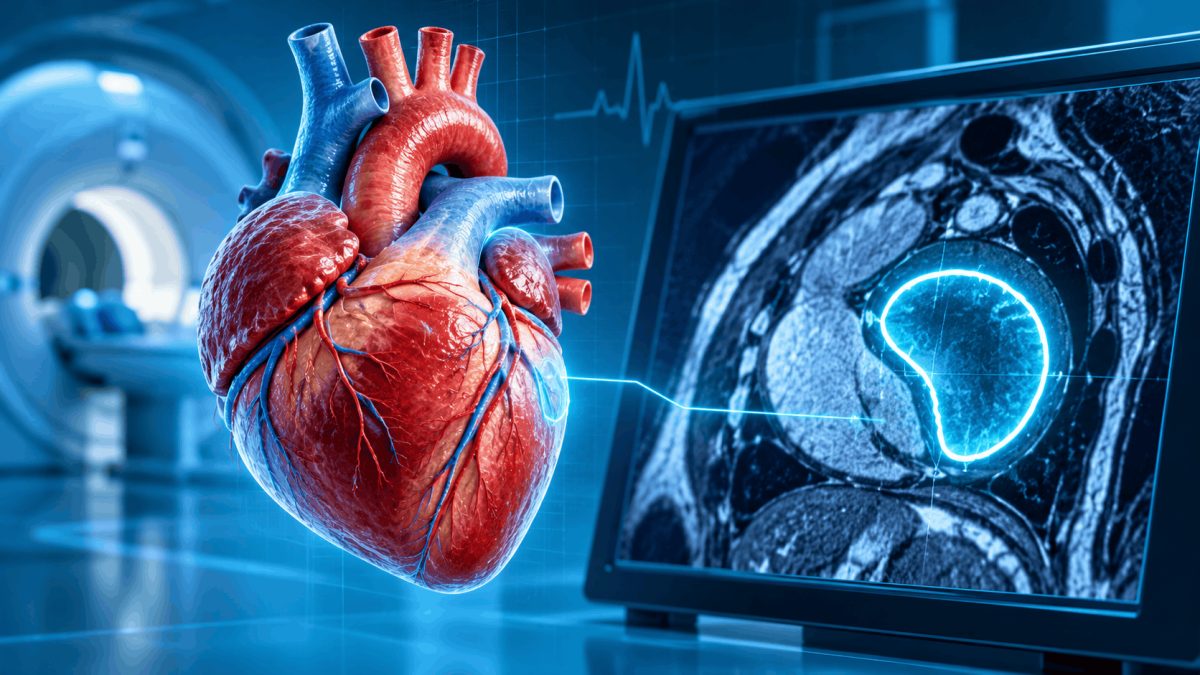
Doctors check how well the heart pumps by measuring something called ejection fraction on an MRI scan. Now an AI tool has done this for 27,382 patients. Its numbers were slightly better than the doctors' at predicting who would die.
The study came from City St George's, University of London, and University College London. It was published in The Lancet Digital Health on 2 November.
Why This Number Matters
Ejection fraction is the share of blood the heart pushes out with each beat. A low number can mean the heart is weak. Doctors use it to pick heart failure treatments, decide on implanted devices, judge the risk of surgery, and watch the heart during chemotherapy.
How the AI Gets the Number
To measure it, someone has to draw the outline of the heart's main pumping chamber on every slice of the MRI. They do it once when the heart is full and again when it has squeezed. The change in volume between the two gives the number.
The AI draws these outlines by itself. It uses deep learning, which means software that learns from many example scans.
The tool is an early version called 1CMR, made by MycardiumAI in Liverpool. It took 2 to 3 seconds per patient. The team's earlier work found that an expert needs about 13 minutes.
None of the study hospitals' scans were used to train it.
How They Tested It
The team did not just check whether the AI agreed with doctors. They asked a different question: whose numbers predict death better?
They used old scans from 26,106 patients at Barts Heart Centre in the UK and 1,276 patients at UPMC in the US. The scans were taken between 2010 and 2019.
Patients were followed for 5.6 years on average, and 3,458 of them (13%) died.
The AI's numbers matched who died slightly better than the numbers in the doctors' normal reports. The result still held after the team allowed for age and sex.
Why a Small Gain Can Matter
The authors call the improvement small. But ejection fraction guides treatment for so many people. If you apply a slightly better measurement to thousands of scans, a few more high-risk patients may get help sooner.
The AI still made mistakes for about 1% of patients. So doctors should keep checking its work.
What We Still Don't Know
This study looked back at old scans. It did not test the AI on patients in live hospital care.
About 95% of the patients came from one UK hospital. For patients with a thick-walled heart condition called hypertrophic cardiomyopathy, the AI did slightly worse.
The senior author also invented the tool. No regulatory approval or evidence of hospital rollout was identified in the reviewed reports.
Better prediction does not prove the AI measures more accurately, or that patients end up healthier. The team's next step is to combine the AI's scan results with ECG data.