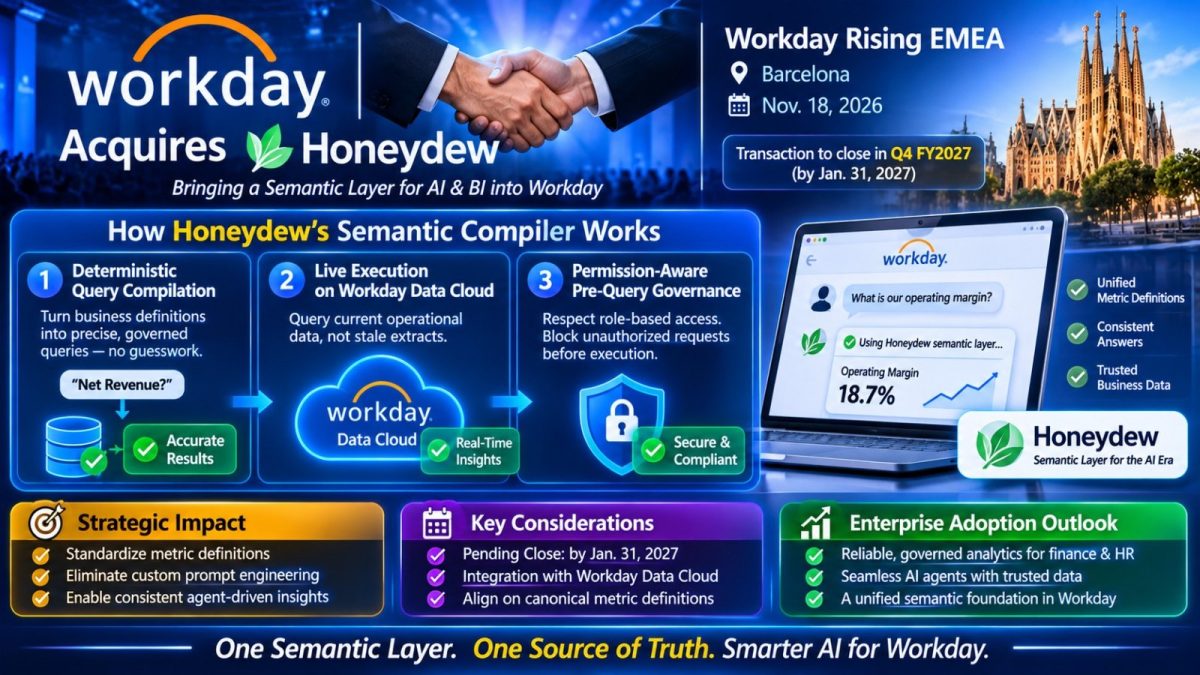
Why Shared Business Definitions Break in Enterprise AI
Ask a finance dashboard, an executive chatbot, and an autonomous workflow agent to calculate net revenue or active headcount, and each system can return a different figure. One query excludes contractors, another counts unfilled requisitions, and a third applies a mismatched fiscal calendar. On November 18, 2026, at its Workday Rising EMEA conference in Barcelona, Workday announced its intent to acquire Honeydew, a semantic layer designed for artificial intelligence and business intelligence (BI). Financial terms were not disclosed. Workday expects the deal to close in the fourth quarter of its fiscal year 2027, ending January 31, 2027.
Models should never improvise formulas behind payroll or revenue numbers. Workday plans to enforce shared business definitions directly inside its system of record.
Technical Architecture of Honeydew’s Semantic Layer
According to Workday’s official PR Newswire announcement, Honeydew separates business logic from physical storage schemas across three core architectural mechanisms:
Declarative Semantic Graph and Deterministic Query Compilation
In our engineering analysis, raw SQL generation by language models risks calculation drift whenever prompts vary in table joins, null handling, or fiscal date filters. Honeydew lets data teams define entities, relationships, and metric formulas once inside a declarative semantic graph. At runtime, an agent passes structured intent specifying required metrics and dimensions. Honeydew’s compiler then resolves join paths deterministically and produces optimized, dialect-specific SQL.
Direct Execution on Live Workday Data Cloud
Conventional semantic layers typically sit atop static tables copied into an external cloud warehouse via scheduled extract-transform-load (ETL) pipelines. Answers therefore stay tied to the most recent batch refresh. Workday plans to pair Honeydew’s compiler directly with Workday Data Cloud’s live operational store, resolving metric queries against real-time human capital and financial records without managing external extracts.
Pre-Execution Row- and Column-Level Security Injection
Workday’s role-based permissions travel alongside the semantic definitions. Before any compiled query reaches underlying compute engines, the semantic layer injects row-level and column-level security predicates tailored to the requesting user or agent. Unauthorized requests are blocked prior to execution rather than flagged in a post-hoc audit log.
Independent Editorial Critique and Integration Risks
In our editorial assessment, acquiring a semantic compiler reflects a structural shift across enterprise software: model reasoning matters far less than deterministic context when agents touch payroll and general ledgers. Because enterprises rely on Workday as a core system of record for workforce and financial data, there is zero tolerance for inconsistent financial math.
Still, enterprise architects should weigh two practical risks before assuming immediate operational value:
Post-Close Engineering and Integration Execution
As noted in the forward-looking statements section of Workday’s PR Newswire announcement, embedding Honeydew into live Workday Data Cloud workflows remains subject to customary closing conditions and post-merger integration execution after January 31, 2027.
Organizational Consensus Over Canonical Metrics
A semantic compiler prevents SQL drift, yet it cannot resolve human disagreements if finance, HR, and regional operations refuse to standardize competing metric definitions first.
Enterprise Adoption Outlook
By moving semantic compilation closer to live operational records, Workday targets a core bottleneck in enterprise agent reliability. Once closed and integrated, governed metric compilation will determine whether autonomous agents deliver consistent boardroom reporting.


