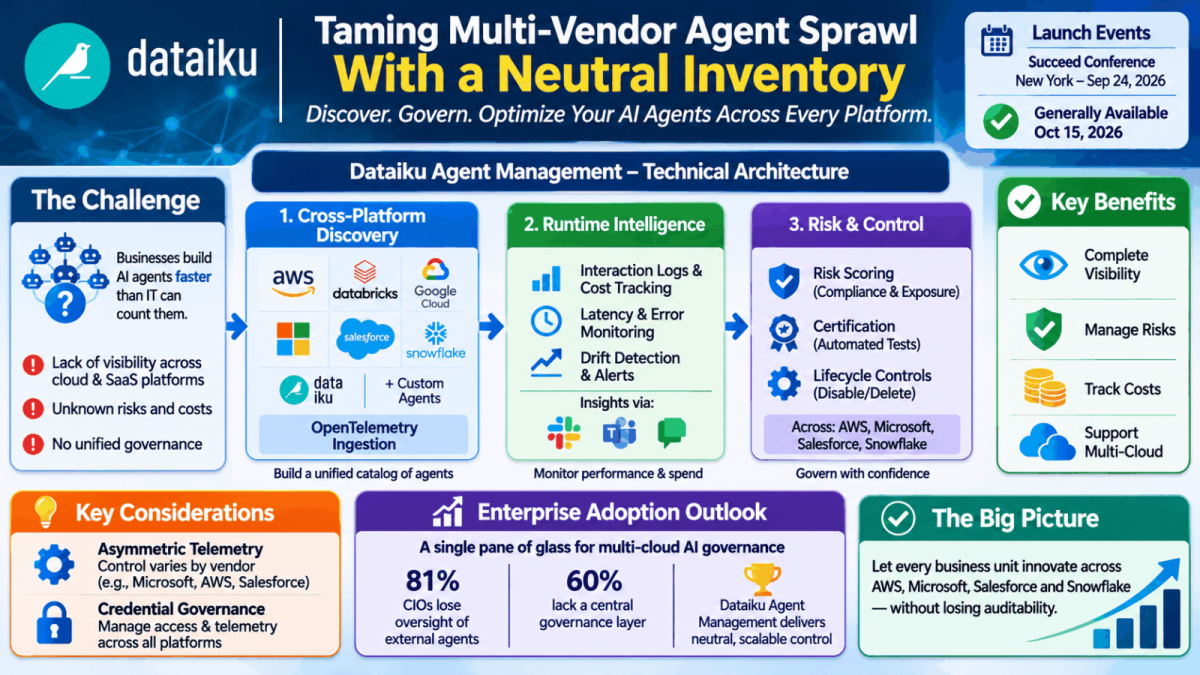
IT teams can track every physical server down to the serial number, but most of them can't say how many AI agents are running across their business units. Dataiku showed off Dataiku Agent Management at its Succeed conference in New York on September 24, 2026, and it became generally available on October 15, 2026. It's a standalone control plane that counts, checks, and manages agents across competing cloud and SaaS platforms.
Dataiku co-founder and CEO Florian Douetteau said at launch that teams have built agents faster than central IT can count them. Agent Management sits above the platforms where agents actually run, and it tries to answer three questions: what's running, what risks does it carry, and is it worth the cost?
How Agent Management works
According to Dataiku's September 24 announcement, product blog, and version 15 documentation, the product is priced per instance each year, with monitoring charged per agent. It works in three layers.
Finding agents across platforms. Agent Management connects straight to AWS Bedrock, Databricks, Google Agent Platform (Vertex), Microsoft Copilot Studio, Microsoft Foundry, Salesforce Agentforce, Snowflake Cortex AI, and Dataiku itself. For custom agents built outside those suites, an OpenTelemetry receiver takes in pushed data or manual sign-ups. Scheduled or on-demand scans build one catalog showing each agent's owner, data sources, models, and tools, and nobody has to rewrite code.
Watching costs and behavior. Once an agent is registered, the system collects logs, latency, error rates, token use, and spending. It pulls from sources like Azure Application Insights, Dataverse transcripts, Cloud Logging, or MLflow traces when they're supported. If an agent starts acting differently or its costs jump, alerts go to supervisors on Slack, Microsoft Teams, or Google Chat. Leaders can also ask questions in plain language to see how the whole portfolio is paying off.
Risk scores, certification, and remote controls. To help audit teams, the system scores risk based on whether an agent talks to outside customers, touches sensitive records, or runs live transactions. Risky agents can be certified with scheduled automated tests before they go live. On supported platforms like AWS Bedrock, Microsoft Foundry, Salesforce Agentforce, Snowflake Cortex AI, and Google Agent Platform, admins can even disable or delete agents that break the rules right from the console.
Things to think about
I think Dataiku is aiming at a real blind spot. Its September 2026 Harris Poll survey of 685 CIOs worldwide found that 81% had lost full oversight of agents built outside official channels, and 60% had no central governance layer across their environments. Tools from a single vendor, like Microsoft Agent 365 or Salesforce Agentforce governance, work fine inside their own worlds. But most big companies build on several clouds and SaaS tools at once.
Still, architects should know about two limits before using an overlay like this.
Not every platform gets the same treatment. Dataiku's documentation says the connectors vary a lot. For example, Microsoft Copilot Studio supports discovery and Dataverse transcripts, but automated uptime reviews and remote disable actions only work on platforms like Microsoft Foundry, AWS Bedrock, or Salesforce Agentforce.
Credentials and log costs. Agent Management needs service credentials and native trace logs like Application Insights or Cloud Logging. So security teams have to manage read and admin permissions in every connected cloud account, and they also have to pay for storing all those logs.
What happens next
By keeping agent discovery and risk certification separate from the platforms where developers build, Dataiku gives CIOs one place to look at AI governance across multiple clouds. Companies that set up tagging, OpenTelemetry, and certification checkpoints early can let teams build on AWS, Microsoft, Salesforce, and Snowflake without losing track of what's going on.


