UC San Diego Creates a Fast Soft Robot That Works Without Electronics
Most robots need computers, sensors and electronic parts to move. But researchers at the University of California, San Diego, have built a soft robot that can run without any electronics.
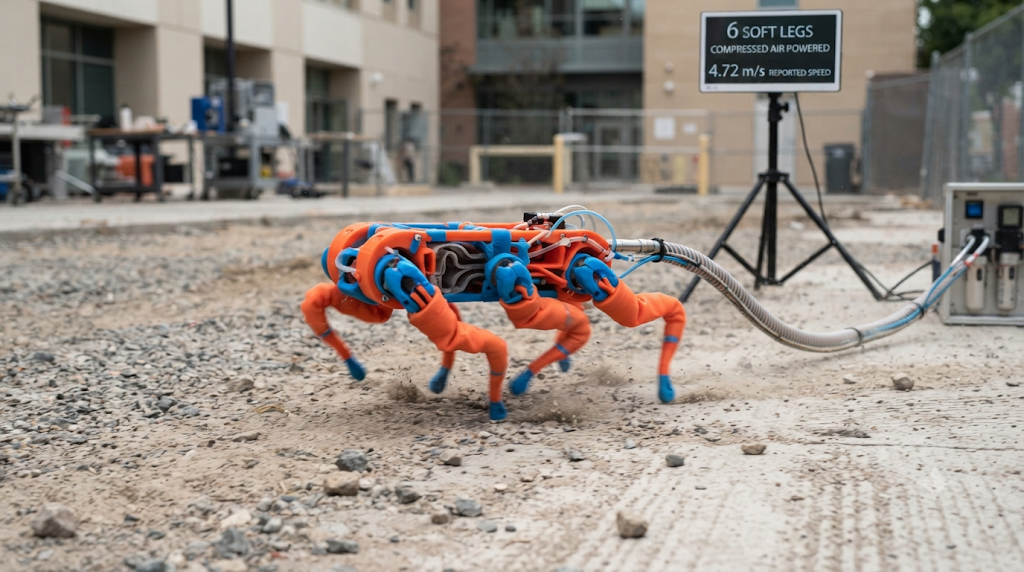
The robot can reach a speed of 4.72 metres per second, which is almost 17 kilometres per hour. The research was published in the journal Science Robotics on November 18, 2026.
A Six-Legged Robot Made Using 3D Printing
Researchers Yichen Zhai and Michael T. Tolley developed the robot at the UC San Diego Jacobs School of Engineering. It has six flexible legs and is 3D printed from a single soft material. Its whole body is printed in one piece, so there's no need to put together lots of separate parts.
In testing, the robot reached 4.72 metres per second. That's more than 100 times faster than the team's earlier walking robot, which moved at only 4 centimetres per second. The researchers also tested it on concrete, grass, gravel, sand and mulch. It could even move through water.
How Does It Move Without Electronics?
Instead of using a computer, the robot moves with compressed air. Inside its body are small air chambers, tubes and valves. When compressed air flows in, the system creates repeated changes in air pressure that make the legs move.
The robot doesn't need software to control each leg. Its body is designed to produce the right movement on its own.
The researchers borrowed an idea from old steam engines. Air moves through two stages. Smaller chambers control the valves, and larger chambers provide the force that moves the legs. This helps the robot move fast while using air pressure more efficiently.
Why Is This Robot Important?
Robots usually depend on electronic systems, which may not work properly in places with strong radiation or magnetic fields. Since this robot has no electronics, researchers believe similar robots could someday be useful in dangerous places or disaster areas.
Its simple design is another advantage. Fewer electronic parts could make some robots easier and cheaper to build. But these possible uses still need more testing.
What Are Its Limitations?
Even though the robot is fast, it has some problems. The biggest is that it needs an external air compressor, so it can't move freely without being connected to an air supply. It also uses a lot of compressed air.
It can't change direction or pick up objects either. And researchers still need to study how long it can run without being damaged.
What Will Researchers Do Next?
The researchers want to reduce the amount of air the robot needs so it can eventually use a portable air supply. They also plan to add steering and object-handling abilities.
For now, this robot is only a laboratory prototype. But it shows that robots don't always need computers to move quickly. With more work, this technology could lead to simpler robots that can operate where ordinary electronic robots struggle.