What Is Happening?
For years, tech gaps in schools were just about hardware who had a good laptop or fast Wi-Fi at home. Now, a new kind of divide is growing around artificial intelligence.
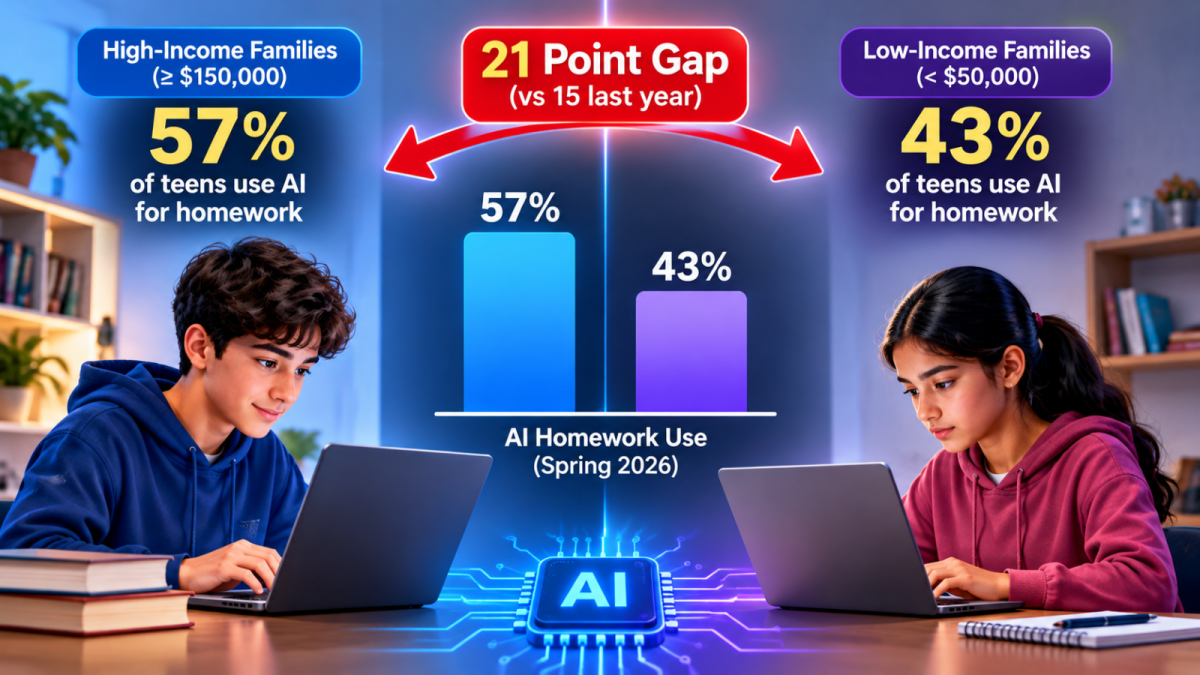
On November 12, 2026, the RAND Corporation shared a new study backed by the Gates Foundation. Researchers tracked about 1,000 parents and 1,800 teens in the US from 2025 to 2026. Their findings show a clear "AI homework gap" between rich and poor families:
-
In spring 2026, 57% of teens from families making $150,000 or more used AI for homework. Only 43% of teens from families making under $50,000 did the same.
-
Just 15 months earlier, both groups were tied at 39%, meaning a 14-point gap appeared in just over a year.
-
Parent support also split: 67% of richer parents pushed their kids to use AI for school, compared to 45% of lower-income parents.
How Does It Work?
To figure out why this gap grew so fast, researchers looked at daily habits at home instead of just school rules. They compared survey answers over time while accounting for a student's age and basic tech access.
The study found that teens copy what their parents do. Teens whose parents use AI often were much more likely to use it for homework (63%) than teens whose parents never touch it (40%). In fact, a parent's encouragement was one of the biggest reasons a teen used AI even more than family income or school rules.
Still, another study adds an important twist. In February 2026, the Pew Research Center found that when lower-income teens do use AI, they are more likely to let it do most of their schoolwork. Put together, these two reports show a split: richer kids use AI more often with parent coaching, while some lower-income kids use it less often but lean on it to do the heavy lifting.
Why Is It Important?
This research changes how we talk about AI and cheating. It shows that how kids use AI does not start in the classroom it starts at the dinner table.
Education experts say schools now have to fix a gap they did not create. When a teacher assigns an essay, some students get helpful AI tips from tech-savvy parents at home, while others have to figure out the tools all by themselves. However, RAND makes one thing very clear: these surveys only count how often kids use AI, not their final grades. We still do not know if this gap in AI habits will lead to lower test scores later on.
What Are the Challenges?
Schools cannot police how families use AI at home. Simply banning AI in class fails because it ignores the home habits students build every day. Teachers are stuck trying to make things fair when students have very different levels of tech help outside of school.
What Happens Next?
Instead of just banning AI, schools need to teach students how to use it well. Teachers and school leaders must focus on showing all students how to check AI answers and use these tools to learn so kids without tech help at home do not fall behind.


