Robot Fish Are Swimming With Real Fish
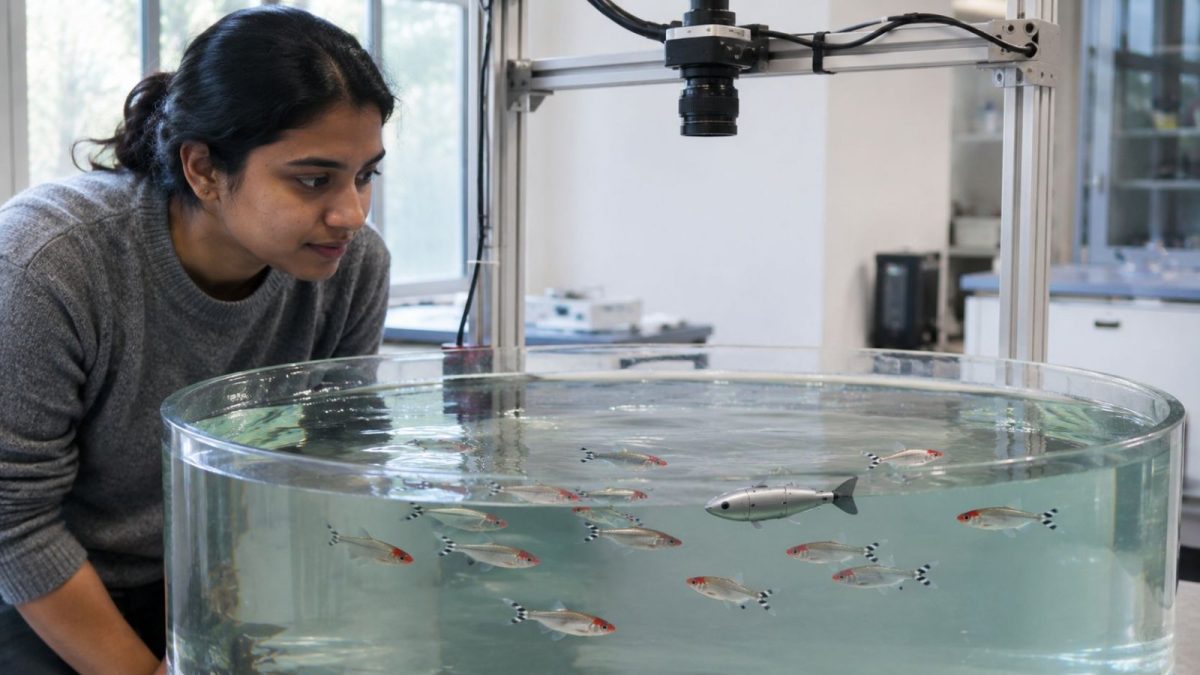
Scientists are now putting robotic fish that swim among real fish inside tanks, streams and lakes. The robots look and move like fish, and real fish often treat them like part of the group. This helps researchers understand why fish swim together, and it doesn’t hurt the fish. Think of a toy boat that moves along with a group of ducks.
A robot that joined a real school
In August 2026, a team from EPFL in Switzerland and CNRS in France shared a new study. It’s a preprint, which means other scientists haven’t checked it yet. They tested a robot with small fish called rummy-nose tetras. The robot swam with four real fish and moved along with the group.
How does it work?
The robot is called LureBot. It moves under the tank floor, and a magnet pulls a fish-shaped model through the water above it. Cameras watch the real fish all the time. A computer reads where each fish is and tells the robot how to move. So the robot reacts to the fish, and the fish react to the robot.
Another robot, ScaFi, is made for open water. It has a stiff front and a soft tail. One motor pulls two cables to bend the tail like a real fish tail.
Why does it matter?
Real fish are hard to study up close. A robot can swim the same way every time, so scientists can repeat a test. In the school study, the robot watched only one nearby fish at a time and still kept up with the group. The authors say real fish seem to watch two.
Robots can also go where fish live. In 2018, MIT built a soft robot fish called SoFi. It swam more than 50 feet deep near Fiji’s Rainbow Reef for up to 40 minutes at a time. Its camera took photos and video of the reef.
ScaFi shows another use. The team built it in three sizes, from nearly two feet to nine feet long. So one design could fit a creek, a stream or a lake.
What are the problems?
Fish don’t always accept the robot. In a 2026 guppy study, a robot kept swimming toward the fish, and they swam away. They did this more as the tests went on. Only five fish were tested, so more work is needed.
The school robot had limits too. It can’t feel the water movement from nearby fish. It also swam side by side more than real fish do. ScaFi lost speed at its largest size. All of this is still research, not a product you can buy.
What happens next?
A 2026 review in Nature Communications says future robots could swim in three dimensions and adjust to the fish around them. Then they might join wild groups and send back live data. The guppy team also wants to test whole schools. These are goals, not proven results.
Robotic fish are still learning how to fit in. They give scientists a steady way to ask questions that nature makes hard to answer. Each careful test helps us understand how fish live together.