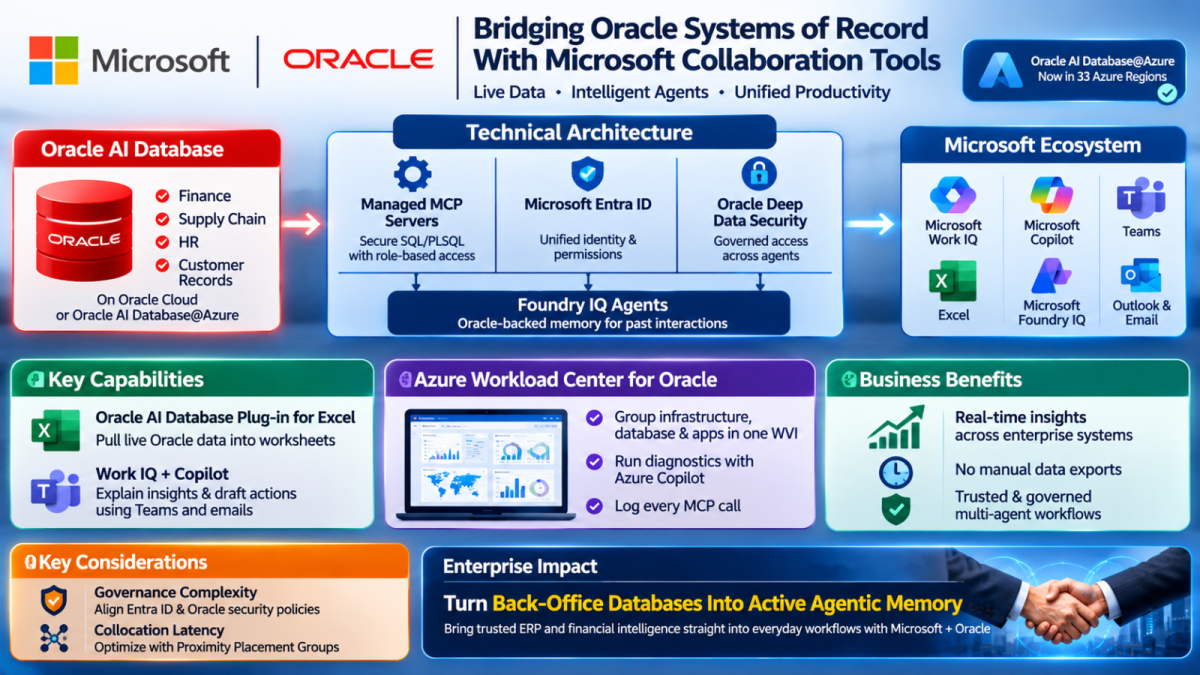
A big problem with company AI agents is that ledger data and everyday workplace info live in totally different places. On November 17, 2026, at Microsoft Ignite, Microsoft and Oracle showed new connections between Oracle AI Database and Microsoft Work IQ, Foundry IQ, Excel, Teams and Microsoft Copilot. It runs on Oracle AI Database@Azure, which now covers 33 Azure regions. Agents can look at finance, supply chain, HR and customer records, and also use clues from meetings, emails, documents and chats.
Microsoft and Oracle say they don't copy private records into outside vector stores. Instead, they bring the controlled agents straight to the live database.
How It Works
According to the Azure Blog post written by Microsoft's Mike Hulme with Oracle's Arpan Shah and Muneer Mirza, there are three layers.
Managed MCP servers, Entra ID and agent memory. Developers in Microsoft Foundry connect agents to Oracle AI Database, on Oracle Cloud Infrastructure or Oracle AI Database@Azure, using managed Model Context Protocol (MCP) servers and the Agent-to-Agent (A2A) protocol. Managed MCP only lets agents use SQL and PL/SQL actions, tools and premade reports that IT has approved, based on application roles. Logins go through Microsoft Entra ID and Oracle Deep Data Security. Foundry IQ agents also use Oracle-backed memory to remember past customer interactions and cite policies.
Oracle plug-in for Excel. This one is available right now. Analysts, planners and controllers can pull live Oracle transaction data straight into their worksheets, so there are no more manual CSV exports or IT tickets asking for data. Inside Excel, Copilot mixes those numbers with Work IQ info from Teams and email to explain why margins changed, point out reconciliation problems and draft action plans with rules built in.
Azure Workload Center for Oracle. This is in limited preview. It puts infrastructure, database and application dependencies together in one Workload Virtual Instance (WVI). If an order-processing app slows down, admins log in with Entra ID and ask diagnostic agents to look into it, using Azure Monitor Health Models and the Azure Copilot Run Oracle agent. Every managed MCP call is logged so it can be audited.
Things to Think About
I think this fits Microsoft's bigger plan at Ignite, along with Copilotforce for Salesforce, to make Copilot the front door to all the systems that hold company records. Using managed MCP to bring agents to Oracle also avoids expensive ETL copying and keeps the database's security in place.
Still, architects have two things to deal with before rolling it out widely.
Two security systems to line up. Admins have to carefully match Microsoft Entra ID permissions, application roles and Oracle Deep Data Security rules. If they don't match, multi-agent workflows could get stuck, or sensitive financial tables could be exposed.
Latency and where your systems live. Proximity Placement Groups on Oracle AI Database@Azure cut the round-trip time between VMs and Exadata by about 50%. But companies with older on-premises Oracle databases still have network and migration trade-offs to deal with before they get real-time agent performance.
What Happens Next
By combining managed MCP servers, live Excel plug-ins and Workload Virtual Instances, Microsoft and Oracle turn back-office databases into active memory for agents. Companies that set up their Entra-to-Oracle role mappings early can bring trusted ERP and financial info right into analysts' everyday work.


