Imagine a small paper box that stays closed after being folded. Researchers at Wuhan University in China have developed a tiny robot that works in a similar way.
This robot uses a special folded design and magnetic fields to move. It can crawl, roll, jump and even pick up objects.
The research, led by Professor Yang Li, was published in Nature Communications in November 2026.
What Is the Magnetic Origami Robot?
The robot was developed by researchers mainly from Wuhan University.
It uses a design inspired by origami, the Japanese art of folding paper.
Instead of having many mechanical parts, the robot uses its folded body to perform different movements.
During laboratory tests, the robot successfully crawled, rolled, jumped and grabbed objects.
It could also hold objects of different shapes, including live silkworm pupae.
Wuhan University shared an English announcement about the research on November 20, 2026.
How Does the Robot Work?
The robot uses magnetic fields to control its movements.
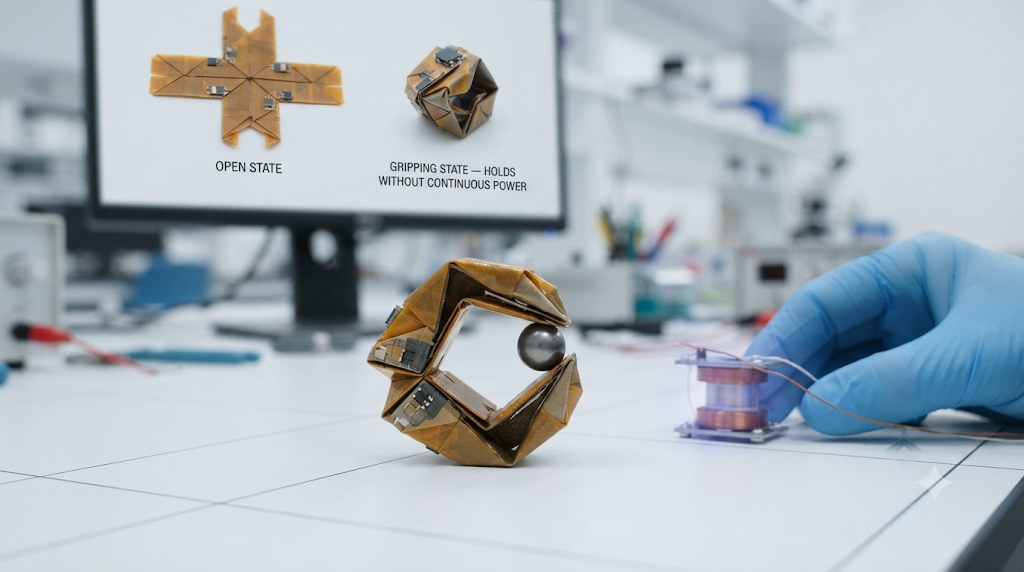
Its special design is called bistable, meaning it can stay in two different shapes without needing constant force.
For example, a light switch stays on or off until someone changes it.
The robot works in a similar way.
When researchers change the magnetic field, the robot can move or change its shape.
A stronger magnetic pulse can make it switch between its two stable positions.
When the robot closes around an object, it can keep holding it without continuous magnetic power.
The researchers also designed it to work with magnetic fields that are not perfectly even.
Why Is This Technology Important?
Most robots depend on motors, sensors and software to control their movements.
However, this robot uses the shape of its body to perform some actions.
Researchers call this mechanical intelligence.
It means the robot's physical design helps control its behaviour without needing complicated instructions for every movement.
This could make future tiny robots simpler and easier to develop.
The ability to hold objects without constant power may also help reduce energy use.
In the future, similar robots could be useful for inspecting narrow spaces or performing special medical tasks.
What Are the Limitations?
The magnetic origami robot is still a laboratory prototype.
It needs external magnetic equipment to move and has not been tested inside human patients.
Although it successfully handled live silkworm pupae, this does not prove it is safe for medical procedures.
Using robots inside the human body would require more testing.
Researchers would need to study how the robot behaves in body fluids, how safely it moves and whether it works with medical imaging equipment.
What Happens Next?
The researchers may continue testing the robot under more realistic conditions.
Before it can be used in medicine or industry, its safety, reliability and performance must be carefully studied.
No commercial or medical product has been announced yet.
This research shows how a simple folded design can help robots perform different movements. Although the technology is still developing, it could lead to smaller and more flexible robots in the future.