How Robots Are Learning to Recover From Their Own Mistakes
When we drop something, we usually pick it up and continue what we were doing. For robots, this is not always possible. Many robots stop working when they make a mistake and need someone to help them.
Researchers are trying to solve this problem by teaching robots how to recognise mistakes and correct them on their own.
Teaching Robots to Try Again
Researchers at Carnegie Mellon's Robotics Institute developed a method called Failure-Aware Retry (FAR). It allows robots to learn from unsuccessful attempts and try again without human help.
Another method called FailSafe uses AI to watch the robot's movements and suggest changes when something goes wrong.
FLARE, a system presented at the CVPR 2026 conference, helps robots restart or repeat tasks after making mistakes.
The research papers on FAR and FailSafe are preprints, meaning they may not have been reviewed by other experts yet.
How Do Robots Correct Their Mistakes?
Robots use cameras and software to check whether they are doing a task correctly.
When something goes wrong, the robot tries to find the reason behind the mistake.
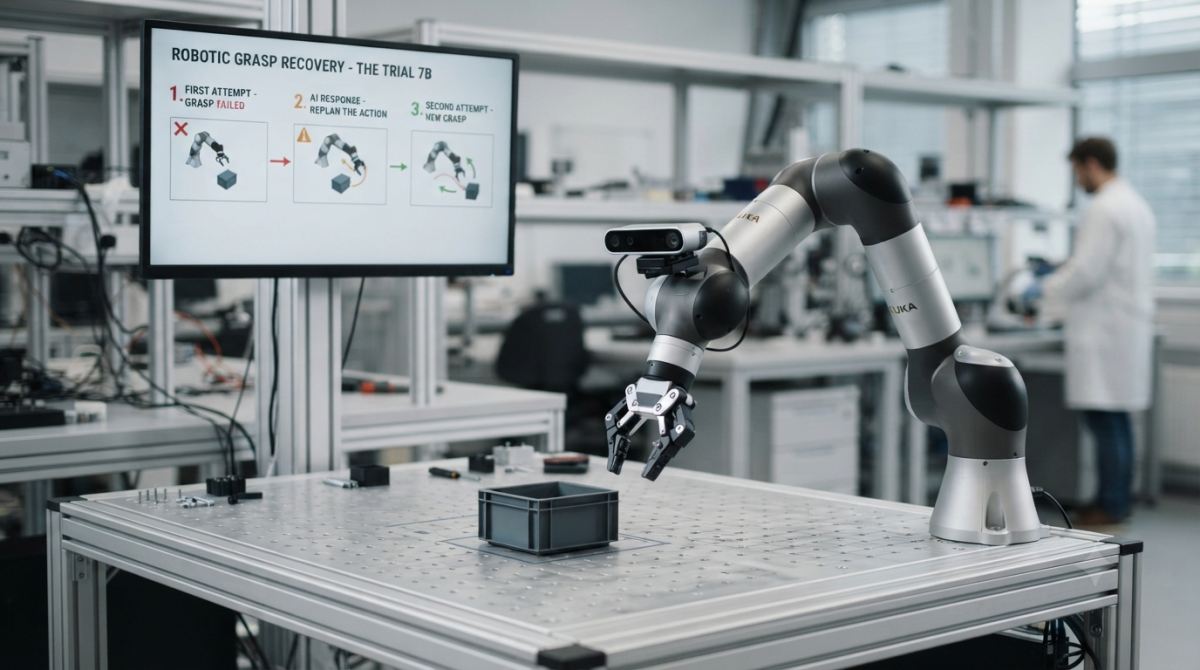
For example, if a robot drops an object because of a poor grip, it can change the position of its hand and try picking it up again.
FailSafe checks the robot's actions every ten steps and suggests changes whenever it detects a problem.
What Did the Experiments Show?
Researchers at Carnegie Mellon tested FAR in computer simulations. The success rate increased from 47% to 63.4%.
Robots that simply tried again without learning from their mistakes achieved a success rate of 59.1%. This shows that even giving robots another chance can improve their performance.
In a separate experiment, FLARE helped a real robotic arm improve its block-stacking success rate from 62.5% to 75% over 40 trials.
Why Do Robots Still Need Improvement?
Although these results are encouraging, robots still have trouble dealing with unexpected situations.
A study called LIBERO-Recover tested six AI models using computer simulations. In one group of tasks, the average success rate dropped from 38.3% to 5% after mistakes occurred.
Another research paper released in November 2026 showed that human demonstrations using virtual reality improved success on difficult gripping tasks from 24% to 45%.
These experiments show that robots still need better training and sometimes require human support.
What Could Happen in the Future?
Robots that can correct their own mistakes could be helpful in factories, warehouses and farms. Workers may not have to stop their work every time a robot drops an object or fails to complete a task.
However, most of the current results come from laboratories and computer simulations. Robots need more testing in real workplaces before companies can depend on them.
Learning from mistakes is something humans do naturally. Teaching robots to do the same could help them become more independent and useful in everyday life.