When medical students want to learn surgery, they often watch experienced doctors. But can robots learn the same way?
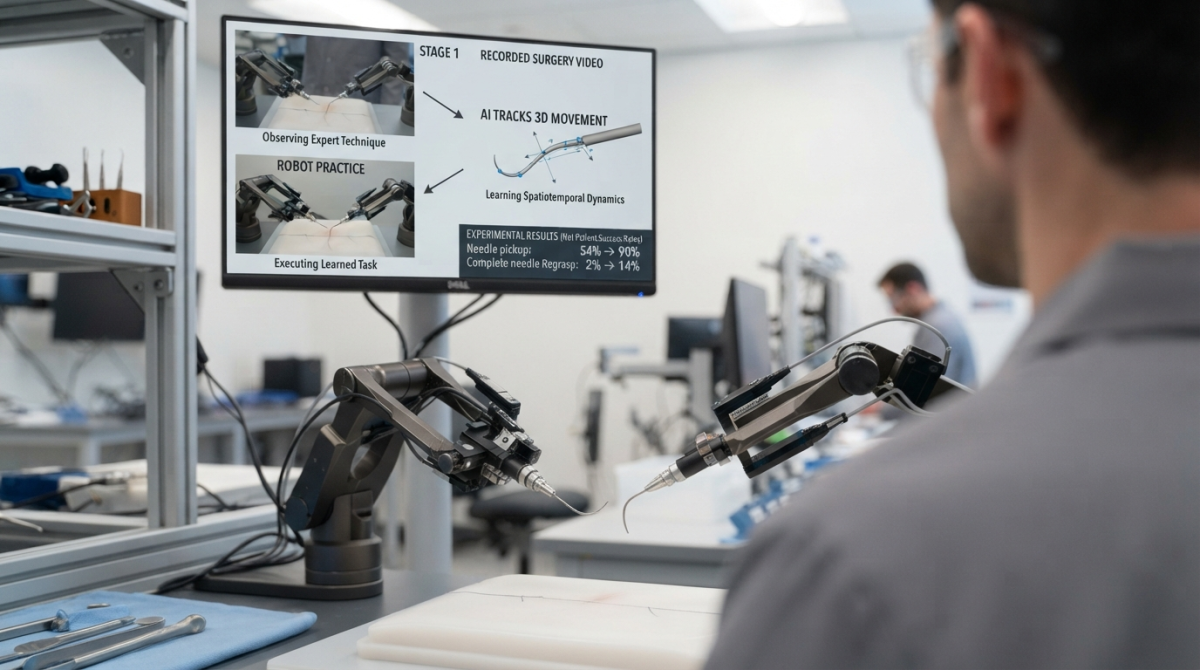
Researchers from Vanderbilt University and Intuitive Surgical have made a new AI training method called FlowScope. It helps surgical robots learn how instruments move by watching recordings of real operations.
What Is FlowScope?
FlowScope is a training method that helps surgical robots get better at their skills. The researchers collected videos from 1,149 surgeries and used around 1.35 million short clips to train the AI. After the training, they tested the AI on a real surgical robot, and each training method was tested 50 times. The research paper came out in November 2026, and other experts haven't reviewed it yet.
How Does the Robot Learn From Videos?
Learning from surgery videos is harder than it sounds. The videos show how the tools move, but they don't show the commands that were used to move them.
To get around this, the researchers used a technique called 3D scene flow. It helps the AI understand how objects move in different directions. For example, it can learn if a needle is going forward, sideways, or deeper into a space. By learning these movements, the AI gets a better idea of how surgical tools work. The researchers also found that this method helped the AI judge the depth of a needle more accurately.
How Well Did the Robot Perform?
The researchers compared FlowScope with another AI model that didn't get the video training first. According to them, picking up a needle improved from 54% to 90%. Passing a needle between robotic instruments improved from 4% to 52%. Finishing the whole needle-regrasp task improved from 2% to 14%.
Collecting special training data for surgical robots can cost a lot, so using surgery videos that already exist could cut some of that effort. But these tests were done in a lab, not on patients.
What Problems Are Still There?
Surgery has many hard steps, and even a small mistake can have serious results. In the 50 trials, the robot finished the first needle handover 26 times, but it completed the whole task only seven times. This means the robot still has trouble when it has to do several actions together.
There are also worries about patient privacy and permission when real surgery recordings are used to train AI. The study doesn't prove that robots can do surgery on patients by themselves.
What Could Happen in the Future?
More experiments are needed to see if FlowScope works well on other surgical tasks. One interesting part of this research is that videos already recorded in hospitals could become useful learning material for robots.
The improvement in needle pickup is impressive, but the 14% success rate for the whole task shows there is still a lot of work to do. For now, FlowScope is a research project and isn't ready to be used on patients.