What Is Happening?
In late October 2026, economists Bruce Sacerdote and Mason Parris-Bacon shared the first part of a big study at Dartmouth’s "AI at 70" event, followed by a formal paper in November. They asked 1,003 U.S. college students across the country along with 1,201 students and 332 incoming freshmen at Dartmouth about their habits. The answers show a massive gap between what students admit doing and what they think others do.
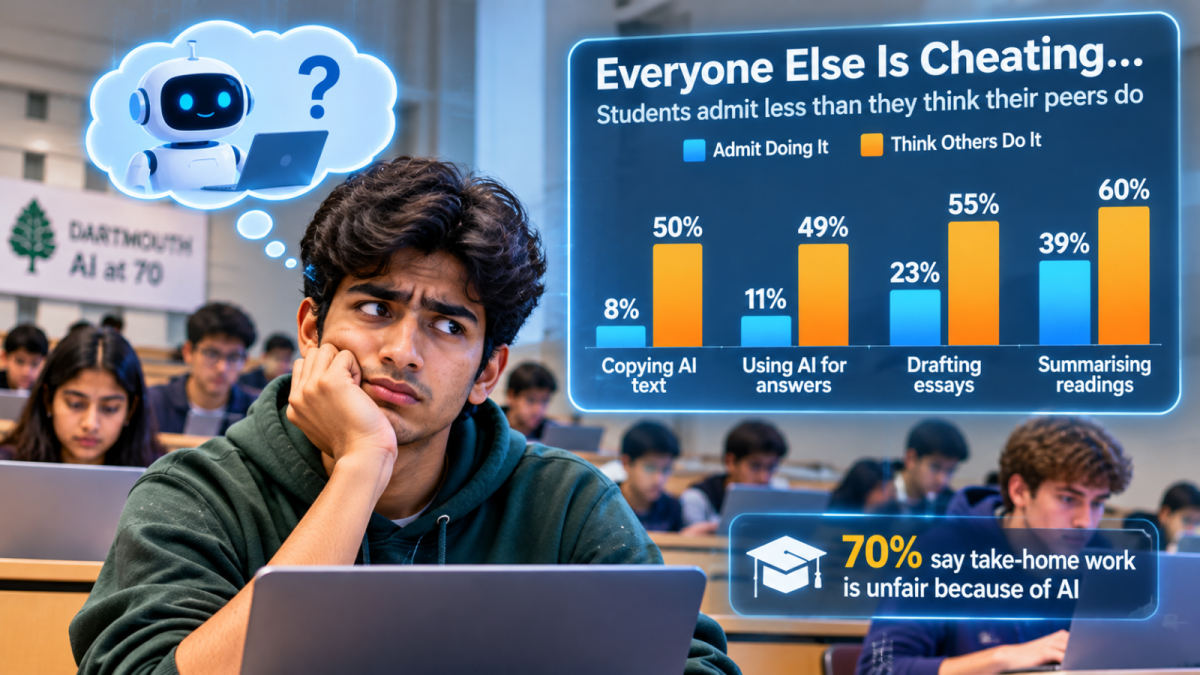
Only 8 percent admit copying AI text with almost no edits, yet 50 percent think classmates do it. Just 11 percent admit using AI for math or science answers, while 49 percent assume friends do. Also, 23 percent admit writing essays with AI compared to 55 percent who suspect others, and 39 percent summarize class readings with AI while 60 percent think peers rely on it. Researchers say that while some students hide rule-breaking even on secret polls, talks with students show they greatly overguess how much their classmates cheat.
How Does It Work?
Modern chatbots run on large computer models trained on huge piles of text to guess smooth, natural replies. Because these web tools are free, fast, and open inside any phone or laptop browser, students can write essays or fix coding bugs in seconds. Yet the same smart software also acts like a helpful private tutor. Across the poll, 61 percent of U.S. college students say they use AI to explain hard topics, and 52 percent say chatting back and forth with a bot makes their final work better.
Why Is It Important?
This gap matters because imagined cheating changes real student behavior. In the poll, 70 percent of U.S. college students say take-home homework has become unfair because of AI. Another 39 percent say they feel pushed to use AI simply because their friends do—up sharply from just 14 percent among incoming freshmen before classes even start. When honest students think everyone else is getting an easy boost, peer pressure pulls them into the trap.
What Are the Challenges?
Colleges cannot fix this with one strict campus-wide ban. Because 79 percent of students taught themselves how to use AI without clear school rules, a single ban only causes confusion. Worse, text-checking software often fails to tell the difference between simple grammar fixes and full robot writing, leaving teachers guessing and honest students worried about unfair blame.
What Happens Next?
Researchers suggest colleges share real poll numbers so students see that most classmates are not blindly copying text. Schools can also use more live classroom tests and clear rules for each subject—allowing AI for coding or practice quizzes while keeping essay writing strictly human. Students can break the trap by using chatbots to test their own knowledge instead of letting the computer think for them.