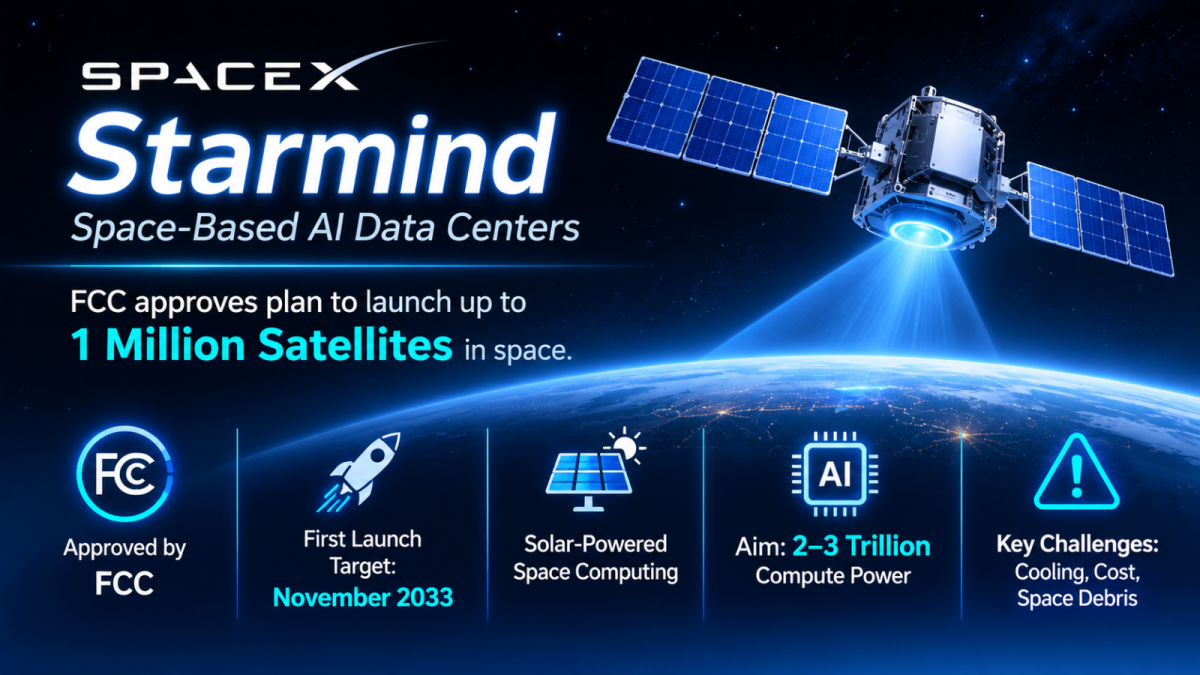
On November 25, 2026, the US Federal Communications Commission (FCC) approved a plan from SpaceX called Starmind. SpaceX is allowed to launch up to one million satellites that would work as data centers in space. These satellites would use solar power to run AI programs and then send the results back to Earth. Reports say this is the first approval of its kind.
What the approval actually means
The FCC expects the first Starmind satellite to launch by November 2033. The approval also comes with deadlines. So it's more like permission to try than a promise that it will happen.
"Up to one million" is just the maximum limit. It doesn't mean SpaceX will really build or launch that many.
Why SpaceX wants to do this
AI needs a huge amount of electricity, land, and cooling. Building more data centers on Earth is getting harder. SpaceX says space has lots of sunlight, so it could be a way to add more computing power without building more data centers on the ground.
What the approval doesn't prove
Getting approved is not the same as having something that works. The FCC decision doesn't show that data centers in orbit can actually work or make money. Some scientists in news reports are doubtful about the plan.
Here are the big problems people are asking about:
- Cooling: Space is a vacuum, so getting rid of heat from powerful computer chips is really hard.
- Launch cost: Sending that much equipment into orbit costs a lot.
- Radiation: Radiation in space can damage chips and make them wear out faster.
- Sending data back: The results have to reach Earth quickly and reliably.
- Space junk and the night sky: A huge number of satellites could cause crashes, create debris, and make the sky brighter, which bothers astronomers.
Nobody outside SpaceX has shared real cost or performance numbers for Starmind. So for now, these are open questions, not answers.
The bigger picture
Since the first launch is planned for 2033, Starmind is a long-term bet. It won't fix AI's power problem anytime soon. Still, the approval shows that regulators and tech companies are taking the energy problem seriously. Whether space is really a good place for data centers is something we'll only find out once the hardware is actually up there.