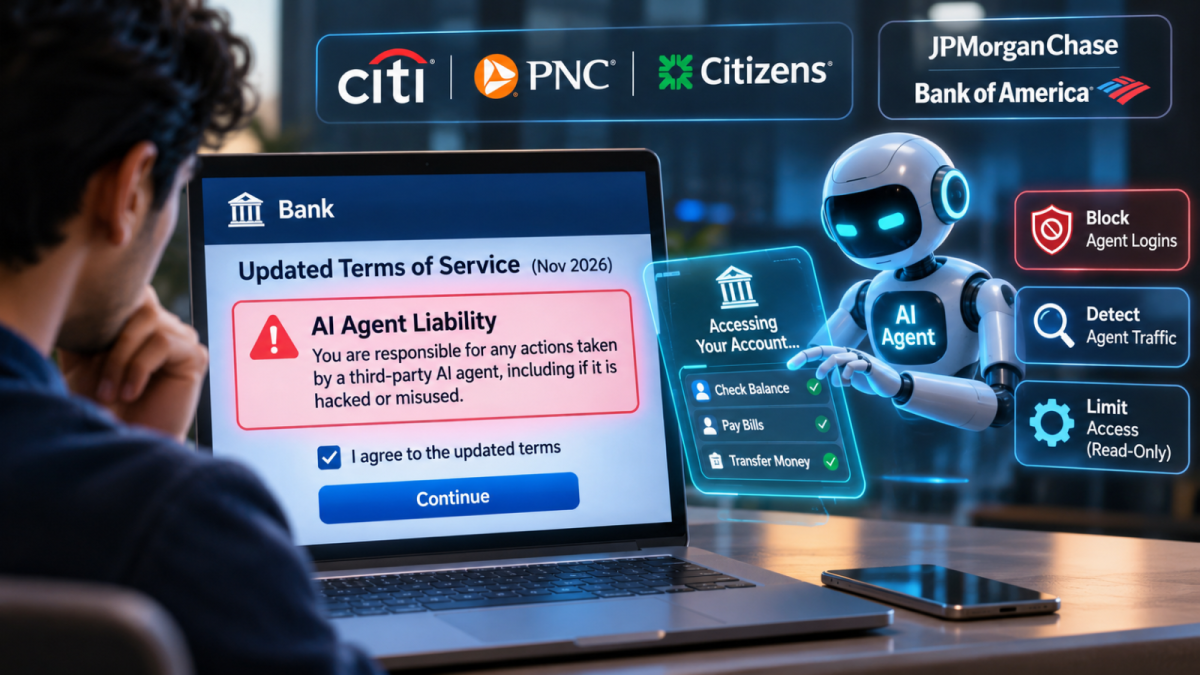
Banks Say You’re Responsible When Your AI Agent Goes Wrong
In November 2026, Citi, PNC and Citizens rewrote their customer terms. Now people who give third-party AI agents access to their bank accounts are responsible for what those agents do. This matters because the terms apply even if the agent is hacked. JPMorgan Chase and Bank of America announced similar policies in October.
What happened
Citi added a new section to its Online User Agreement, and TechCrunch reported it on 18 November. It says customers are responsible for what happens through a third-party AI agent. That includes activity that uses login details that were later shared or leaked. Customers also have to watch what the agent does, and Citi can cut off an agent’s access without notice. PNC changed its terms on 18 November, and Citizens emailed its customers a similar warning. Wells Fargo’s updated agreement starts on 24 November, and it treats transactions by a customer’s agents as authorized.
Why banks are doing this
Axios reported in October that banks were finding unauthorized third-party AI agents inside customer accounts. Some of them tried actions that looked like they didn’t come from the user’s instructions. Citi says it doesn’t allow third-party AI agents to log into accounts or make transactions directly on its platforms. So the terms work as a ban, and also as a backup plan if something goes wrong.
Block, detect and limit
Banks are using three tools at once. They block agent logins, they detect agent traffic and they limit access. Reports say read-only access is becoming a likely middle path. That means an agent can see your financial data but can’t move your money. Bank of America is reportedly working on rules to decide who is responsible for payments an AI approved.
The gap in responsibility
This part is my own thinking. The bank says the customer is responsible, but the customer might have little control over what an AI company’s agent does. If the agent’s maker also limits its own responsibility, the customer is left with the loss. I couldn’t check the terms of any specific agent product, so read them yourself before you write about one.
What could happen next
If banks offer their own agents, or approved read-only tools, customers could get help with budgets and bill reminders under clearer rules. That’s a possibility, not an announced plan. Banks, fintech firms and AI companies may compete to offer approved agent access with clear rules about who pays. Insurers might also create new products for losses from agents. None of this is confirmed.
Challenges
I haven’t seen a court or regulator decide whether the banks’ idea of “authorized” will hold up. It’s also not settled whether existing consumer protections limit it. Most customers also don’t read terms updates closely.


