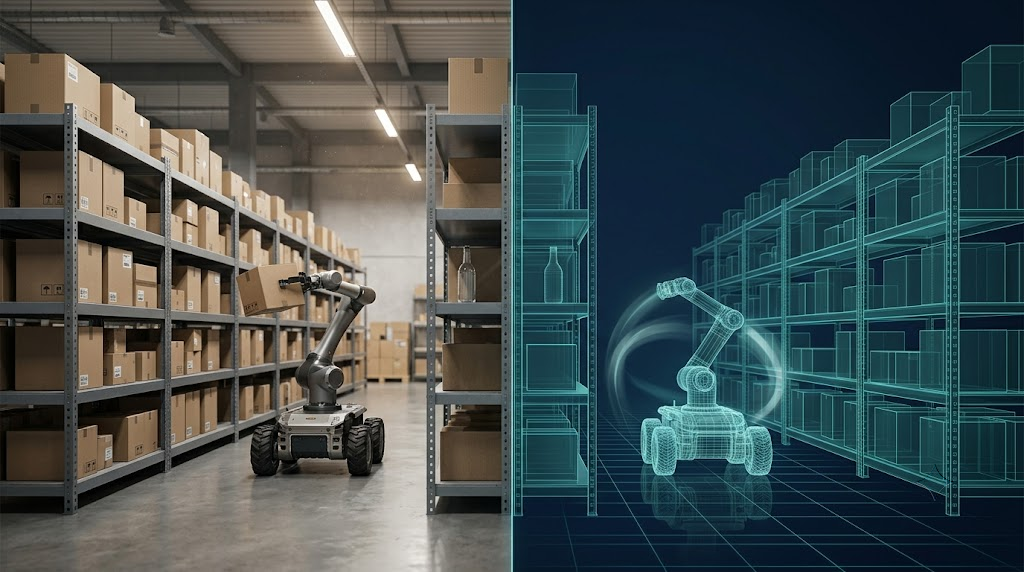
In a January 2026 study, a robot hand learned to grip objects in a virtual world where every joint reported its exact torque. The real hand has no direct torque sensors, only motor-current readings. That mismatch shows why simulation matters and why it is risky. Robots need far more practice attempts than real hardware can safely survive, yet a virtual world is only as useful as its match to reality.
Why Robots Practise in Virtual Worlds First
Many robot skills are learned by trial and error, and a physical robot can damage itself, its surroundings or people while it fails. Simulation runs thousands of virtual robots in parallel, with no such risk. It can also stage rare events on demand. Agility Robotics' chief technology officer told Tech Briefs in June 2026 that its Digit robot, already piloted in real warehouses, relies on simulation alongside collected data and engineered skills. He said tracking the long tail of failures, such as broken totes or slippery floors, is critical.
What a Virtual World Is Made Of
A simulator has three parts. A physics engine calculates motion, friction and collisions. A renderer draws what the robot's cameras would see. A generator adds variety, such as randomised lighting and object positions, so a policy does not depend on one virtual setup. Researchers call this domain randomisation.
2026 brought major tooling updates. At GTC on 16 March, NVIDIA announced Cosmos 3, which it describes as a model combining synthetic world generation, vision reasoning and action simulation. It also previewed Isaac Lab 3.0 on its Newton 1.0 physics engine. By April, NVIDIA said Newton 1.0, Isaac Sim 6.0 and Isaac Lab 3.0 were generally available. Newton was co-developed with Google DeepMind and Disney Research. NVIDIA named Boston Dynamics, Figure, Agility and 1X among users; that is vendor reporting, not measured results.
Where Simulation Is Already Used
NVIDIA says ABB, FANUC, KUKA and Yaskawa, with over two million installed robots combined, use its tools to validate production lines through digital twins, which are virtual copies of real facilities. CMR Surgical says it uses simulation to train and validate its Versius surgical robot before clinical deployment. Both are company statements.
Where the Virtual World Still Falls Short
Recent results show progress and limits. A June 2026 preprint trained a model on about 800 synthetic demonstrations per task and no real ones. It reached 35 percent average success across four real-robot tasks, ten trials each. A March study found that unknown payloads create enough mismatch to degrade simulation-trained humanoid control. Its fix used differentiable simulation to estimate real parameters.
GeniWorld, from Tsinghua University and Tencent Robotics X (August 2026), added world-model-generated trajectories to 25 real demonstrations per task. Success rose from 40.8 to 69.0 percent in the authors' own lab tests; no independent replication was found.
Evaluation is also thin. A June 2026 Nanjing University position paper found essentially no work, among the roughly 40 papers it tabulated, measuring how far a model's predictions drift from reality when policies are optimised against it.