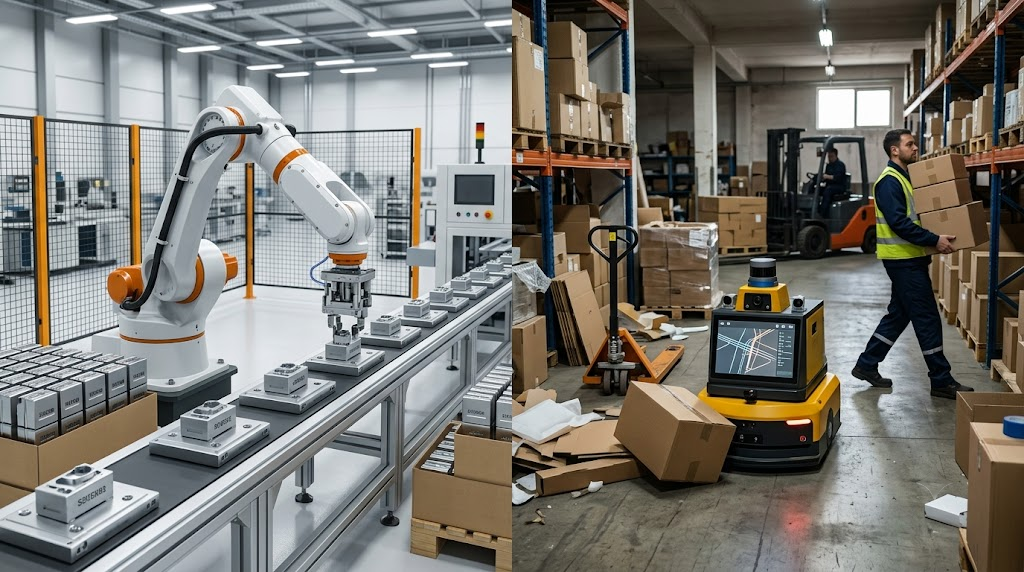
A factory robot can perform the same movement thousands of times without getting tired. Give it the same part, the same position and the same instructions, and repetition becomes its strength. But move that same robot into an environment where objects change position, people suddenly enter its path or conditions become unpredictable, and the problem becomes much harder.
Factories Give Robots a Predictable World
Industrial robots work best when engineers can control the environment around them. A robotic arm on an assembly line may have a fixed position, a known work area and parts arriving in predictable locations.
The robot does not need to understand everything happening around it. It mainly needs to perform a defined sequence accurately and repeatedly. Sensors, fixtures and software are often designed specifically to reduce variation.
This is why robots are widely useful for tasks such as welding, painting, assembly and material handling. Their advantage comes from repeatability: once the task and environment are well defined, the same movement can be executed again and again.
The Real World Keeps Changing
Outside a controlled factory cell, the robot has to deal with uncertainty.
A warehouse robot may encounter a blocked route. A mobile robot can face unexpected pedestrian traffic. A gripper may find that an object is slightly different from the one it was trained or programmed to handle. Outdoor robots can also encounter changes in lighting, weather, terrain or friction.
Research published in 2026 describes unexpected disturbances such as damaged components, flat tires and wind gusts as challenges that can cause robots to lose control. The researchers developed an online-learning method specifically to help robots recover from previously unseen disturbances.
Why One Small Change Matters
Humans are generally good at making quick adjustments when something looks different. A person assembling a component can notice that a part is slightly misaligned and reposition it before continuing.
A conventional robot may instead follow the movement it was programmed or planned to execute. If its sensors cannot correctly interpret the new situation, the original plan may no longer work.
This becomes even harder when several changes happen at once. A robot may need to identify an object, understand where it is, predict whether its path is clear and then choose a safe movement—all within a changing environment.
Recent reviews of AI-based collaborative robotics also point to problems including computational latency, limited training data and difficulty translating high-level reasoning into safe physical actions.
AI Is Helping Robots Handle Variation
Newer robots are increasingly using computer vision, machine learning and foundation models to deal with situations that cannot be described completely with fixed rules.
Instead of being told exactly where every object will be, an AI system can potentially recognize what it sees and select an appropriate action. Research into online learning is also exploring how robots can adapt their controllers when unexpected disturbances occur.
However, AI does not remove the problem completely. A robot operating around people still needs reliable sensing, motion control and safety systems. In safety-critical situations, a response that is almost correct can still cause a collision or damage equipment.
The Goal Is Not Perfect Autonomy
The difference between a controlled factory and a messy real-world environment explains why robotics often progresses task by task.
A robot does not have to understand everything around it to be useful. It needs to perform its intended task reliably within the conditions for which it was designed.
That is why factories remain an important environment for robotics, while researchers continue working on systems that can adapt when those conditions change. The challenge is not making robots repeat a successful action—it is helping them recognize when the usual solution no longer applies and respond safely.