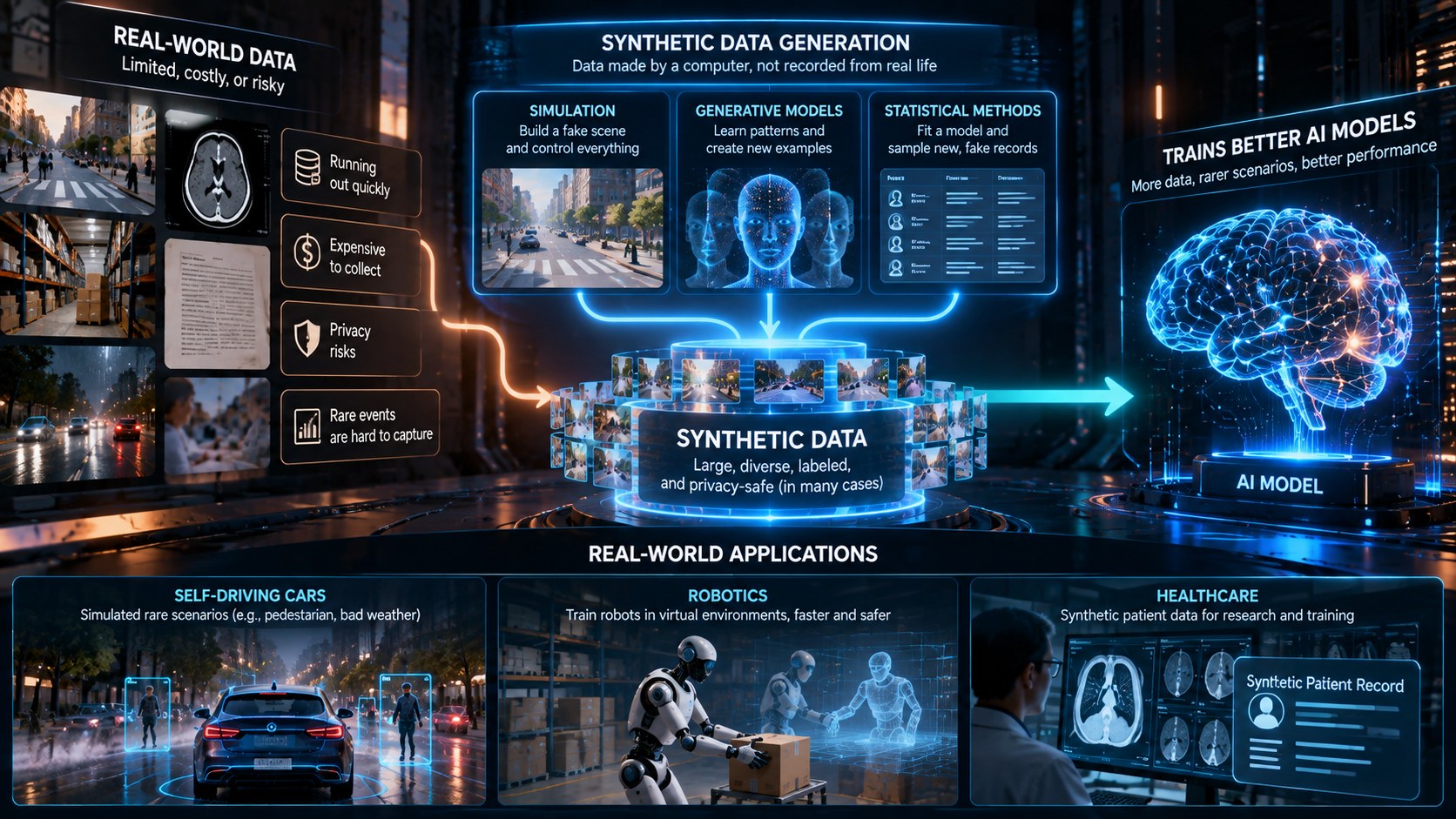
Every AI system has to learn from something. For most of the last decade, that meant the open internet: scraped photos, articles, sensor logs, medical records. That supply is running low, and estimates say most of the good, freely usable text online could run out within a few years. There has never been enough real footage of a pedestrian stepping in front of a self-driving car, a rare cancer on a scan, or a warehouse robot dropping a box. These moments matter most because they are rare, which is why so little real data shows them.
Synthetic data is the industry's fix: data made by a computer instead of recorded from real life. In the past year and a half, it has gone from a niche trick to something companies spend billions on. Nvidia bought the synthetic-data company Gretel for a nine-figure sum in March 2025, folding it into a bigger push that now includes Cosmos, its models built to generate fake video for training robots and self-driving cars.
What synthetic data actually is
Synthetic data copies the patterns in real data without coming from any one real person, car, or event. There are three main ways to make it. Simulation builds a fake scene, like a street or warehouse, and controls the lighting, weather, and camera angle, so labels come free and perfectly accurate. Generative models, like Nvidia's Cosmos 3, learn from real examples and create brand-new ones: a face, a product photo, a page of patient notes. Simpler statistical methods fit a model to real records, then sample new, fake rows from it, often for bank or hospital data.
Where it's already doing the heavy lifting
This is already doing heavy lifting across industries. In robotics, Nvidia pairs Omniverse with Cosmos to build training data for robot arms, cutting the process from days to hours; makers like 1X and Figure AI use it because not having enough data is one of the biggest reasons robots struggle in new settings. Waymo shows the scale in self-driving cars: over 200 million real driverless miles by 2026, against more than 20 billion simulated miles. In February 2026, it rolled out a model built on Google DeepMind's Genie 3 to create fake scenes of rare events, though it has not published test results, and the announcement came amid U.S. safety investigations into the company. In healthcare, fake patient records help work around scarce, sensitive data, and in vision, rendered scenes generate perfectly labeled images.
The law here is messier than the marketing suggests
The EU's AI Act tells companies to use synthetic or anonymous data, not real personal data, when fixing bias in high-risk systems, but that comes with more paperwork, not less. Under GDPR, things are unclear: making synthetic data from real personal data counts as processing, and whether the result still counts as personal data depends on details regulators have not fully worked out. Research has found that data marketed as fully anonymous can still be attacked in ways that reveal the real people behind it. In the U.S., calling data synthetic does not automatically exempt a company from HIPAA. Synthetic data can lower privacy risk, but treating it as a legal shortcut is exactly what regulators are pushing back against.
Why it's not a free lunch
It is not a technical free lunch either. A simulated scene is a simpler version of real-world light and physics, so models trained only on it often stumble on real footage, which is why most projects mix in real data too. A generator also picks up the real world's imbalances and can repeat them even more confidently, making bias harder to spot. The bigger risk is model collapse: a 2024 study in Nature found that models trained again and again on their own output slowly lose touch with rare, real patterns and settle into a blander version of reality, like a photocopy of a photocopy. Keeping a little real data in the mix slows this a lot, but the problem is not solved; a 2025 paper calls it one of AI's most serious open problems. Underneath all this sits a quieter danger: a model trained on bad synthetic data does not fail obviously, so mistakes only surface once it meets a reality it was never trained for.
Why this matters, and where it's heading
This matters beyond engineering. Whoever builds the best synthetic-data tools controls who can compete at the top of physical AI, and Nvidia's bet on Gretel and Cosmos is a wager that this becomes a bottleneck like chips already are. It also raises the stakes on trust: a wrong finger count on an AI birthday card barely matters, but that same quiet, confident error inside a training scene for a surgical robot or self-driving car is a different problem, because synthetic data's whole appeal is looking just as real as the real thing. Expect more paperwork rules, more consolidation among big toolmakers, and slow progress toward independent ways to check synthetic data for quality and privacy. Until that catches up, synthetic data solves the scarcity and privacy problems, but not the part about knowing whether what you made is actually any good.