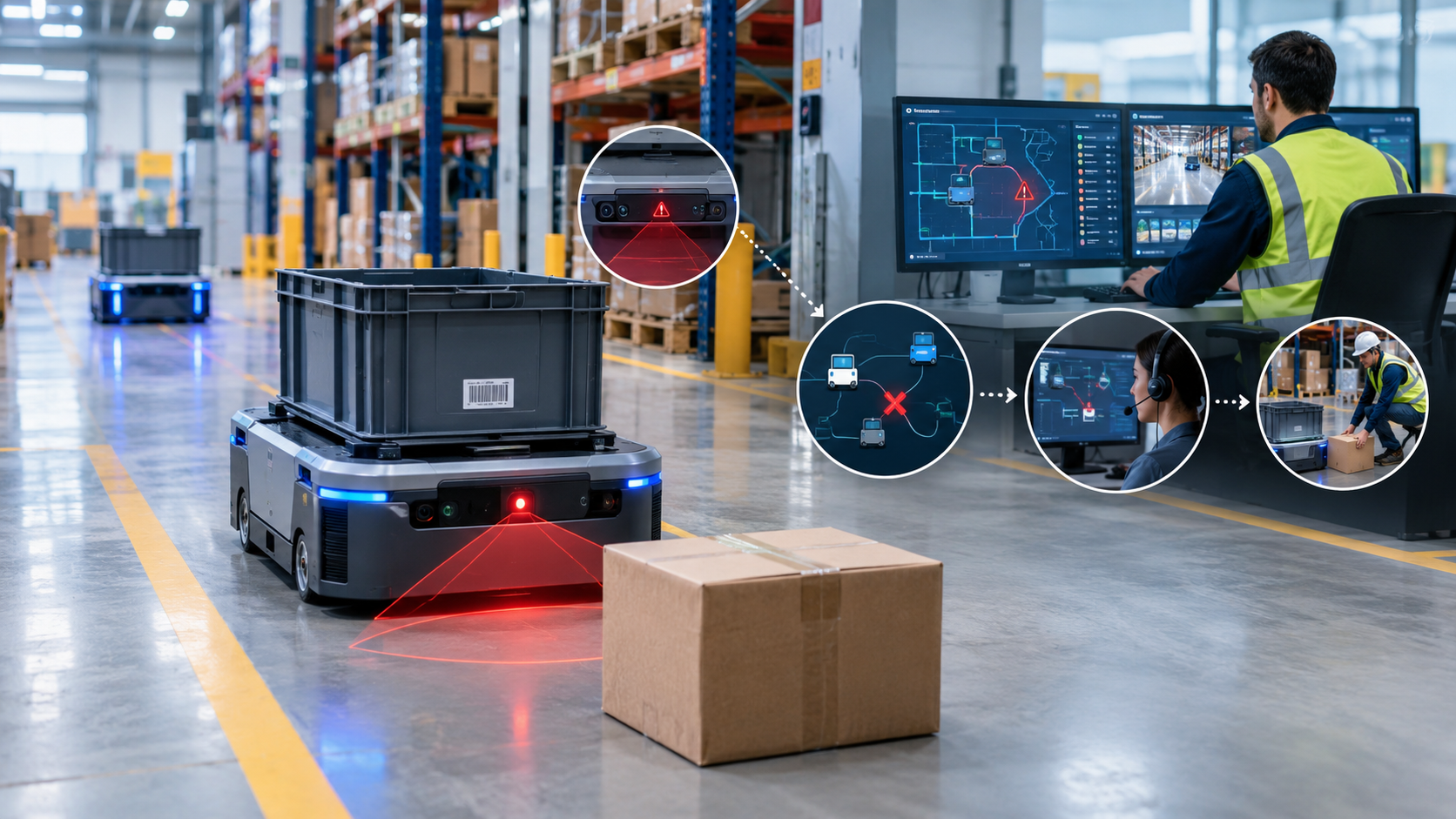
Warehouse robots often fail quietly. They simply stop. A camera can't tell whether a shape is a box or a shadow, or a gripper loses hold of an item it has never seen, and the machine does the sensible thing: it halts and waits. What happens next is the part vendors rarely show in demo videos.
How a robot knows it is stuck
A robot's cameras and depth sensors feed software that estimates what an object is and where it sits. Planning software then turns that estimate into a path or a grasp. When confidence drops, or no safe route exists, a well-designed robot pauses instead of guessing.
A March 2026 research preprint called REPAIR shows the idea in a laboratory setting. Robots work on their own, and only when a failure cannot be recovered does the system ask a remote operator for help. In the authors' tests, this matched fully remote control for easily collectable items while reducing the operator's mental workload. The paper is still under review.
The person on the other end
Once a robot asks for help, an operator typically sees its camera feed and either nudges it with a waypoint or drives its arms directly, then hands control back.
On 5 August 2026, San Francisco startup Avatar Robotics announced a $6.5 million seed round for a business built on this idea: wheeled, semi-humanoid robots in warehouses, guided by remote operators. The company says its robots have packed, sorted and helped ship more than 900,000 products since a December 2025 launch. Those figures come from Avatar's own announcement and are not independently verified. Avatar says the human-led phase is meant to generate the data that improves autonomy over time.
Research points the same way. A July 2026 preprint called HELP tested a setup where two people supervise twelve robots: a teleoperator gives remote corrections and recovery demonstrations, while a floor operator monitors the fleet and physically resets robots. That was a research pipeline, not a commercial warehouse.
When one stuck robot blocks everyone
In a crowded aisle, a stalled robot quickly becomes everyone's problem. In March 2026, MIT and warehouse-automation company Symbotic published a method that learns which robot should get right of way. It prioritises robots about to get stuck and reroutes others before a jam forms. In simulations based on e-commerce warehouse layouts, it delivered roughly 25 percent more throughput than other methods. The researchers say it is still far from real-world deployment.
MIT's write-up explains why this matters: after serious congestion or a collision, a company may have to shut a warehouse for hours to sort things out by hand.
What still goes wrong
Remote rescue only works if the network holds, and a robot that loses its connection mid-task is just a parked machine. Some failures also can't be fixed by video. Someone must walk over and reset the robot, as HELP's floor operator does.
There is also a data problem. A July 2026 preprint, EgoRecovery, notes that failure modes are highly varied, so teaching robots to recover takes far more recovery examples than ordinary success demonstrations.
Finally, the numbers that matter are hard to find. Avatar's announcement quotes products handled, but in the text I reviewed it does not break out how much was done by remote operators and how much autonomously.
The useful question about any warehouse robot, then, isn't whether it is autonomous. It's how often it needs help, how fast help arrives, and whether each rescue makes the next one less likely.