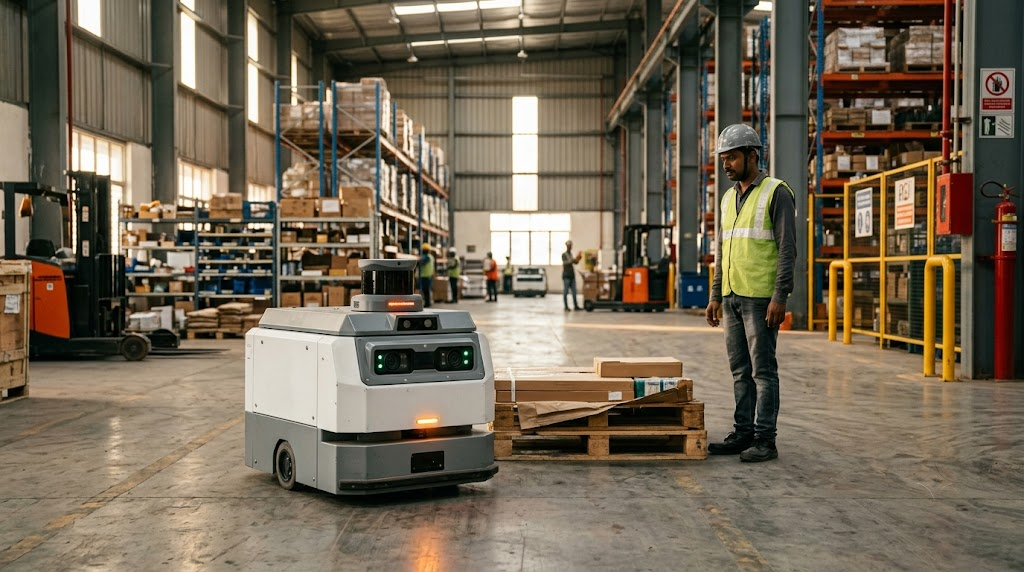
A robot moving through a warehouse may depend on several sensors at the same time. But what happens when one of them suddenly stops working? A camera can fail, a LiDAR unit can become unreliable, or an IMU can produce incorrect measurements. For an autonomous robot, losing reliable information can be as important as losing a motor.
Robots Monitor Their Own Sensors
Autonomous robots do not simply collect sensor data and assume it is correct. Their software can continuously check whether measurements are available and whether different sensors agree.
For example, a mobile robot may compare LiDAR information with camera or IMU measurements. If one sensor suddenly reports something very different from the others, the system can identify the measurement as unreliable.
A 2026 Scientific Reports study on mobile-robot localization specifically examined situations where individual sensing streams become noisy, intermittent or unavailable. The researchers combined LiDAR, vision, GPS, UWB and IMU data and used filtering methods to improve localization when individual measurements became unreliable.
This approach is important because a robot should not blindly trust a sensor that has stopped behaving normally.
Redundancy Gives Robots a Backup
One way to handle sensor failure is redundancy. Instead of using only one sensor to perform a critical function, a robot can use different sensing technologies that provide overlapping information.
For example, a camera might identify a person while LiDAR measures the person's distance. If the camera becomes unavailable, LiDAR may still provide information about an obstacle, although the robot loses some ability to identify what the object is.
Researchers are also developing methods that estimate uncertainty in sensor measurements. A 2026 IEEE Robotics and Automation Letters study combined image and LiDAR information while estimating uncertainty, allowing the system to identify unreliable predictions caused by sensor degradation.
Redundancy does not mean the robot can continue normally after every failure. Sometimes the remaining information is simply not sufficient for safe operation.
Safe Operation Can Mean Slowing Down
When a robot cannot confidently understand its surroundings, the safest response may be to reduce speed or stop rather than continue autonomously.
This is known as graceful degradation: the system moves from normal operation to a more limited operating mode when part of it fails.
For example, a robot could continue at reduced speed if one non-critical sensor fails but stop completely if the failure affects its ability to detect people or obstacles.
Emergency-stop systems provide another layer of protection. ISO 13850 defines principles for emergency-stop functions on machinery, while the 2025 ISO 10218-1 standard specifies safety requirements for industrial robots.
What If Multiple Sensors Fail?
Multiple failures are much more difficult. If a robot loses both its main obstacle-detection sensor and its backup, continuing to move may create unacceptable risk.
This is why modern safety design considers not only whether a sensor works, but also what happens when it does not.
A 2026 Scientific Reports study on industrial robots investigated fault diagnosis and a “channel self-healing” approach for sensor failures, showing the growing research interest in detecting faults and maintaining operation when possible.
However, fault-tolerant systems still have limits. A backup sensor cannot replace every capability of the failed sensor, and software cannot recover information that no remaining sensor can observe.
The Safest Robot Is Not Always the One That Keeps Moving
Sensor failure shows why autonomous robotics is about more than perception and AI. A reliable robot needs fault detection, redundant sensing, safe fallback modes and emergency stopping.
The objective is not to make a robot continue moving at any cost. It is to make sure that when its understanding of the environment becomes unreliable, the robot can recognize the problem and move into an appropriate safe state.
In many situations, that may simply mean one thing: stop and wait for human intervention.