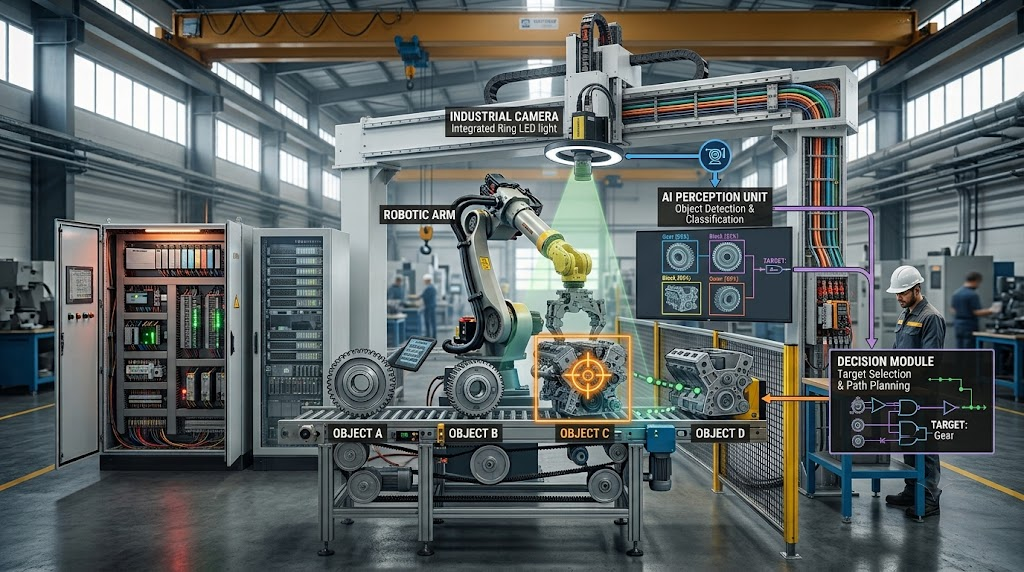
A traditional factory robot can repeatedly pick up the same component and place it in exactly the same location thousands of times. But move that component slightly, change its shape or put an unexpected object in its path, and the robot may not know what to do. This is where AI is beginning to change robotics: instead of programming every possible situation, engineers can train models to interpret what the robot sees and select appropriate actions.
Traditional Robots Follow Rules
Traditional industrial robots are not “stupid.” They can perform extremely precise tasks, but their behaviour is usually defined by carefully programmed instructions.
For example, a robotic arm assembling a component may be programmed to move to specific coordinates, rotate its joints and close its gripper at predetermined points. Sensors and control software can handle known conditions, but the system generally works within a defined range of possibilities.
This approach is highly reliable for repetitive tasks. The limitation appears when the environment becomes unpredictable.
AI Gives Robots Perception
One of AI's most important roles is helping robots understand their surroundings. Cameras can capture images or video, while depth sensors or LiDAR can provide information about distance and 3D shape. Computer-vision models can then identify objects, estimate their position and distinguish between different parts of a scene.
Instead of being told “move to coordinates X, Y and Z,” an AI-enabled robot can receive an instruction such as “pick up the red box” and use its visual information to locate the box and determine how to approach it.
Google DeepMind's Gemini Robotics models demonstrate this direction. Its 2026 Gemini Robotics 2 combines a vision-language-action model with an embodied-reasoning model designed to understand physical environments and plan multi-step tasks.
From Seeing to Deciding
Perception alone is not enough. A robot also needs to decide what to do with what it sees. An AI system can break a task into smaller actions, consider the position of objects and adjust its plan when something changes. For example, if a robot reaches for an object and the object moves, the system can potentially re-evaluate the situation instead of simply repeating the original movement.
NVIDIA's Isaac GR00T platform follows a similar approach for humanoid robotics. Its models can take inputs such as camera video, natural-language commands and the robot's own joint-state information, then produce sequences of robot movements.
AI Does Not Replace Everything
AI is not a replacement for traditional robotics software. A real robot still needs motors, sensors, controllers, safety systems and carefully engineered motion limits.
In many systems, AI operates at a higher level while conventional control software handles precise movements. This separation is important because an AI model may make an incorrect prediction, while low-level controllers need predictable and fast responses.
Safety is another major limitation. A robot working around people cannot simply trust an AI model to make every decision. Collision detection, emergency stops, speed limits and other safeguards remain essential.
The Shift Toward Adaptable Robots
The major change is therefore not that robots suddenly “think like humans.” It is that AI can make robots more capable of handling variation.
Google DeepMind's July 2026 Gemini Robotics 2 update demonstrated capabilities including whole-body control, dexterous manipulation, long multi-step tasks and cooperation between multiple robots. NVIDIA's GR00T 1.7, meanwhile, is being developed as a vision-language-action model that can be adapted to different humanoid robot platforms.
These technologies are still developing and many demonstrations remain research or early-access systems rather than universally deployed commercial robots. The direction, however, is clear: traditional programming tells a robot exactly how to perform known actions, while AI increasingly helps it understand what is happening, what needs to be done and how to adapt when reality does not match the original plan.