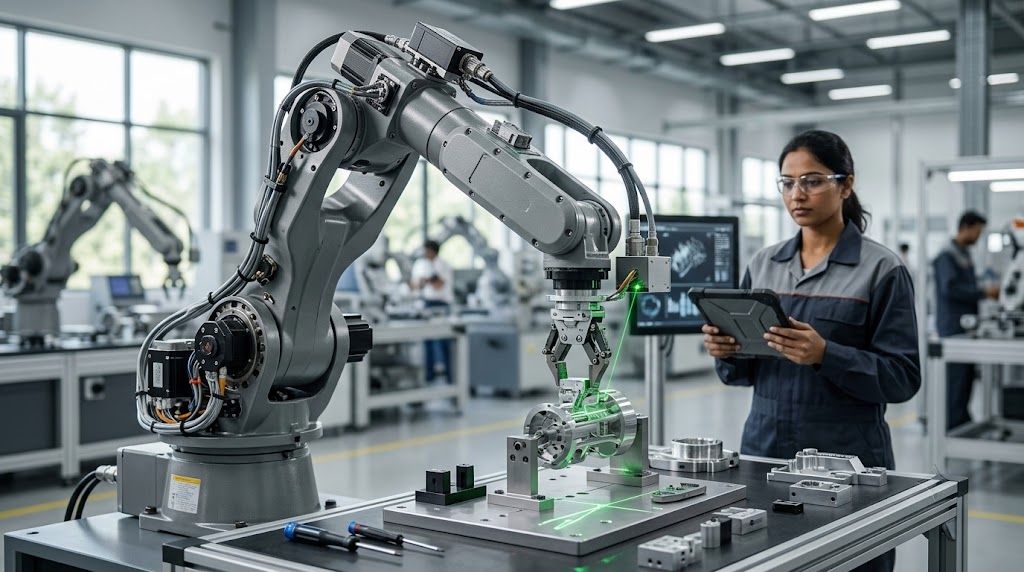
A robotic arm can repeatedly place a component at almost the same position, but getting it to the exact position is a much harder engineering problem. A tiny error at one joint can become a larger error at the tool mounted at the end of the arm. Precision therefore comes from several systems working together rather than from the motor alone.
Motors Provide the Movement
Every joint in a robotic arm needs an actuator, commonly a servo motor, to create controlled movement. The motor turns the joint through a gearbox or transmission, allowing the arm to move with enough torque and speed for its task.
But simply commanding a motor to rotate by a certain amount does not guarantee that the joint actually reaches the intended position. Mechanical backlash, load changes, vibration and deformation can introduce errors.
This is why modern robot arms use feedback rather than relying only on commands.
Encoders Tell the Robot What Happened
An encoder measures the position or movement of a motor or joint. The controller can compare the desired position with the measured position and continuously correct the motor.
This creates a closed-loop control system: command → movement → measurement → correction.
A 2026 study on a 6-DoF robotic arm demonstrated this approach using joint-angle feedback with PID control. Another 2026 study used externally mounted encoders together with laser-tracker measurements to estimate and compensate for robot pose errors under changing loads.
The Controller Coordinates Every Joint
A robotic arm normally has several joints, so the controller must coordinate them rather than move each one independently.
It calculates how individual joints should move to place the end tool at a requested position. This involves kinematics, which describes the relationship between joint angles and the tool's position and orientation.
The controller also has to account for velocity, acceleration, payload and feedback. Research published in 2026 continues to explore improved control methods because robotic arms are nonlinear systems in which movement at one joint can affect others.
Calibration Corrects Hidden Errors
Even with good motors and encoders, a robot's mathematical model may not perfectly match the physical machine. Manufacturing tolerances, joint alignment, tool mounting and mechanical wear can introduce small differences.
Calibration measures these differences and updates the robot's model.
This can make a major difference. In a 2026 Communications Engineering study, a low-cost calibration method reduced mean absolute positioning errors on a Franka robot from about 10 mm to 0.2 mm in the reported experiments. The calibrated robot could also complete tasks with a 0.4 mm tolerance that failed before calibration.
Precision Is a Complete System
The final accuracy of a robotic arm depends on the whole chain: mechanical structure, motors, transmissions, encoders, controller, calibration and the tool attached to the arm.
Even after calibration, temperature, payload, vibration and mechanical deformation can change the robot's behaviour. That is why 2026 research is moving beyond one-time calibration toward real-time error estimation and compensation.
So when a robot places a component within a tiny tolerance, the achievement is not coming from one “precision motor.” It is the result of measurement, feedback, control and calibration continuously working together.