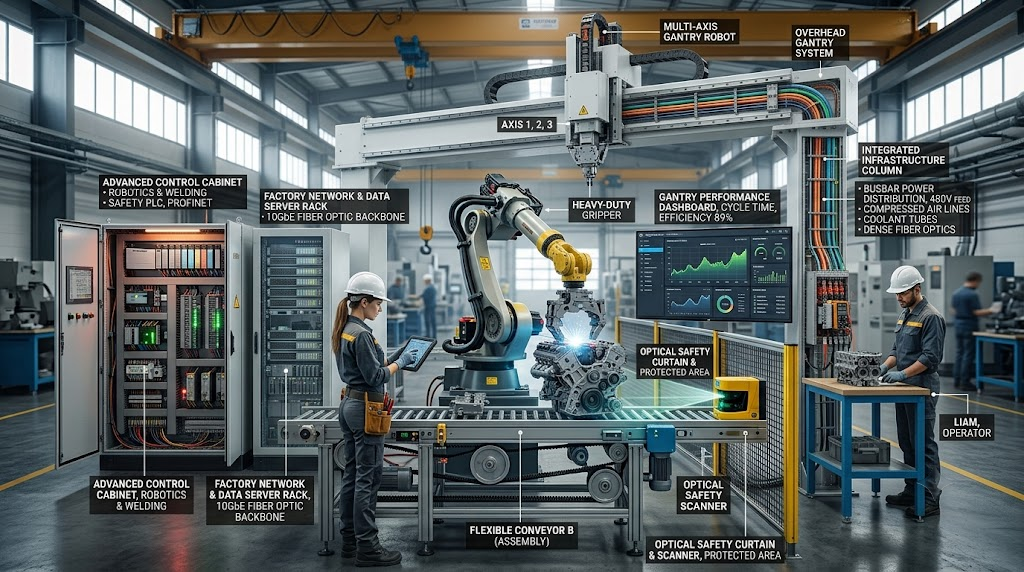
A robot may look like the main machine on a production floor, but it is only one part of the electrical system supporting the process. Robots need power for their controllers, motors and sensors, while the same production cell may also depend on conveyors, cameras, lighting, pneumatic equipment and other machines.
A problem in the electrical supply can therefore affect an entire cell rather than just the robot. Factory designers have to consider reliable power distribution, protection and controlled shutdown procedures according to the equipment and application.
PLCs, Networks and Data Connect the Cell
Industrial robots rarely work completely alone. A programmable logic controller (PLC) can coordinate signals from sensors, conveyors, safety devices and other machines. Industrial communication networks allow these systems to exchange information and coordinate operations.
This connected environment is becoming more important as factories collect increasing amounts of production data. NIST's 2026 roadmap identifies industrial data management and the integration of different sensing and control systems as important challenges for smart manufacturing. The objective is not simply to connect machines, but to make the information reliable and useful for production decisions.
Databases and manufacturing software can record production quantities, inspection results, machine alarms, cycle information and maintenance history. This gives engineers a record of what happened when a problem occurs, instead of depending only on observations from the factory floor.
Safety Has Its Own Infrastructure
A robot cell needs more than a metal fence. Depending on the application, safety systems can include door interlocks, emergency stops, light curtains, scanners and safety-related control functions.
These systems are designed to detect hazardous situations and place equipment into an appropriate safe condition. ISO 10218-1:2025 covers safety requirements for industrial robots, while ISO 10218-2:2025 focuses on robot applications and complete robot cells, including integration, operation and maintenance.
This distinction is important: making the robot itself safe does not automatically make the entire production cell safe. The surrounding machines, movement areas and operating procedures also have to be considered.
Conveyors and Maintenance Keep Production Moving
In many automated factories, the robot is just one step in a longer process. Conveyors or other material-handling equipment deliver parts, position them and move completed products to the next station.
That means a robot can be perfectly healthy and still be unable to work if a conveyor sensor, positioning system or upstream machine fails.
Maintenance is therefore another hidden layer. Engineers can monitor alarms, temperatures, vibration, operating conditions and other signals to identify developing problems. Modern smart-manufacturing research increasingly connects this monitoring with reliability, maintainability and data-driven decision-making.
The Factory Is the Robot's Real System
Automating a factory is not simply a matter of purchasing a robot and programming it. Power, control systems, communication, safety, material flow, data and maintenance all have to work together.
NIST notes that integrating robots with existing devices, sensors and enterprise systems can be difficult, partly because different components may not communicate easily.
The robot may be the most visible machine on the factory floor, but the hidden infrastructure is what allows it to operate safely, repeatedly and at production speed.