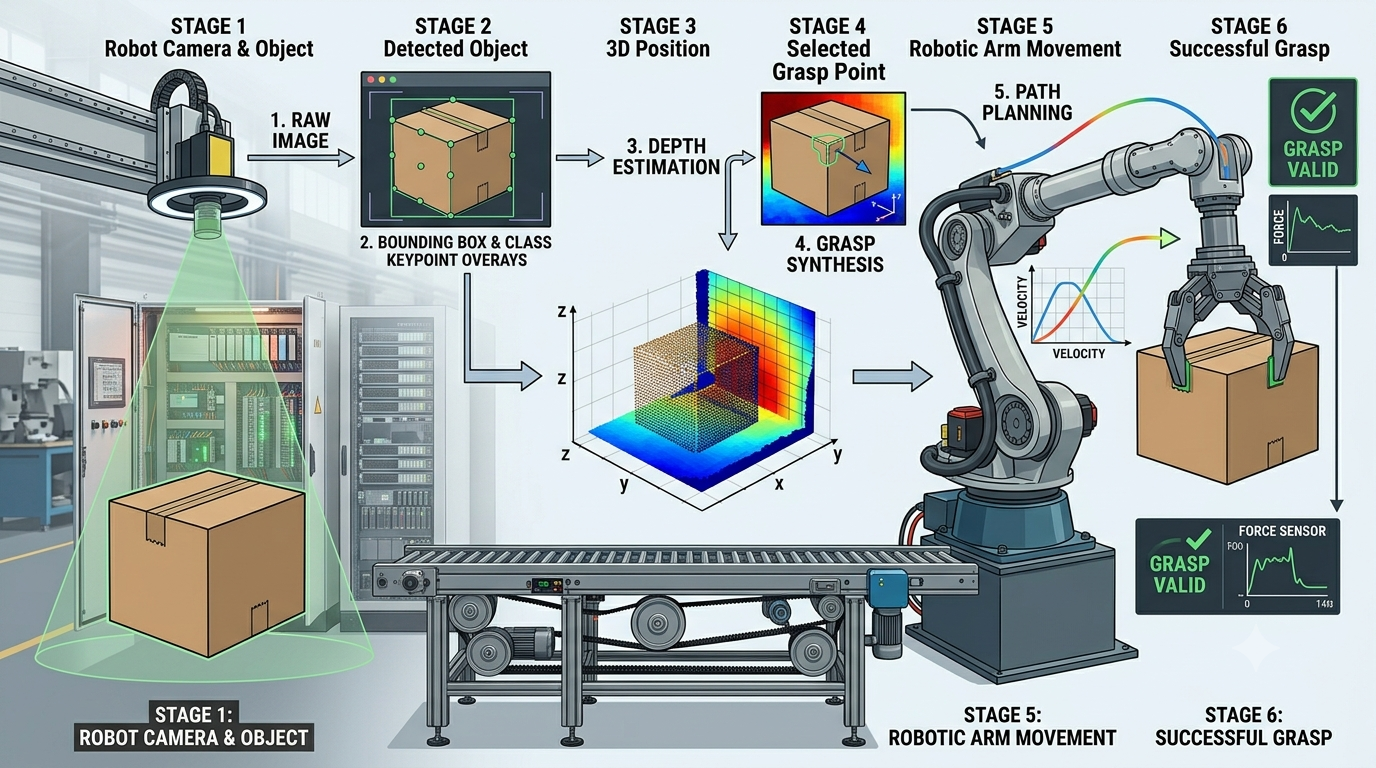
A robot looking at a table does not automatically know which object to pick up or where its hand should go. A camera only provides pixels. Turning those pixels into a successful grasp requires several steps: detecting the object, understanding its position in three-dimensional space, planning a collision-free movement and finally controlling the robot's gripper.
First, the Robot Has to See
Robot vision usually starts with cameras mounted on the robot or above its workspace. A normal RGB camera provides colour and visual details, while depth cameras or LiDAR can provide information about how far objects are from the robot.
Computer-vision software processes these measurements to identify objects. An object-detection model can locate an item in an image and draw a region around it, while segmentation can identify the object's individual pixels.
The robot now knows what it is looking at, but that is only the beginning.
From Pixels to Position
A robot arm cannot move toward “the centre of an image.” It needs coordinates in the physical world.
Depth information helps convert a detected object's image location into a three-dimensional position. The system combines the camera's measurements with its calibration—the known relationship between the camera and robot—to estimate where the object is relative to the robot's arm.
It may also need to estimate orientation. A bottle lying horizontally requires a different approach from one standing upright.
Recent research published in 2026 has demonstrated systems that combine RGB object detection with depth sensing to calculate 3D grasping positions for robot arms. This illustrates the growing connection between computer vision and physical manipulation.
Choosing Where to Grab
Finding an object does not tell the robot exactly where to place its fingers or gripper.
Grasp-planning software evaluates possible grasp points based on the object's shape, orientation and surroundings. A good grasp needs to provide enough contact and stability without colliding with nearby objects.
This becomes particularly difficult when objects are partially hidden or packed closely together. Research such as the 2026 OVGrasp work is exploring open-vocabulary grasping, where robots can identify and manipulate objects they were not specifically trained around.
Turning the Decision Into Movement
Once the robot has a target position and grasp point, motion-planning software calculates how the arm should move. It considers the robot's joint limits, the position of surrounding objects and the required final orientation.
The controller then converts the planned movement into commands for the robot's motors. Sensors continuously provide feedback, allowing the system to check whether the arm is moving as expected.
This creates a pipeline that can be simplified as:
Camera image → Object detection → 3D position → Grasp selection → Motion planning → Motor control → Grasp
Modern AI models are beginning to combine several of these stages. Google DeepMind's Gemini Robotics 2, introduced in July 2026, is a vision-language-action model designed to convert visual and language information into robot actions. NVIDIA's Isaac GR00T platform similarly uses camera input, language instructions and the robot's physical state to generate action sequences.
Why Robot Vision Is Still Difficult
Real environments rarely look as clean as training data. Transparent objects can confuse depth sensors, reflective surfaces can distort measurements and objects can overlap or become partially hidden.
A 2026 study specifically examined transparent-object perception and task-oriented grasping, highlighting how difficult glass and reflective objects remain for vision-based manipulation.
Robot vision therefore is not simply “giving a robot eyes.” The real challenge is turning uncertain visual information into a reliable physical action. A robot must not only recognise an object—it must understand enough about its location, shape and surroundings to interact with it safely.