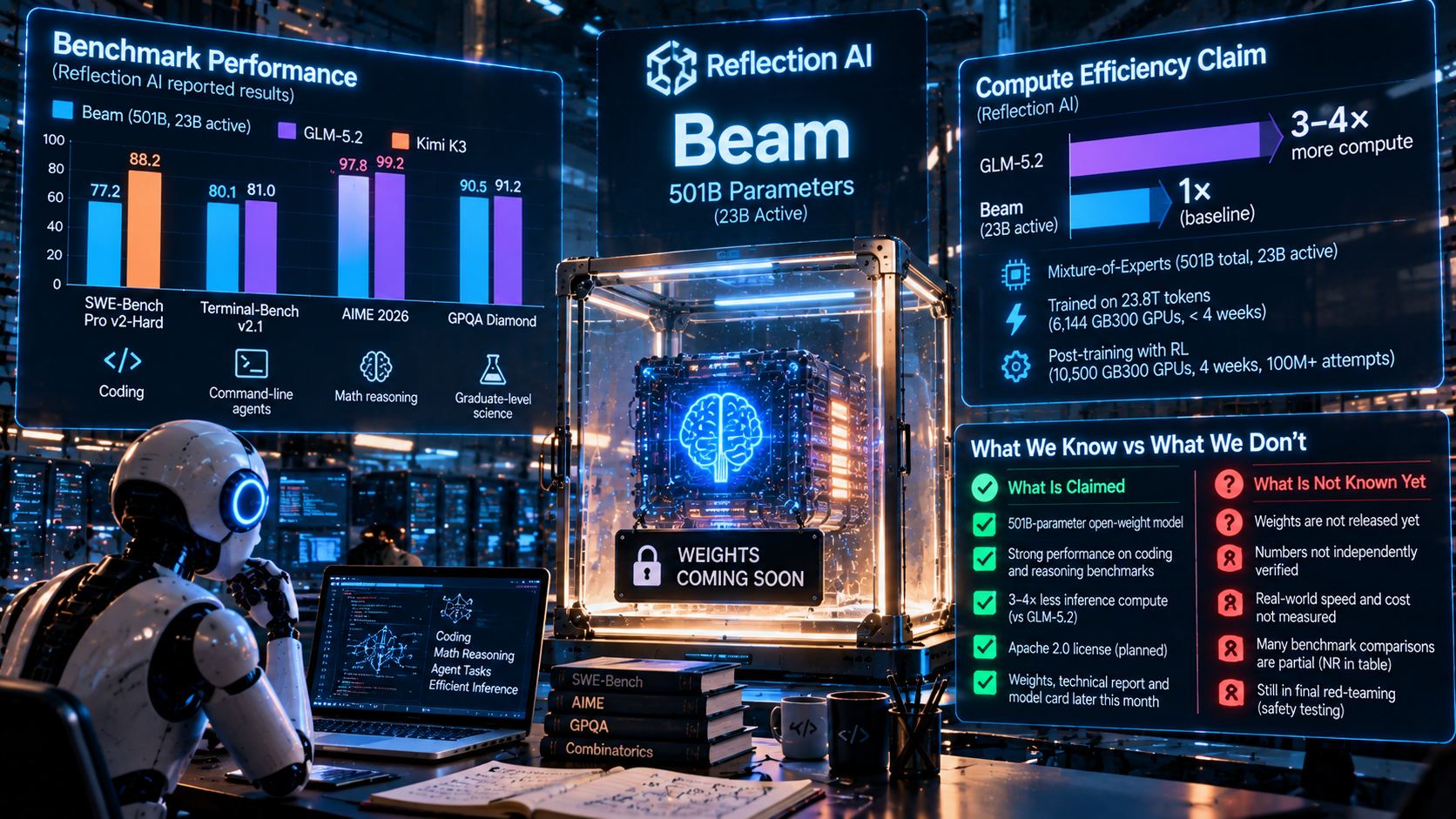
On October 5, 2026, Reflection AI introduced Beam, a 501-billion-parameter open-weight model built for coding and AI agents. Reflection is a US startup backed by Nvidia. Its pitch is simple. Beam matches Z.ai's GLM-5.2 on advanced reasoning tests while using three to four times less inference compute. Inference compute is the computing power needed each time a model answers.
There is a catch. Reflection says it will release the weights, a technical report, and a model card later this month. Until then, nobody outside the company can check these numbers. TechCrunch noted that the claims have not been independently verified.
What Beam Is
Open-weight means the trained model files will be public, so anyone can download and run them. It does not mean the training data is public. Reflection plans to use the Apache 2.0 license, which allows commercial use.
Beam is a mixture-of-experts model. It has 501 billion parameters in total, but only 23 billion are active for each token, which is a small chunk of text. Think of a team of specialists where only a few work on each word. That keeps each answer cheaper than a dense model of the same size.
Reflection says it pretrained Beam on 23.8 trillion tokens using 6,144 Nvidia GB300 chips in under four weeks. It then used reinforcement learning, where the model practices tasks and gets scored. That run used 10,500 GB300 GPUs for four weeks and produced over 100 million attempts. Reflection calls it one of the largest such runs by an open lab. That is the company's own claim.
Beam is not fully available yet. It is in final red-teaming, a safety testing stage, and early access is through a waitlist.
The Scores Reflection Reports
Reflection reports 77.2 on SWE-Bench Pro v2-Hard, 80.1 on Terminal-Bench v2.1, 97.8 on AIME 2026, and 90.5 on GPQA Diamond. The first two test coding and command-line work. AIME is a math competition. GPQA Diamond is a graduate-level science quiz.
Read Reflection's own table closely. Beam scores below GLM-5.2 on Terminal-Bench (81.0), AIME (99.2), and GPQA Diamond (91.2). It trails Kimi K3 by a wide margin, such as 88.2 on SWE-Bench Pro v2-Hard. Reflection admits that Kimi K3 is ahead on raw capability. Its argument is efficiency, not the top score.
Many cells in the table say NR, for not reported. GLM-5.2 has no listed score on SWE-Bench Pro v2-Hard, so the head-to-head is only partial. Reflection also says it took other models' results for its efficiency chart from Artificial Analysis and DataCurve.
How the Efficiency Claim Works
The three-to-four-times claim is the most important one, so it helps to see how it is built. Reflection estimates compute as roughly two times the active parameters times the average number of tokens written per attempt. The company says this is an approximate comparison, not a measured cost. It leaves out reading the prompt, attention, and serving overhead.
In plain words, a model looks cheap on this math if it is small or writes fewer tokens to solve a task. Beam is small in active size, and Reflection says it trained the model to avoid wasted tokens. That may be true. But a calculation is not a bill. One review said the claimed savings have yet to be shown in dollars or time. The claim also covers advanced reasoning benchmarks, not every coding job.
Why It Matters and What Could Come Next
Axios reports that the most powerful open-weight models are almost all made in China. It also says banks and the Pentagon often avoid Chinese models over security risks. Beam is pitched as a Western option. Nvidia backs Reflection and also sells the chips these models run on, so it benefits if open models spread.
In the near term, the weights are due later this month. Then outsiders can run Beam, measure real speed and cost, and test the scores themselves. Reflection also promised safety evaluations. Axios reports that other Western open-weight models are due this month too, so Beam will face quick comparisons.
The long-term picture is speculation. If the efficiency claim holds, companies that avoid Chinese models could run strong coding agents on less hardware. If it does not, Beam is still a large open model, but not a breakthrough. Either way, the gap between a company's chart and independent proof is the real story.