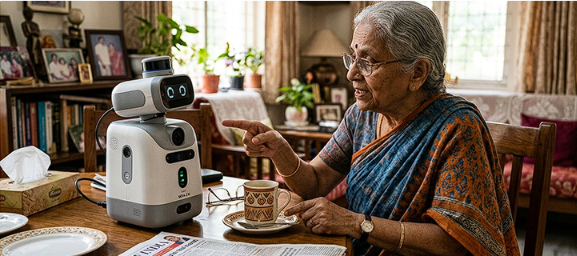
For an elderly individual recovering from surgery at home, operating a service robot using a complex smartphone app or rigid keyboard syntax is frustrating and impractical. However, pointing toward a pill bottle on a bedside table while saying "bring me that" is completely natural. Combining speech with pointing gestures creates an intuitive communication channel that requires zero technical training
The communication gap in assistive healthcare robotics
Traditional human-robot interaction (HRI) interfaces force human operators to adapt to machine constraints. Wearable mixed-reality (MR) headsets (such as Apple Vision Pro) provide high tracking accuracy but present heavy learning curves, eye strain, and physical discomfort for senior citizens. Conversely, speech-only interfaces suffer from spatial ambiguity: asking a robot to "fetch the cup" fails when multiple cups populate a room.
How deictic ray-casting and voice fusion work together
Natural Multimodal Fusion (NMM-HRI) solves spatial ambiguity without requiring head-worn hardware. An overhead RGB-D camera tracks the user's elbow and wrist joints in 3D space, projecting a mathematical pointing ray vector into the room. Simultaneously, an Automatic Speech Recognition engine transcribes spoken instructions. By calculating the angular alignment between the pointing ray and surrounding object candidates, the system identifies the target item with high precision.
Resolving spatial ambiguity with open-vocabulary vision
To operate in cluttered home environments without pre-programmed item catalogs, the system pairs deictic pointing scores with YOLO-World, a real-time open-vocabulary object detector. The visual detections and user intent are passed to a fine-tuned Large Language Model engine, which parses the combined multimodal context and generates deterministic, safe Python execution scripts for the robot arm.
Relevance to Indian healthcare and elderly care infrastructure
India's demographic landscape is experiencing a steady rise in senior citizen populations requiring daily living assistance. In Indian households characterized by joint family structures, varied ambient noise, and multilingual code-switching (e.g., mixing Hindi or regional terms with English), contactless voice-posture interaction provides a low-cost, non-intrusive assistive tool that requires no literacy or digital literacy prerequisites.
Leading Indian Robotics Companies & Commercial Products
Leading Indian Robotics Companies & Commercial Products In the Indian automation landscape, domestic technology pioneers are advancing human-robot interaction across healthcare, logistics, and food automation:
Addverb Technologies (Dynamo & Zippy): Indian robotics innovator developing collaborative mobile robots with intuitive multimodal vision-guided navigation and voice interface systems for industrial and hospital supply logistics.
Gridbots Technologies (RoboVision Assist & Saathi): Healthcare and industrial robotics company manufacturing vision-guided assistive platforms that integrate contactless optical posture tracking for surgical and domestic care support.
Mukunda Foods (Bailley & Dosamatic): Food automation startup engineering commercial kitchen robotics featuring simplified multimodal voice-and-touch interfaces for elderly care and commercial service environments.
Practical limitations: acoustic noise, lighting, and safety guardrails
In field trials, multimodal fusion systems encounter environmental noise. High acoustic noise (above 70 dB) degrades speech recognition accuracy, while harsh sunlight or deep shadows can perturb optical skeleton tracking. Implementing hardware-level collision detection and fallback safety boundaries ensures that the robot arm halts immediately if intent confidence drops below safe operating thresholds.
Ethical governance and field deployment standards
Beyond technical precision, contactless multimodal interaction raises essential governance considerations for domestic deployment. Assistive robots operating in private living quarters must comply with strict privacy standards regarding continuous visual and acoustic surveillance. Storage of camera feeds or biometric joint vectors is prohibited under regional data protection frameworks; all posture estimation and audio parsing are executed entirely on edge hardware without cloud telemetry transmission. Furthermore, establishing multi-layered physical safety protocols guarantees that service manipulators maintain soft joint compliance when moving near human users. By combining lightweight structural materials, proximity sensor slowdowns, and instant emergency speech-cancellation triggers, contactless multimodal fusion delivers a safe, dependable robotic assistant tailored for real-world domestic healthcare.