Picking up a cup is easy for most people, but cleaning an entire toilet is much harder for a robot. It needs to move, hold cleaning tools and complete several steps without making mistakes.
A team of researchers has developed a low-cost toilet-cleaning robot to test how well today's AI models can handle this task. Their study was shared on November 11, 2026.
What Did the Researchers Build?
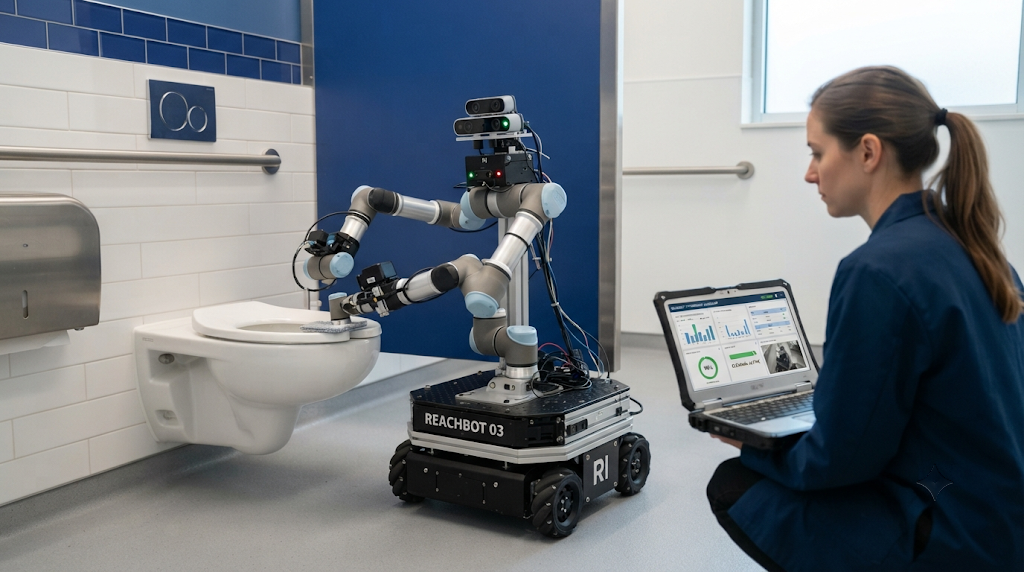
Sven Schreiber and six other researchers developed a robot with two arms, a wheeled base and cameras.
They used a TurtleBot 4 base and two LeRobot SO-101 robotic arms.
The team collected 250 real-world demonstrations. During these demonstrations, people showed the robot how to perform the cleaning task.
The researchers then tested four AI models: π₀, π₀.₅, SmolVLA and GR00T.
These models help robots understand camera images and instructions before deciding how to move.
How Does the Robot Clean a Toilet?
Cleaning a toilet involves several steps.
First, the robot moves into the correct position. Then it uses its arms to handle cleaning tools and remove dirt.
The robot must complete each step properly before moving to the next one.
For example, if it drops a sponge or gets stuck, it may not finish the task.
The researchers also tested extra features to help the robot remember its progress. However, these features did not improve its performance.
How Well Did the Robot Perform?
The researchers tested each AI model 20 times, except GR00T, which was tested only five times.
The best-performing model was π₀.
It completely cleaned the dirty area in 60% of its attempts. This means it succeeded in 12 out of 20 tests.
When small leftover spots were allowed, its success rate increased to 70%.
With limited human help, the success rate reached 90%.
However, these results came from a small number of tests and need further checking.
What Problems Did the Robot Face?
The robot faced several problems during cleaning.
Sometimes it got stuck under the toilet seat. In other cases, it dropped the sponge or failed to move to the next step.
The GR00T model failed all five of its attempts.
Even the best model failed in 40% of the tests under strict scoring rules.
The study used only one robot, one toilet and one cleaning task.
This means the results do not prove that the robot can clean different bathrooms reliably.
What Happens Next?
The researchers believe more training examples could help robots perform longer tasks.
Their robot also uses 3D-printable parts and ROS 2 software, which may help other researchers build similar systems.
Future studies need to test different bathrooms, cleaning tools and situations.
This research shows that robots are improving, but they still struggle with everyday jobs that people find simple.
A robot that cleans a toilet once is interesting. A robot that can clean it correctly every day would be much more useful.