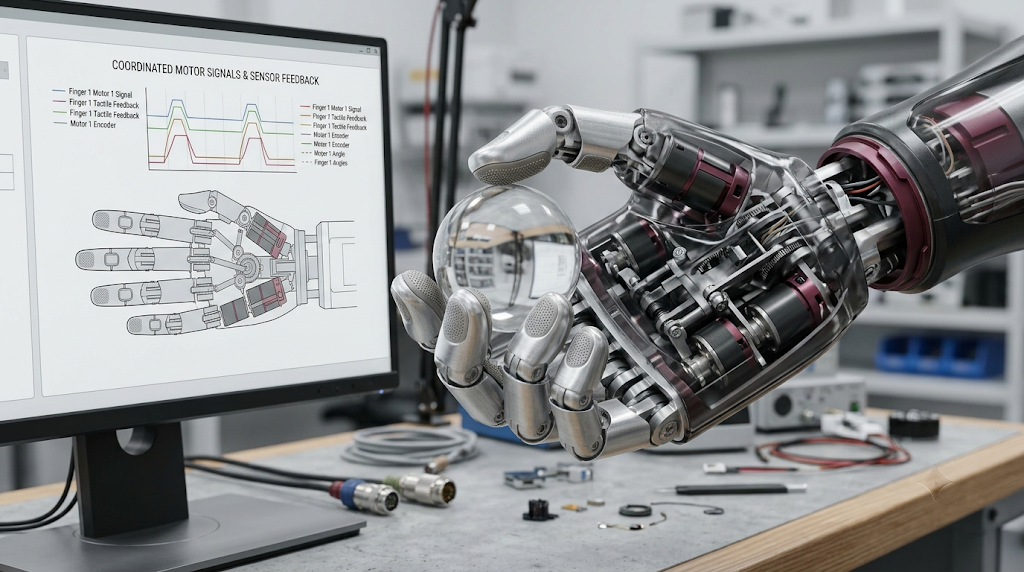
Imagine a robot holding a glass that suddenly starts slipping. Its fingers must react quickly before the glass falls. At the electronica 2026 event, Inova Semiconductors and Lattice Semiconductor showed a new motor control system for humanoid robot hands. They developed it with help from the German Aerospace Center (DLR).
The system connects 18 motors and 10 touch sensors through one network. The companies say it can help robot fingers react much faster.
What Did the Companies Develop?
The companies introduced a demonstration system for a robotic hand with 18 motors.
It is not a finished robot or a product available for sale.
Inova provided its APXpress communication technology, while Lattice supplied special programmable chips called FPGAs.
DLR's Institute of Robotics and Mechatronics helped with the research.
The main goal is to make robot fingers move quickly and work together smoothly.
How Does the System Work?
Think of a robotic hand like a team of workers. Every finger needs instructions at the right time.
The new system sends motor instructions 10,000 times every second. Each round takes just 100 microseconds.
According to the companies, communication takes less than 10 microseconds.
This means the system can collect information and update motor movements during the same round.
The motors are also connected in a chain, which helps reduce the number of wires.
Touch sensors use the same network, but their information follows a different schedule. This helps important motor instructions arrive on time.
How Is It Different From Other Robot Hands?
Many robotic hand systems update their movements around 1,000 times per second.
The new demonstration uses a faster cycle of 10,000 times per second.
However, fast robot hands already exist. Earlier DLR research showed systems with even faster control loops.
The interesting part of this demonstration is that all 18 motors and the touch sensors can communicate through one network.
Still, speed alone cannot make a robot hand better. It also needs good sensors, proper grip strength and software that understands what to do.
What Are the Limitations?
The companies have shared impressive numbers, but independent researchers have not yet confirmed them.
There are also no published results showing how well the hand holds objects, how much electricity it uses or how long it can work without problems.
The demonstration used early versions of APXpress chips.
Robot manufacturers would also need to adjust the technology for their own designs.
What Happens Next?
Inova plans to continue developing chips based on this network technology.
The next important step is testing the system in real robotic hands.
Researchers need to check how quickly the fingers react when objects slip and whether the system works reliably for long periods.
This technology could help improve humanoid robot hands. But faster communication does not automatically mean better robots.
Real-world testing will show how useful the system actually is.