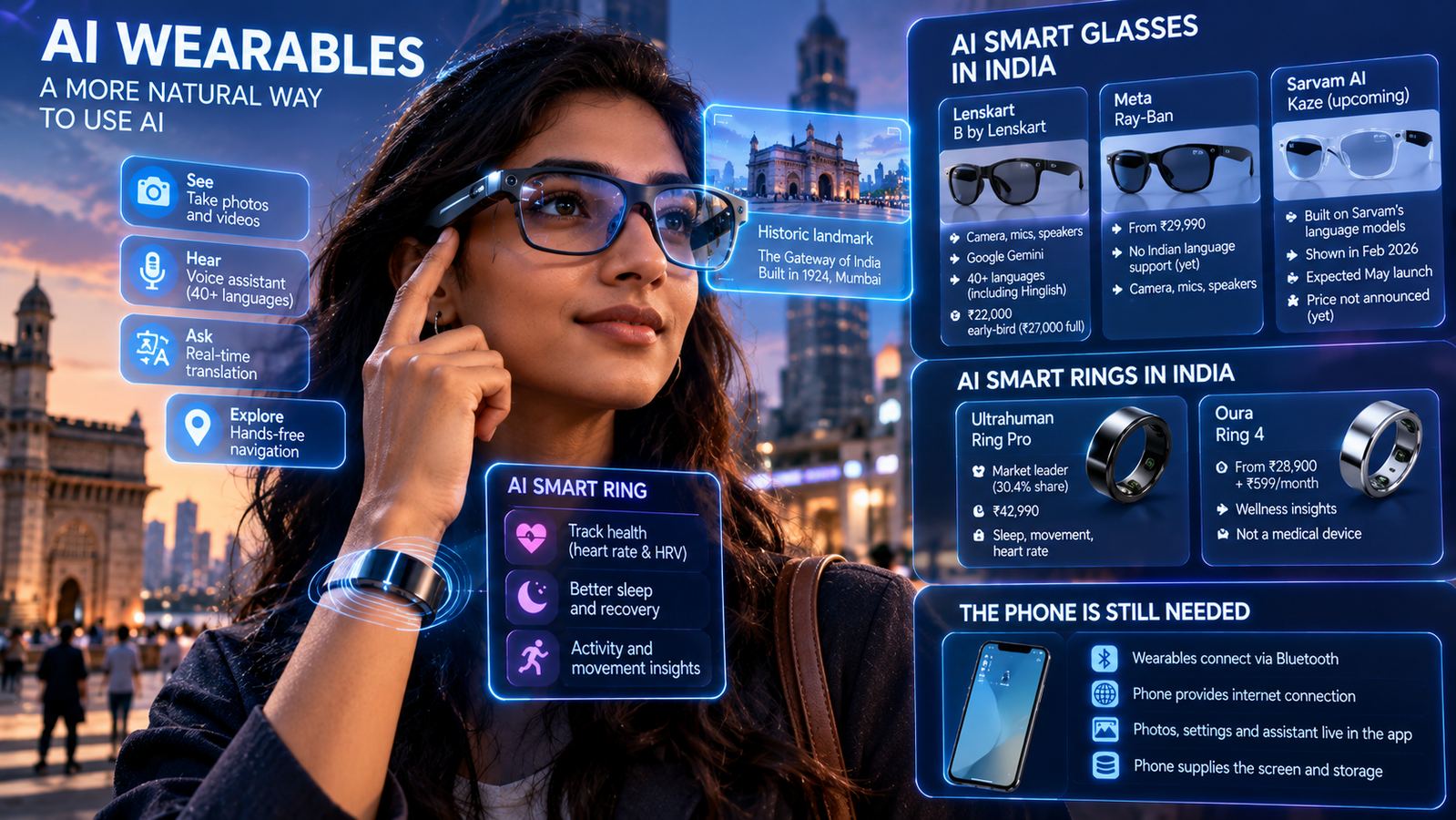
More than 35,000 people signed up for B by Lenskart's smart glasses before anyone outside the company could buy a pair. Lenskart opened its early-access list on 31 March 2026 and had passed that number by 12 May, with an early-bird price of ₹22,000 against a full price of ₹27,000. The glasses have no screen. A camera, microphones and small speakers sit inside an ordinary-looking frame, and you talk to an AI assistant instead of tapping a display.
That idea is now being pitched from faces and from fingers. Here is what is confirmed, what is still only promised, and what “replacing the phone” would take.
Glasses came first, and Indian brands are undercutting the imports
Meta's Ray-Ban glasses went on sale in India on 19 May 2025 from ₹29,990, without support for any Indian language, which limited their use at home. Meta followed in February 2026 with the sports-focused Oakley Meta Vanguard, from ₹52,300, and its app now offers Hindi. Lenskart's B is the first serious local answer: a 40-gram frame with Google's Gemini assistant, which Lenskart says handles more than 40 languages, including Hinglish. Sarvam AI, a Bengaluru startup, showed its Kaze glasses at the India AI Impact Summit in February and said they would launch in May on its own language models. Its website still carried a waitlist sign-up when we checked, and we found no published price. Reliance Jio's “JioFrames” have been tipped for December, but that is a report, not an announcement.
The phone is still doing the heavy lifting
“Replace the phone” is the industry's slogan, not a feature of anything now on sale. B by Lenskart connects over Bluetooth, the short-range wireless link, to an Android 12 or newer phone or an iPhone on iOS 18 or newer, and its app is where photos, settings and the assistant live. The glasses take over the microphone, camera and speaker. The phone still supplies the internet connection, the screen and the storage. Sarvam has not published Kaze's battery life, camera resolution or price, so its promise stays a promise for now.
Rings are the quieter wearable, and the one with real market data
Smart rings are already an established category here. Ultrahuman, a Bengaluru company, led it last year with a 30.4 per cent share, according to IDC figures reported by TechCrunch. Oura, the Finnish brand, entered India in March 2026 with the Ring 4 from ₹28,900 plus a ₹599 monthly membership, while Ultrahuman's newer Ring Pro is priced at ₹42,990. The “AI” in a ring is mostly software that reads sleep, movement and heart-rate data and turns it into suggestions. Makers' claims about battery life and health predictions are company figures until independent reviewers have worn the final hardware for weeks. These are wellness tools, not medical devices.
A camera on your face raises questions no spec sheet answers
Lenskart's glasses switch on an LED whenever the camera is recording, a sensible safeguard, though a small light is easy to miss in a crowded room. Social habits around wearing a camera in public haven't formed yet. There is also the data: voice and image queries usually go to cloud servers, so what a company stores, and for how long, matters as much as what the device can do. We didn't find that spelled out in the launch material for either Lenskart's or Sarvam's glasses.
So, will anything replace the phone?
Not yet, and probably not as a single device. The likelier picture is a phone that stays in the pocket more often: glasses for quick questions, translation and photos, a ring for sleep and recovery. What is new in India is that local languages, prices under ₹30,000 and engineered-in-India claims are part of the pitch from the start. Whether Kaze and JioFrames arrive as promised, and whether Lenskart's rollout widens, will decide if this stays a waitlist story. The real test is a dull one: who is still wearing these six months later.