Stuck to the Wall, Not to the Old Way: How Climbing Robots Inspect Bridges, Tanks and Towers
Magnets grip steel and suction grips concrete. In 2026, climbing robots carrying ultrasonic and camera payloads completed real inspections, though human crews are still in the loop.
A 200-meter chimney, a bridge pier over water and a steel tank holding hazardous material all pose the same problem. Getting an inspector close enough to check them is slow, costly and risky. Wall-climbing robots now do part of that job. They cling to the surface, carry sensors and bring back data that rope teams and access lifts once gathered by hand. In 2026 they were working on both concrete and steel, but they still work alongside people rather than replacing them.
Magnets for Steel, Suction for Concrete
How a robot sticks decides what it can climb. Magnetic wheels suit steel. A 2026 paper in Communications of the IBIMA says magnetic climbers are built for ferromagnetic structures where manual access is hazardous, costly or impractical. Research on industrial storage tanks describes a robot with magnetic wheels and a mechanism that adapts to changing wall curvature, so it keeps its grip on curved walls.
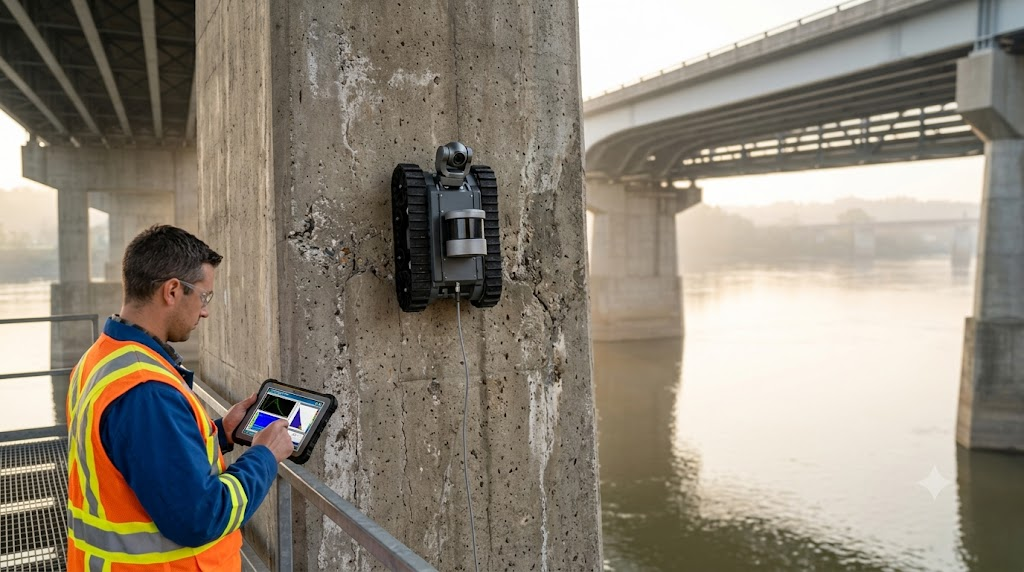
Concrete is not magnetic, so those robots rely on suction instead. HausBots’ crawler creates low-pressure zones under its chassis, which lets it hold vertical and overhead surfaces, including rough, porous concrete. A newer approach is aimed at tight spaces. A January 2026 paper describes small climbing robots that use acoustic adhesion to cross gaps, right-angle corners and curved surfaces, and it demonstrated them inside retired aircraft engines.
The Robot Is the Carrier; the Sensors Do the Inspecting
Climbing is only half the job. Gecko Robotics says its wall-climbing robots carry payloads that check wall thickness, cracking, pitting and other degradation on tanks, boilers and piping. Its best-known TOKA series uses magnetic wheels to drive up steel walls while carrying ultrasonic and other sensors.
Software matters just as much now. A 2026 study reported a crack-width relative error of 0.53% for a real-time segmentation network running on a negative-pressure climbing robot, and Hoban Construction completed a demonstration of an AI-based exterior wall crack inspection robot in May 2026. The robot can now find, measure and log a defect in one pass.
What 2026 Field Work Showed
At an EDF site, a HausBots robot carrying ACS’s MIRA ultrasonic tomography system completed the full range of non-destructive tests on a 200 m concrete chimney, with high-quality scans at each test location. The project also removed the need to work at height.
On bridges, ENR reported in May 2026 that engineering firm Wiss, Janney, Elstner Associates is using the HB3 crawler, which was tested on the Chicago Skyway piers. A rainy-weather bridge inspection in Louisiana was faster, safer and more reliable with the robot, though the team still used a truck for close-up checks and used the robot for continuous scanning.
Which Claims Need Careful Reading
Many performance figures come from vendors or forecasters. Gecko says its robots finish inspections about 10 times faster than older methods, but its own materials quote different data multiples (100x on one page, 1,000x on others). Treat those as company claims. A vendor article on aircraft inspection likewise says one technician can scan a narrowbody fuselage in under 90 minutes, which is also an unverified claim.
Market numbers are projections, not measurements. Mordor Intelligence values the wall-climbing inspection robot imaging market at USD 126.49 million in 2026, rising to USD 249.14 million by 2031. Cost figures can also date quickly. A 2018 report put Gecko’s robots at $50,000 to $100,000 each, so current prices may differ.
The limits are physical too. Magnetic robots need steel, and the EDF chimney work was a field test of viability rather than routine practice. As the Louisiana example shows, inspectors still handle close-up checks.
What Comes Next
The likely shift is from one-off scans to repeat data. If each inspection is geotagged and stored, owners can compare the same spot year to year and catch slow deterioration earlier. How fast that happens depends on how well robots grip rough or curved surfaces, how accurate the AI crack tools prove outside demonstrations, and how readily asset owners accept robot-collected data for maintenance decisions.