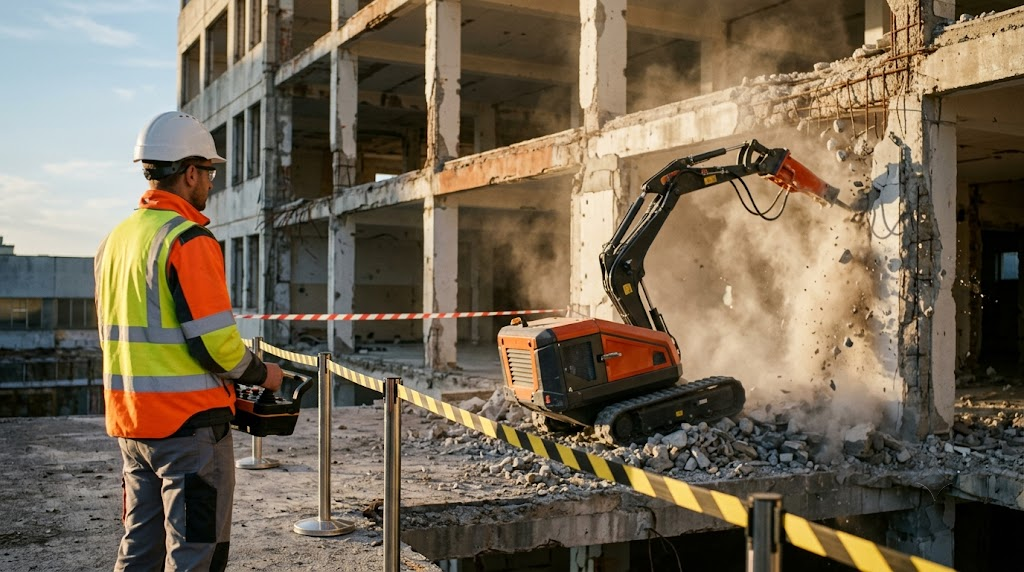
Pulling down an old building is among construction’s most dangerous jobs. Floors can give way, walls can fall without warning, and dust hides hazards. Remote-controlled demolition robots keep workers outside the danger zone. As of 8 October 2026, the machines are more powerful, and extreme versions are being tested in Fukushima. How much safer demolition has become is less certain.
Operators at the Console, Not Under the Ceiling
A demolition robot is a compact tracked machine with an arm and a hydraulic tool such as a breaker, crusher or shear. Husqvarna says its DXR remote controls let operators work from up to 300 meters away and report live machine status such as temperature and active faults. A 2022 launch article cited a range of 328 feet, about 100 meters, so manufacturer figures differ. The same article says the robots run on electric power with lithium-ion batteries, and their outriggers expand to create a large, stable footprint.
Independent evidence supports the ergonomic case. The construction safety group CPWR says the robot eliminates the need for workers to operate pneumatic tools by hand, reducing hand-arm vibration and overhead work. That is a health benefit. Remote operation does not make a weak building stable, so engineers must still plan the demolition sequence. That point is my inference.
The 2026 Machines Behind the Breaking
Brokk and Husqvarna are the best-known makers. Brokk unveiled the Brokk 130+ at CONEXPO-CON/AGG in March 2026, with a new BHB 175 breaker it says delivers 20% more hitting force and 40% higher impact frequency. Water jets are an alternative to impact. Brokk’s North American distributor also handles Aquajet hydrodemolition equipment.
Fukushima: Remote Demolition at the Edge of Human Reach
Nuclear decommissioning is not ordinary demolition, but it shows where remote work goes. In February 2026, TEPCO unveiled a 22-meter robot arm weighing about 4.6 tonnes for a third debris removal trial, with about 880 tonnes of hazardous material remaining and full-scale extraction delayed until at least 2037. On 2 October, TEPCO began inserting a remote-controlled arm into the No. 2 reactor containment vessel to prepare another retrieval attempt next year. In February the trial was planned for later this year, so the schedule appears to have slipped. The two trial retrievals so far recovered samples weighing just under 0.7 grams and 0.187 grams, about 0.9 grams combined, against roughly 880 tonnes still in the reactors.
What Is Proven, and What Is Only Promised
Working products versus demonstrations
Brokk and Husqvarna machines are commercial products sold to demolition contractors. The Fukushima arms are purpose-built for one site and remain in trials, with about 0.9 grams of debris recovered so far.
Research prototypes versus commercial systems
I found no source confirming fully autonomous demolition robots in commercial use. The machines described here are controlled by a person. The Fukushima arm is a trial system.
Company claims versus verified results
The 20% and 40% figures are Brokk’s own. The remote-control ranges are Husqvarna’s own and differ between sources. CPWR independently supports the ergonomic benefits. I found no independent study showing fewer collapse injuries. The Fukushima schedule comes from TEPCO statements as reported.
Near-term versus long-term
Near-term, expect more powerful, connected machines doing selective, indoor and high-risk demolition. Robots that survey an unstable building, plan the work and demolish it on their own are long-term speculation.
What Safer Building Removal Could Lead To
If remote machines become standard for risky jobs, workers shift from swinging breakers to supervising them, and old, fragile structures become cheaper to remove safely. Watch for independent injury data, rules requiring remote methods on unstable buildings, and whether any maker proves autonomy beyond a demonstration.
Editor’s Takeaway: Remote demolition robots clearly remove workers from the point of impact, and 2026 brought stronger machines. But the evidence for fewer fatalities is thin, and autonomy is unproven. Check who measured the safety gain and which jobs the machine suits.