How Robots Are Changing Indian Factories and Warehouses
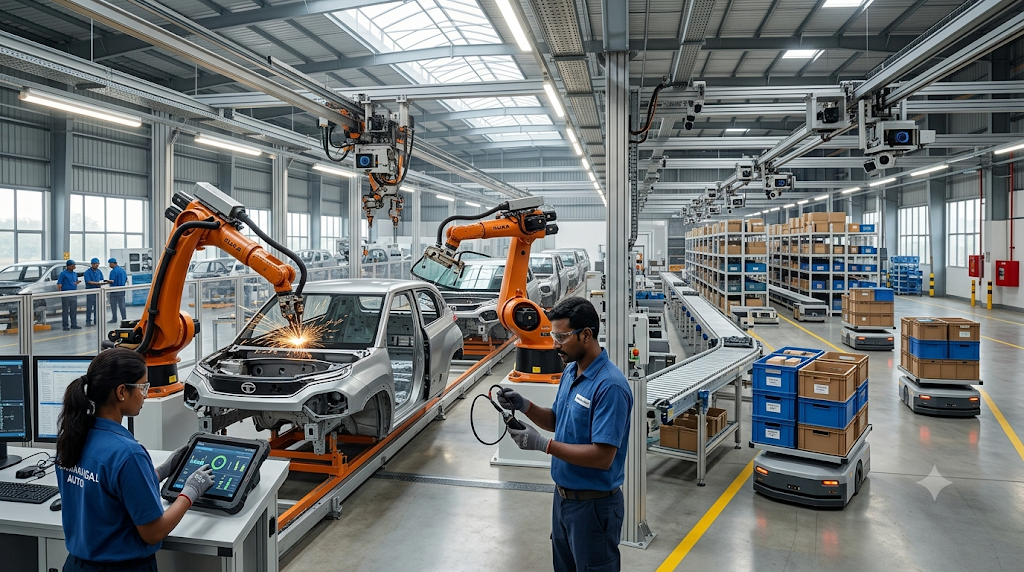
Walk into a modern automobile factory in India and you may find robotic arms performing welding, assembly, painting and material-handling tasks while people manage production and inspection. In warehouses, autonomous mobile robots can move goods and cartons with less manual transportation.
In 2026, robotics in India is becoming more connected with artificial intelligence, machine vision, collaborative robots, warehouse software and Physical AI.
From Robotic Arms to Mobile Robots
Industrial robotic arms remain important in Indian factories. They are used for welding, painting, assembly, machine tending and material handling where accurate and repetitive movements are required.
Factories are also combining robots with sensors, cameras and software. Maruti Suzuki's Kharkhoda facility is an example, using its Suzuki Smart Factory approach and human-aware collaborative robots.
Warehouses use a different type of automation. Autonomous mobile robots (AMRs) can move through indoor environments and transport goods. Automated storage systems, robotic sorters and autonomous forklifts are also becoming part of warehouse automation.
Why Companies Are Investing in Automation
Automation is not only about replacing workers. Robots can perform repetitive tasks consistently and reduce physically demanding work.
In warehouses, mobile robots can transport cartons and materials, allowing workers to focus more on picking, packing, inspection and supervision.
Companies are also looking for better productivity, consistent quality and more efficient use of their facilities.
Software Is Becoming Important
A robot cannot operate effectively without instructions and coordination.
Modern warehouses combine robots with software that manages inventory, orders, robot movement and equipment. Fleet-management systems can help coordinate multiple robots and plan their tasks.
This means modern automation is becoming a combination of robots, software, sensors and data, rather than just a single machine.
AI Is Changing Robotics
Artificial intelligence is one of the major robotics trends in 2026.
AI can help robots recognize objects, understand sensor information and respond to changing environments. In warehouses, AI can support vision-based recognition, route planning and task allocation. In factories, AI and machine vision can assist inspection and quality control.
The industry is also moving toward Physical AI, where AI systems are designed to interact with the physical world.
Human-Robot Collaboration
The future is not necessarily factories without people.
Collaborative robots, or cobots, can work alongside people in suitable applications. Workers can handle inspection, decision-making and tasks requiring flexibility, while robots perform repetitive movements.
This approach combines human judgment with robotic consistency.
India’s Robotics Workforce
The growth of robotics is also creating demand for skilled workers. Robotics teams need knowledge of programming, electronics, sensors, machine vision, AI, mechanical systems and industrial software.
In 2026, Digital Divide Data opened an AI and robotics Global Capability Centre in Dehradun, showing India's growing involvement in AI, robotics and Physical AI-related work.
Conclusion
India's factories and warehouses are moving toward more connected automation.
Robotic arms, AMRs, cobots, AI, machine vision and warehouse software are increasingly working together. The biggest change is not simply having more robots, but connecting robots with software, sensors, AI and people.
India's robotics growth will depend on skilled workers, reliable technology, safety and effective system integration.