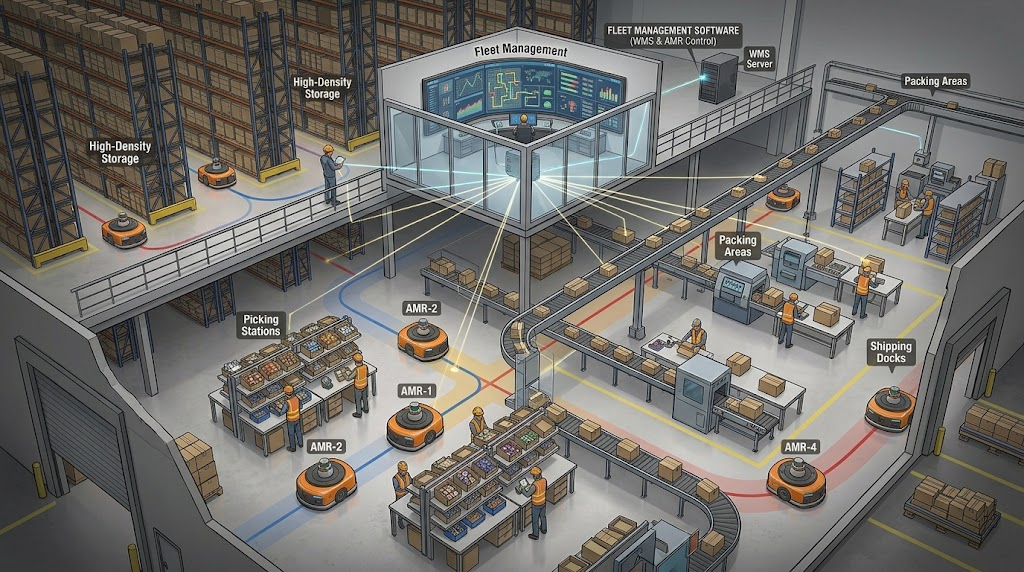
From Conveyor Belts to Robot Fleets: Inside an Automated Warehouse
A warehouse can now have thousands of robots moving goods without every machine following the same fixed conveyor route. In August 2026, Ocado said more than 17,000 of its warehouse bots were operating across its automated warehouses, collectively travelling about 153 million kilometres a year. The interesting part is not just the number of robots—it is the software that makes such a large fleet behave like one coordinated system.
From Fixed Conveyors to Flexible Robots
Traditional conveyor systems move products along predetermined paths. They can be extremely efficient, but changing the physical layout or flow can require significant engineering work.
Mobile robots offer a different approach. Autonomous mobile robots (AMRs) can navigate around a warehouse and transport goods between storage, picking, packing and shipping areas. Ocado's 2026 AMR system, for example, includes Chuck for order-fulfilment tasks and Porter for moving heavier loads. The company says Porter can carry loads up to 1,500 kg and operate alongside warehouse workers.
This flexibility does not mean each robot operates independently.
The Software Behind the Fleet
The warehouse needs an orchestration layer that decides what should happen next. A warehouse-management system can provide information about orders and inventory, while fleet-management or orchestration software turns those requirements into individual robot tasks.
The software can decide which robot should collect a particular item, calculate suitable routes and coordinate multiple machines competing for the same space. It also needs to respond when a robot becomes unavailable, an aisle becomes blocked or priorities change.
Ocado's IQ software illustrates this approach. The company describes it as a central control system that coordinates Chuck and Porter, assigns tasks and guides work in real time while integrating with existing warehouse systems.
Research published in 2026 also identifies multi-robot coordination, task allocation and fleet management as key technical areas in warehouse robotics, alongside human-robot collaboration and safety.
Robots Still Need Humans
Automation does not necessarily mean removing people from the warehouse. Humans may pick items, supervise operations, handle exceptions, maintain equipment or perform tasks that robots cannot reliably automate.
Amazon's Proteus, for example, is designed to operate alongside human workers. Amazon says the robot combines cameras and other sensing technologies with LiDAR and 3D point-cloud processing to navigate dynamic environments.
This creates another software challenge: robots must understand their operating environment while humans remain part of the workflow. A warehouse therefore needs safety zones, obstacle detection, controlled traffic and procedures for situations that automation cannot resolve automatically.
The Next Challenge Is Coordination
Adding robots does not automatically make a warehouse faster. If dozens or thousands of machines compete for the same routes, charging stations or work areas, congestion can reduce the benefits of automation.
TCS, for example, describes a robotics system using digital-twin technology and robot sensor data to plan collision-free paths for multiple AMRs and handle dynamic obstacles. Its fleet-management system can also connect with warehouse-management systems to receive material-handling orders.
The evolution from conveyors to robot fleets is therefore really an evolution in control. The physical robots are only one part of the system. Sensors provide information, software assigns work, navigation controls movement, and humans handle exceptions. The warehouse becomes less like a collection of machines and more like a coordinated digital-physical system.